Why are you paying over $100 per seat for a platform that requires a full-time administrator just to keep the lights on? For lean sales teams, searching for Outreach.io alternatives is often the first step toward reclaiming their calendar. The promise of enterprise sales engagement frequently turns into a nightmare of complex workflows and fragmented data. You spend more time configuring triggers than actually talking to prospects. It's a common frustration to pay for a massive feature set while your reply rates drop because the outreach feels generic and robotic.
You know that effective outbound shouldn't feel like a second job. You need a system that works quietly in the background so you can focus on closing. This guide highlights the most efficient platforms designed for the 2026 landscape. These tools prioritize AI-native personalization and consolidated workflows to eliminate enterprise bloat and maximize your B2B pipeline. We will explore ten platforms that integrate data, AI writing, and automated sending into a single, transparently priced solution. You'll discover how to achieve higher reply rates through better personalization without the burden of a complex, four-subscription stack.
Key Takeaways
- Enterprise tools often require dedicated administrators. Learn why lean teams are ditching bloat for streamlined workflows that prioritize selling over software management.
- Effective Outreach.io alternatives in 2026 must combine verified B2B data with AI-native personalization. This integration ensures your messages land in the primary inbox and earn actual replies.
- Tool sprawl kills productivity and inflates budgets. Discover how consolidating your data, warmers, and senders into one platform reduces technical friction and data silos.
- Performance-based models are disrupting the traditional seat-based market. Shift your focus from paying for software access to paying for qualified leads and measurable results.
- AI has moved beyond basic templates to deep lead research. Use integrated engines to create bespoke outreach that scales without losing the human touch.
Why Sales Teams are Moving Away from Outreach.io in 2026
The era of "more is better" in sales technology has ended. Outreach.io was designed for massive enterprise teams with dedicated operations departments. For lean sales teams, this complexity acts as a tax on productivity. You shouldn't need a full-time administrator to manage a simple sequence or fix a broken trigger. In 2026, sales success comes from signal-triggered precision, not the volume-based spam that legacy platforms were built to facilitate.
The High Cost of Enterprise Sales Software
Legacy platforms often demand a $10,000 annual commitment before you send a single email. This upfront cost is a significant barrier for startups. Seat-based pricing models also penalize growth. If you add a new SDR, your bill jumps immediately. This creates an ROI gap where the cost of the tool can actually exceed the value of the pipeline it generates.
Modern Customer relationship management (CRM) strategies require agility. When you evaluate Outreach.io alternatives, look for transparent pricing that scales with your results. High-performing teams are moving away from rigid annual contracts toward flexible platforms like Deeplead, which offers self-serve options starting at $37/month. This allows you to pay for the value you receive rather than the number of logins you create.
The Learning Curve vs. The Speed to Lead
Speed is a competitive advantage. A typical enterprise onboarding cycle lasts three months. That's a quarter of your sales year lost to training and technical configuration. Most teams only use 20% of the features they pay for, leading to "feature fatigue" and missed opportunities. Lean teams need to start sending in 24 hours, not 90 days. Minimalist platforms eliminate the friction of complex tech stacks. You no longer need separate subscriptions for:
- Verified B2B data providers
- Email warming services
- AI writing assistants
- Deliverability monitoring tools
Consolidating these into a single engine prevents data silos and technical errors. It allows your sales reps to spend their time selling instead of troubleshooting software. This shift from "Sales Engagement" to "Revenue Action" is why many are seeking leaner Outreach.io alternatives that prioritize execution over administration. By choosing a platform that handles the heavy lifting in the background, you ensure your team stays focused on the only metric that matters: qualified meetings.
The 3 Core Requirements of a Modern Outreach Alternative
In 2026, a basic email sequence is a commodity. Successful outreach requires a foundation that connects data, AI, and delivery. If your platform doesn't handle all three, you aren't saving time; you're just managing more subscriptions. Most Outreach.io alternatives focus only on the "sending" part. This forces you to buy a separate database, export CSVs, and manually clean lists. A modern alternative must include a built-in, verified B2B database to eliminate these manual steps.
AI-Researched Email Writing
Generic templates get marked as spam. AI-native platforms use signal-based personalization to stand out. This technology goes beyond simple tags like "first name." It analyzes recent news, company reports, or industry shifts to find a specific hook. AI personalization is the use of real-time prospect data to craft unique value propositions. Research from the Harvard Business Review on How Generative AI Will Change Sales highlights that AI isn't just about speed; it's about relevance. AI Deal Explorers can now identify high-value leads by monitoring live buying intent, ensuring you only contact people ready to buy.
Built-in Deliverability Protection
Your messages only work if they land in the primary inbox. Traditional setups require third-party "warmup" tools that are often technical headaches and security risks. A superior alternative manages domain health and pre-warmed inboxes natively. This prevents your main company domain from being blacklisted. You can maintain a 95%+ deliverability rate without manual setup by using a platform that rotates sending inboxes automatically. This "set and forget" infrastructure is essential for lean teams that don't have time for technical troubleshooting.
Finally, your tool must talk to your source of truth. Seamless synchronization with HubSpot or Salesforce ensures that qualified leads move through the funnel without manual entry. If you want to eliminate the technical friction of multiple subscriptions, consider using an all-in-one outreach engine that handles the entire process from data to delivery. By consolidating these requirements, you turn a fragmented tech stack into a high-performing pipeline generator.
Top Outreach.io Alternatives Compared: 2026 Market Leaders
Evaluating the market requires looking beyond feature lists. You need to assess the total cost of ownership and the technical friction involved in daily operations. In 2026, the best Outreach.io alternatives are those that reduce the distance between finding a lead and sending a personalized message. Choosing between legacy players and the new wave of AI-first platforms depends on whether your team values complex workflows or operational speed.
The Legacy Tier: Salesloft and Apollo
Salesloft remains a standard for large corporations that require complex, multi-departmental workflows. It's built for scale but often feels like a mirror of Outreach, maintaining a high administrative burden. Apollo provides an extensive contact database. However, users frequently find that its sending capabilities require external tools to manage high-volume outreach effectively. Both platforms struggle with a reputation for being template-heavy. This leads to generic messaging that prospects in 2026 easily ignore. These tools are best for teams that have dedicated sales ops to manage the software.
The AI Challengers: Deeplead and Artisan
The new wave of Outreach.io alternatives prioritizes integration over modularity. Deeplead integrates its verified database directly into the sending engine. This removes the need for manual CSV exports and data cleaning. Campaigns are signal-triggered. They respond to live intent rather than following a static, pre-set sequence. This approach ensures your team only contacts prospects when there is a clear reason to reach out. While Artisan positions itself as purely AI-native, it often lacks the flexible service models that lean teams require to stay agile.
Deeplead disrupts the traditional seat-based model with accessibility. The self-serve platform starts at $37/month, allowing startups to access professional-grade tools without a five-figure commitment. Comparison criteria should focus on three areas:
- Setup Time: Legacy tools take months to configure. Deeplead gets your SDRs sending in under 24 hours.
- Data Quality: Fragmented stacks rely on syncing multiple tools. Integrated platforms provide verified data that updates in real-time.
- Total Cost: All-in-one engines eliminate the need for separate subscriptions for data, warming, and AI writing.
If your goal is to eliminate tool sprawl, the all-in-one approach is the logical choice. You can scale from the self-serve platform into a performance-based Pay-Per-Lead model as your pipeline grows. This flexibility ensures your sales stack remains an asset rather than a technical liability.
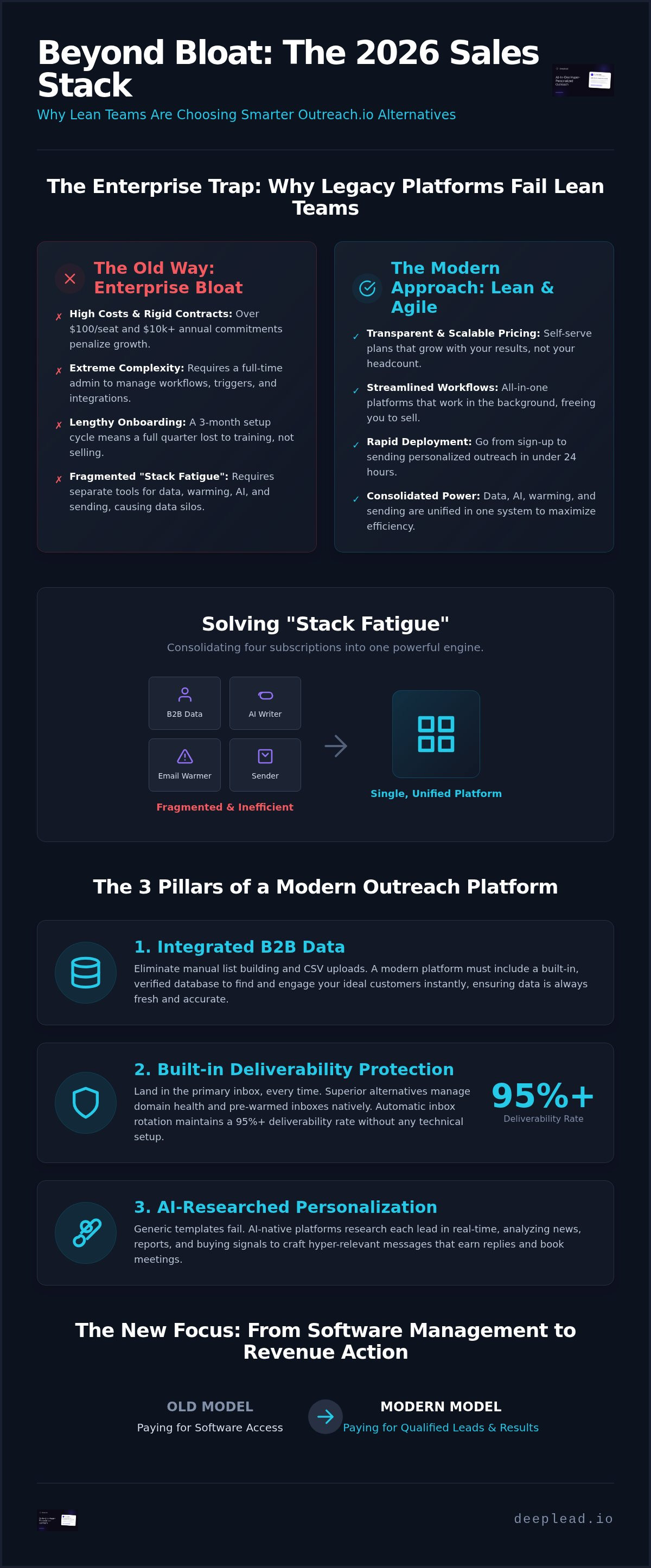
Solving the "Stack Fatigue" Problem: One Tool to Rule the Pipeline
Many teams seeking Outreach.io alternatives fall into a common trap. They replace one expensive platform with a "Franken-stack" of four different tools. You end up paying for a database, a lead enricher, an AI writer, and a sending tool. Managing multiple bills and API connections becomes a part-time job. This "Tool Sprawl" creates a technical tax that slows down your sales cycle and introduces constant data syncing errors.
Data silos are the silent killers of conversion rates. When your lead list is disconnected from your email sender, you lose the ability to act on live signals. Industry benchmarks suggest that consolidating these functions into a single interface can reclaim up to 40% of an SDR's day. Instead of toggling between tabs, your team manages every conversation from a unified dashboard. Exploring integrated Outreach.io alternatives allows you to focus on the human element of selling while the engine handles the technical heavy lifting.
Eliminating Data Enrichment Friction
Manual CSV uploads are a relic of the past. They are slow, prone to error, and the data is often stale by the time you hit send. Modern platforms use real-time verification to ensure every email address is active at the moment of outreach. Signal-triggered campaigns act on intent data instantly. If a prospect shows interest or an industry shift occurs, the system responds without manual intervention. This integration ensures your messaging is always timely and relevant.
Managed Sending and Inbox Health
Scaling your outreach requires a distributed inbox strategy. Sending high volumes from your main company domain is a high-risk gamble that often leads to blacklisting. Managed sending inboxes allow you to rotate outreach across multiple pre-warmed domains. This protects your primary domain health while ensuring high deliverability. Automated auto-responders further enhance efficiency by using AI to handle initial replies and common objections. This ensures no lead goes cold while your team focuses on high-value closing activities.
Consolidating your workflow is the fastest way to increase your B2B pipeline. Stop managing a complex stack and start scaling with a unified outreach engine that handles data, AI research, and sending in one place.
Deeplead: The Logical Successor to Outreach for Lean Teams
Transitioning from complex legacy systems doesn't have to be a multi-month technical project. Most Outreach.io alternatives still require extensive manual setup and internal oversight. Deeplead is built for speed. You can migrate your existing sequences and data into our platform in under 48 hours. This allows your team to maintain momentum without the administrative downtime typically associated with enterprise software shifts.
Self-Serve vs. Performance-Based Models
Flexibility is the core of a modern sales stack. Deeplead offers three distinct ways to engage, depending on your team's internal capacity. The self-serve SaaS platform starts at $37/month. It provides the all-in-one kit needed for teams that want to manage their own campaigns. For those focused strictly on cost-per-acquisition (CPA), the Pay-Per-Lead model acts as the ultimate ROI hedge. You pay between $50 and $150 per qualified reply; this shifts the risk from your budget to our performance.
Managed services offer a middle ground for high-growth startups. Our Done-For-You Outbound service costs $3,000/month and removes the need for software management entirely. We handle the managed sending inboxes and pre-warmed domains. This saves your SDRs over 10 hours per week. They stop troubleshooting deliverability and start focusing on the conversations that drive revenue. It's a simple trade: you provide the ICP, and we provide the pipeline.
The AI Deal Explorer Advantage
Finding the right prospects requires more than a static list. The AI Deal Explorer researches the web to find high-value leads that match your Ideal Customer Profile (ICP) with precision. It identifies intent signals that suggest a prospect is ready for a conversation right now. You can set up automated research workflows that analyze company data and write every email for you. This ensures every message is bespoke and highly relevant, which is the only way to earn a response in a crowded inbox.
Stop overpaying for features you don't use. Move away from enterprise bloat and build a leaner, more effective pipeline. Scale your outbound with Deeplead today and see how an integrated engine transforms your results.
Scale Your Revenue Without the Complexity Tax
The search for Outreach.io alternatives often ends when you realize that more features don't equal more meetings. Lean sales teams thrive on integration and execution. By consolidating your data, AI research, and sending infrastructure into one engine, you eliminate technical friction and tool sprawl. You no longer need to manage a fragmented stack of four different subscriptions just to reach your prospects.
Modern outbound success requires a built-in verified B2B database and an AI-native personalization engine to ensure your messages land in the primary inbox. You can now choose between driving the platform yourself or utilizing pay-per-lead options that align costs directly with your results. This transparency ensures that your sales technology remains an asset rather than a technical liability. It's time to stop fighting your software and start building your pipeline with precision.
Take the first step toward a more efficient sales process. Start your all-in-one outreach for $37/month and reclaim your team's productivity. You have the tools to win; now you just need the right engine to power them.
Frequently Asked Questions
Is Deeplead a direct replacement for Outreach.io?
Deeplead is a streamlined alternative for teams that find enterprise platforms too complex. It replaces the fragmented sales stack with an all-in-one outreach engine. The platform integrates verified contact data, AI-researched personalization, and automated sending into a single interface. This makes it one of the most efficient Outreach.io alternatives for lean teams that want to eliminate administrative bloat and focus on closing deals.
How does the Pay-Per-Lead model work compared to a SaaS subscription?
A SaaS subscription provides software access for a monthly fee starting at $37. The Pay-Per-Lead model is performance-based; you only pay between $50 and $150 per qualified reply. This model is ideal for companies that want to hedge their ROI. It shifts the financial risk from your software budget to our delivery performance, ensuring you only pay for measurable sales opportunities.
Do I need a separate database like Apollo to use Deeplead?
No. Deeplead includes a built-in verified B2B database as part of the platform. You can perform custom data pulls and enrichment directly within the interface. This integration eliminates the need for external data subscriptions and the technical friction of manual CSV uploads. By keeping your lead data and sending engine in one place, you maintain higher data accuracy and better campaign timing.
How does Deeplead handle email deliverability and spam filters?
We utilize managed sending inboxes and pre-warmed domains to protect your primary domain health. This distributed sending strategy is essential for maintaining high deliverability. The platform handles inbox rotation and warming automatically, ensuring your messages land in the primary inbox. These technical safeguards allow you to scale your outreach volume safely without the risk of being flagged by modern spam filters.
Can Deeplead sync with my existing CRM like HubSpot or Salesforce?
Yes. Deeplead provides seamless synchronization with major CRM platforms including HubSpot, Salesforce, and Pipedrive. When the system identifies a qualified reply, the lead data and interaction history are pushed directly to your CRM. This ensures your sales team has a single source of truth and prevents manual data entry errors that often occur when using fragmented Outreach.io alternatives.
What makes Deeplead different from other AI email tools?
Most AI tools use generic templates that prospects easily ignore. Deeplead uses an AI Deal Explorer to identify live intent signals and perform deep lead research. This engine crafts bespoke value propositions based on real-time prospect data. The result is a highly personalized message that feels human-written, leading to significantly higher reply rates than standard AI-generated sequences or mass-market templates.
Is there a limit to how many emails I can send per month?
Sending limits are determined by your specific plan and the number of managed inboxes you utilize. We focus on deliverability and engagement rather than raw volume. Our system scales your outreach by adding more warmed-up inboxes and rotating senders. This approach ensures you reach the maximum number of prospects possible while staying within the safety limits set by major email service providers.
How quickly can I set up my first campaign on Deeplead?
Most users launch their first campaign in under 48 hours. The platform is designed for rapid deployment with a minimalist interface that avoids the three-month onboarding cycles common in enterprise software. Because the data, AI research tools, and sending infrastructure are already integrated, you can move from account setup to active outreach without the need for complex technical configuration or a dedicated administrator.