What if the biggest threat to your 2026 revenue isn't a lack of leads, but the chaos of the fifty inboxes you used to find them? You've likely felt the sting of scaling outbound only to realize you're drowning in automated "out of office" replies while high-intent prospects go cold in a forgotten tab. It's exhausting to watch your deliverability tank because you can't manage the technical health of a massive inbox network manually. Effective B2B sales inbox management shouldn't feel like a full-time job for your best closers.
We agree that your time is better spent closing deals than hunting through digital noise. You're about to master the technical and operational framework for managing high-volume sales inboxes. This ensures every lead is qualified and no reply goes unanswered. We'll walk through creating a single view for all conversations, automating the filtering of non-leads, and maintaining peak deliverability without the manual overhead. This methodical approach turns your inbox from a source of stress into a streamlined engine for growth.
Key Takeaways
- Protect your deliverability by distributing outreach volume across multiple sending accounts to avoid modern spam triggers.
- Implement a unified B2B sales inbox management workflow to aggregate replies from every domain into one searchable dashboard.
- Automate the triage process using AI logic to separate high-intent leads from automated "out of office" noise.
- Reduce your speed to lead with AI-powered responses that handle initial inquiries instantly and keep prospects warm.
- Build a sustainable technical foundation by enforcing SPF, DKIM, and DMARC standards across all sending accounts.
What is B2B Sales Inbox Management?
B2B sales inbox management is the technical and operational process of organizing, triaging, and responding to inquiries across dozens of sending accounts. It isn't just about reading emails; it's about maintaining a high-performance infrastructure. In 2026, the era of sending thousands of emails from a single domain is over. Deliverability now depends on volume fragmentation. You must spread outreach across multiple inboxes to protect your sender reputation. This creates a massive management burden. The core objective is simple: reduce the time between a prospect’s reply and a sales rep’s engagement.
The shift from manual checking to automated, unified systems is now a requirement for survival. If your team spends hours logging in and out of accounts, they aren't selling. Modern management centralizes these disparate threads into a single, actionable stream of data. This allows you to scale your outreach without scaling your stress.
The Evolution of Sales Inboxes in 2026
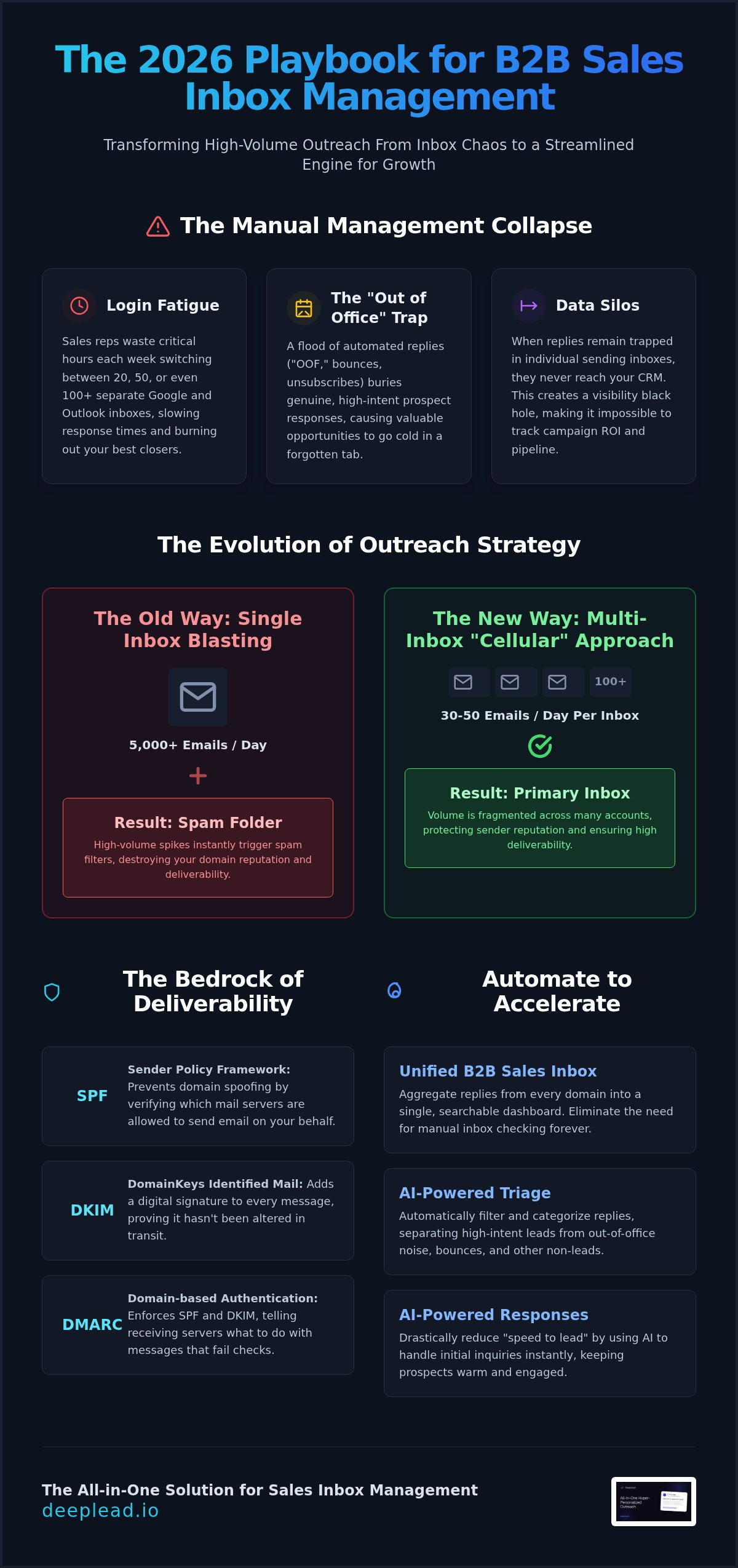
The "single inbox" strategy died because sophisticated spam filters now flag high-volume spikes instantly. Modern teams use multi-domain strategies to keep their primary domains safe. This shift requires a bridge between your outreach engine and your revenue. Inbox management is the bridge between initial outreach and closed deals. You no longer manually check accounts. Instead, you use unified systems that pull every conversation into a single interface. This allows you to scale volume without increasing the headcount needed to monitor it.
Common Bottlenecks in Manual Management
Scaling outbound volume often leads to operational collapse. Login fatigue is a real cost; switching between 20 or 50 Google and Outlook accounts wastes hours every week. It's a friction point that slows down your speed to lead. If a prospect replies, they expect an immediate answer. If that reply sits in an unmonitored inbox for four hours, the lead goes cold.
Then there's the "Out of Office" trap. Automated replies flood your inbox, burying actual revenue opportunities. Without automated filtering, your reps spend more time deleting junk than talking to buyers. Finally, data silos prevent growth. When replies stay trapped in a sending inbox, they don't reach your Customer relationship management (CRM) systems. This lack of visibility makes it impossible to track which campaigns actually drive pipeline. You need a system that syncs these conversations automatically to maintain a clean record of truth.
Delivering to the Primary Inbox: The Technical Foundation
Deliverability is the prerequisite for effective B2B sales inbox management. If your messages land in the junk folder, your management strategy is irrelevant because there are no replies to track. In 2026, major providers enforce strict authentication protocols that are no longer optional. You must implement SPF, DKIM, and DMARC correctly to even enter the conversation. This technical foundation prevents spoofing and signals to servers that you're a legitimate sender. High-performance teams don't leave this to chance; they treat technical health as a core sales metric.
Scaling these efforts requires more than just volume. According to the latest research from McKinsey, growth champions are rewiring their playbooks with AI to manage these complex technical requirements. This includes maintaining "Inbox Health" through consistent engagement and keeping bounce rates below 2%. If your bounce rate spikes, your domain reputation dies. Consistent, low-volume engagement across multiple accounts is the only way to sustain high deliverability at scale.
Managed Warming and Domain Health
Pre-warmed domains are non-negotiable for new outreach campaigns. Automated warming tools simulate human behavior by sending and receiving messages, opening them, and marking them as important. This builds a positive history before you send your first cold email. Avoid "spiky" sending patterns where you go from zero to 200 emails overnight. Smooth out your volume to stay under the radar of sophisticated spam filters. Monitor your deliverability scores and blacklists in real-time to catch issues before they burn your domains.
Multi-Inbox Architecture
Adopting a "Cellular" approach is the safest way to scale. Limit each inbox to 30-50 emails per day. If you need to send 5,000 emails, you shouldn't use one account; you use 100 or more. Map these inboxes to specific buyer personas to keep your messaging focused and relevant. This architecture allows you to scale from 5 to 500 inboxes without increasing technical complexity. If one "cell" gets flagged, the rest of your campaign remains healthy. You can easily access managed sending inboxes that arrive pre-configured and pre-warmed for this level of scale.
Unified Reply Management: Turning Chaos into Workflow
Scaling outreach creates a visibility problem. When you manage 50 domains, checking each one individually is impossible. Unified reply management solves this by aggregating every response into a single, searchable interface. This is the heart of B2B sales inbox management; it transforms a fragmented mess into a linear workflow. You don't need to hunt for leads. They appear in one stream, ready for action.
Filtering the noise is your next priority. Outreach volume inevitably attracts automated junk. Use logic-based systems to separate "Book a Call" from "Not Interested." This ensures your reps focus only on high-intent prospects. Every reply must sync with your HubSpot, Salesforce, or Pipedrive account automatically. This preserves the record of truth and prevents leads from falling through the cracks. When the technical data lives in your CRM, you can finally see which campaigns are actually generating pipeline.
Team collaboration becomes effortless when you centralize communications. You can assign specific threads to account executives based on lead value or territory. This ensures the right person handles the right conversation without manual forwarding. It's a professional approach that prevents the "double-reply" or the missed follow-up that happens in decentralized setups.
Centralized vs. Decentralized Management
Manual login workflows are a productivity killer. An SDR switching between 20 accounts loses focus and momentum every time they hit a login screen. Unified API-driven platforms eliminate this friction, saving your team 2+ hours per day on administrative tasks. There is also a security advantage. You can manage permissions within a central dashboard without ever sharing individual inbox passwords with staff or contractors. If a rep leaves, you revoke access in one place without resetting dozens of credentials.
AI-Powered Triage and Sentiment Analysis
Modern AI categorizes replies by intent instantly. It identifies Positive, Neutral, and Negative sentiments to help you prioritize your day. High-value leads are flagged for immediate human intervention, while "Out of Office" or "Wrong Person" replies are auto-archived. This clears the clutter so you can maintain a high speed-to-lead. While AI handles the triage, your team maintains control over the high-ticket conversations that require a personal touch. This "human-in-the-loop" model ensures you don't lose the nuance required for complex B2B deals while still enjoying the benefits of automation.
Maximizing Speed to Lead: AI Response Strategies
The first five minutes after a prospect replies are the most critical for your conversion rate. If you wait an hour, the lead's interest has already begun to cool. If you wait a day, they've likely engaged with a competitor. Effective B2B sales inbox management in 2026 relies on immediate, relevant engagement. AI auto-responders allow you to bridge the gap between a prospect's curiosity and a rep's availability. When a lead asks for more information at 2 AM, your system provides it instantly. This keeps the momentum alive without requiring your team to work around the clock.
Personalization at scale is no longer about just using a first name. Modern AI analyzes the specific nuance of a reply to research and draft a tailored follow-up. This isn't a generic template. It's a context-aware response that addresses the prospect's specific questions. To maintain quality, use a "human-in-the-loop" model. The AI drafts the perfect reply based on your case studies and data; your sales rep simply approves and sends it. This workflow gives you the speed of a machine with the oversight of a professional closer.
Automated Lead Qualification
You can set specific triggers for AI to handle the initial qualification process before a meeting ever hits the calendar. If a prospect expresses interest but asks about pricing or compatibility, the AI can ask a follow-up question to ensure they meet your ideal customer profile. It also handles common objections with ease. When a lead says "not now," the system can automatically categorize them for a three-month follow-up. AI responders maintain your brand voice with perfect consistency while ensuring your speed to lead remains under the five-minute mark.
The AI Deal Explorer
The AI Deal Explorer identifies hidden opportunities that standard keyword filters often miss. It analyzes reply patterns and sentiment to predict which leads are most likely to close based on historical data. This allows you to prioritize your morning routine with precision. Instead of scrolling through a chronological list, you start with the highest-intent replies first. You can use the Deeplead AI Deal Explorer to surface these high-value conversations automatically, ensuring your best reps spend their energy on the deals with the highest probability of success. This methodical approach turns a crowded inbox into a prioritized pipeline of revenue.
Deeplead: The All-in-One Solution for Sales Inbox Management
Deeplead simplifies the entire outbound process by consolidating verified data, AI-personalized writing, and automated sending into a single interface. Most teams struggle because their tools don't talk to each other. Deeplead fixes this by providing an integrated engine that handles the heavy lifting of B2B sales inbox management. You no longer need to jump between a database, a writing tool, and a sending platform. Everything lives in one dashboard, allowing you to focus on the conversation rather than the configuration.
The system includes built-in inbox warming and access to pre-warmed domains from day one. This removes the technical barrier to entry for high-volume outreach. The Deeplead Unified Reply System allows you to manage 100 or more inboxes from a single view. You can track every response, filter out the noise, and engage with high-intent leads without ever leaving the platform. As your pipeline grows, you can transition seamlessly from self-serve tools to professional managed services to maintain your momentum.
Why Deeplead Replaces Your Disconnected Sales Stack
A fragmented sales stack is expensive and inefficient. Deeplead eliminates the need for separate subscriptions for data enrichment, email warming, and sending software. You get full platform access starting from $37/month, which is a fraction of the cost of maintaining multiple legacy tools. Efficiency is built into the workflow; every reply syncs directly into your existing CRM. This ensures a seamless handoff between your outreach system and your account executives, keeping your records accurate and actionable.
Performance-Based Scaling
Your needs will change as your outbound volume increases. Deeplead offers flexible scaling options to match your growth. You can start with the SaaS platform and move to a Pay-Per-Lead model, where you pay $50 to $150 per qualified reply. If you want to offload the entire process, the Done-For-You outbound service provides total inbox management for $3,000/month. This allows you to leverage Deeplead’s infrastructure and expertise while your team focuses exclusively on closing deals. Start managing your sales inboxes with Deeplead today to eliminate the chaos and scale your revenue with precision.
Scale Your Revenue Without the Operational Overhead
Mastering B2B sales inbox management is the difference between a stalled campaign and a predictable revenue engine. You've seen how technical health and fragmented volume protect your reputation. It's time to shift to automated precision. Centralizing your replies ensures no lead goes cold. This methodical approach removes the friction of login fatigue and buried opportunities.
Deeplead provides the single interface you need to replace your disconnected sales stack. You get unified reply management for 100+ inboxes along with AI-powered lead triage and auto-responders. With built-in domain warming and verified data, you can scale with total confidence. You don't need to choose between volume and quality when you have the right infrastructure in place.
Streamline your B2B outreach with Deeplead’s unified platform.
Your outreach shouldn't be limited by browser tabs. Take control of your workflow. Turn your inbox into a high-performing partner for growth. You've built the foundation; now let the right systems drive your success.
Frequently Asked Questions
What is the best way to manage multiple sales inboxes?
The most efficient method is using a unified reply management system that aggregates all domains into one dashboard. Manual logins waste time and lead to missed opportunities. Centralization allows your team to triage leads without switching accounts. This structure improves your speed to lead and ensures no high-intent reply is buried under automated noise. It transforms a scattered process into a linear, manageable workflow for your reps.
How many emails should I send per day from a single sales inbox?
Limit each inbox to 30 to 50 emails per day to maintain high deliverability. Sending high volumes from one account triggers modern spam filters in 2026. Use a multi-inbox architecture to spread the load across several domains. If you need to send 500 emails daily, use 10 to 15 different inboxes rather than one. This cellular approach protects your sender reputation and ensures consistent inbox placement.
Does using multiple inboxes hurt my brand reputation?
No, using multiple inboxes protects your brand reputation by safeguarding your primary business domain. Most professionals use secondary domains for outreach to prevent their main site from being blacklisted if a campaign faces high spam reports. It is a standard industry practice for scaling safely across the country. This strategy keeps your essential corporate communications separate from your high-volume outbound sales activity.
How does AI help with B2B sales inbox management?
AI automates the categorization of replies by intent and drafts personalized follow-ups based on the context of the conversation. It filters out "out of office" junk and flags positive sentiment for immediate human action. AI Deal Explorers can even predict which leads are most likely to close. This technology turns B2B sales inbox management into a high-speed, data-driven workflow. It allows your reps to focus on closing deals.
What is a unified reply management system?
A unified reply management system is a single interface that pulls in emails from every sending domain you own. It eliminates the need for separate logins and manual checking. You can respond to prospects, archive negative replies, and sync conversations to your CRM from one screen. This is essential for managing 50 or more inboxes without operational chaos. It provides total visibility into your campaign performance.
Can I sync my sales inboxes with HubSpot or Salesforce?
Yes, modern outreach platforms sync directly into HubSpot, Salesforce, and Pipedrive to maintain accurate records. Deeplead ensures every reply is logged in your CRM automatically. This preserves a single source of truth for your sales team. You don't have to manually update contact records; the system handles the data entry for you. This integration ensures a seamless handoff between your outreach tools and your closers.
How do I stop my sales emails from going to spam in 2026?
Implement SPF, DKIM, and DMARC records while maintaining a spam complaint rate below 0.3%. Use pre-warmed domains and keep your daily sending volume low per account to avoid technical triggers. High engagement rates and low bounce rates are critical for staying in the primary inbox. Consistently monitoring your deliverability scores helps you catch technical issues before they burn your domains. Technical health is your foundation for success.
What is the difference between a warmed-up inbox and a regular one?
A warmed-up inbox has an established sending history that signals reliability to email providers. Regular, new inboxes are often flagged as suspicious if they send cold emails immediately. Warmed-up inboxes use automated engagement to build a positive reputation over time. Deeplead includes pre-warmed domains to ensure your B2B sales inbox management starts with high deliverability. This foundation is necessary for landing in the primary folder instead of spam.