Why pay $30,000 a year for data that expires before your sales team even opens the spreadsheet? Most B2B leaders agree that the biggest drain on ROI isn't the initial cost of the subscription. It's the manual lag time between seeing a buying signal and actually sending an email. Finding the best intent data provider for identifying in-market b2b buyers in 2026 requires looking past the size of the database. You need a solution that prioritizes action over observation.
Buying expensive data that sits unused in a CRM leads to high bounce rates and missed opportunities. We know a predictable pipeline requires more than just a list of names; it requires a streamlined workflow. This guide breaks down the top intent data providers and explains why the right choice isn't just about the data. It's about how fast you can act on it. You'll learn how to move from signal to sent email in minutes. This approach ensures higher response rates through better timing and a simplified tech stack that replaces the traditional, clunky "Franken-stack" model.
Key Takeaways
- Intent data in 2026 prioritizes live buying signals over static lists to ensure your outreach reaches prospects while they're actively researching.
- Combining 1st-party site behavior with 3rd-party keyword tracking provides a comprehensive view of the dark funnel and buyer readiness.
- Finding the best intent data provider for identifying in-market b2b buyers requires auditing for data freshness and seamless integration with your email automation.
- The most effective solutions bridge the activation gap by moving from signal detection to personalized outreach without manual intervention.
- A streamlined, all-in-one workflow reduces costs and eliminates the lag time that often causes high-value intent signals to go stale.
What is a B2B Intent Data Provider and Why Does It Matter in 2026?
A B2B intent data provider is a service that monitors digital footprints to identify companies and contacts exhibiting specific 'buying signals'. These signals range from deep keyword research to frequent visits to competitor comparison pages. In the fast-paced environment of Business-to-business (B2B) sales, identifying these signals is the first step in selecting the best intent data provider for identifying in-market b2b buyers. These platforms act as a compass for your outreach team; they tell you exactly who is looking for a solution like yours before they ever fill out a contact form.
The landscape has changed significantly. In 2026, static lead lists are no longer just inefficient; they're liabilities. Relying on outdated contact info leads to high bounce rates and wasted sales cycles. Modern buyers have become more elusive because AI-filtered inboxes now identify and block generic prospecting emails with ease. To break through, your outreach must be hyper-relevant. This is where the 'activation gap' becomes a problem. Many teams buy expensive data but let it sit in a CRM for weeks. By the time they reach out, the prospect has already signed with a competitor. Finding the best intent data provider for identifying in-market b2b buyers means finding a partner that helps you close this gap instantly.
The Three Pillars of Modern Intent Data
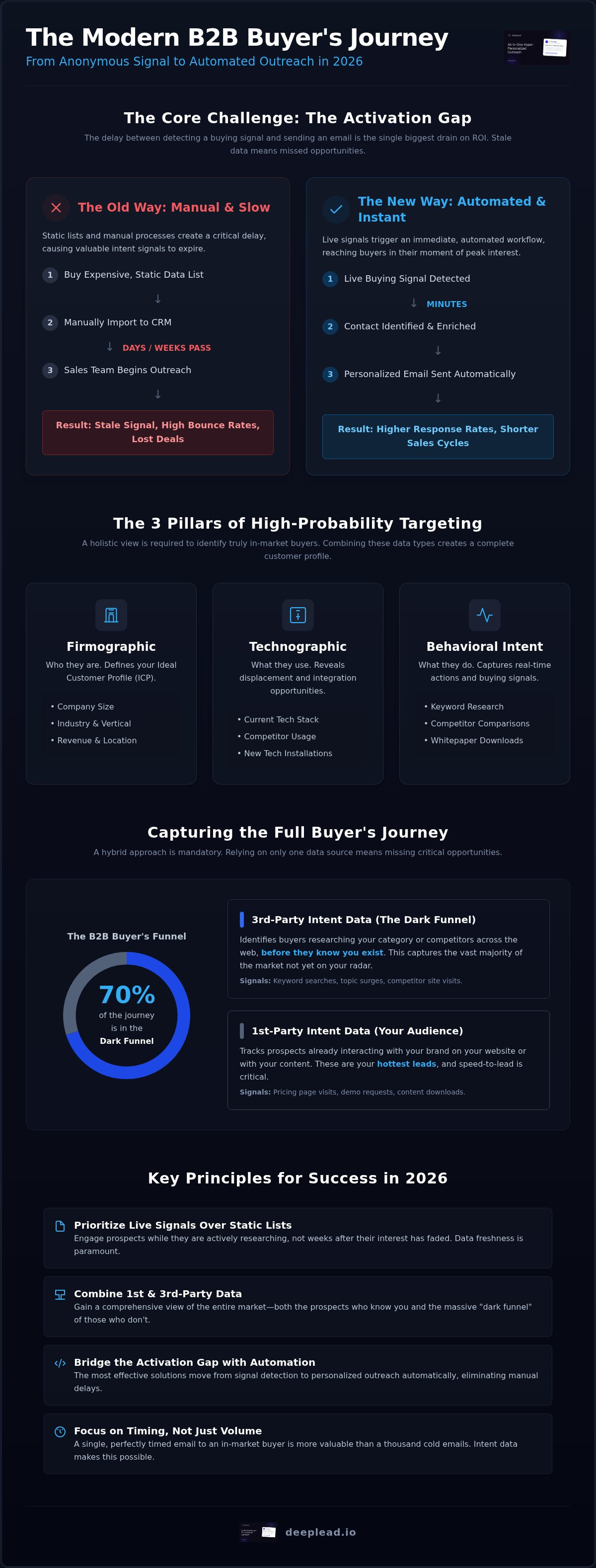
Success requires more than just a single signal. You need a holistic view built on three pillars. Firmographic data defines your ideal customer profile by company size, industry, and revenue. Technographic data shows you the prospect's current tech stack, which is vital for displacement campaigns. Behavioral intent is the final, most important piece. It captures real-time actions like whitepaper downloads or searches for specific pain points. When these three pillars align, you have a high-probability target that is ready for a conversation.
Why Traditional Lead Generation is Dying
The old model of volume-based cold calling is failing. It creates a massive drain on resources and drives your Customer Acquisition Cost (CAC) to unsustainable levels. Intent data fixes this by shifting the focus from quantity to timing. When you target people who are already in a buying cycle, your response rates climb and your sales cycle shrinks. Intent data is the bridge between sales research and revenue. It allows your team to stop guessing and start selling to people who actually want to hear from them, ensuring every email sent has a clear purpose.
1st-party intent is the strongest indicator of interest. It tracks prospects who are already interacting with your brand. They are downloading your whitepapers or lingering on your pricing page. 3rd-party intent tracks buyers who are searching for your category or competitors on external sites. Choosing the best intent data provider for identifying in-market b2b buyers means finding a solution that balances both sources. If you only focus on 1st-party data, you miss the vast majority of the market that hasn't found you yet. If you only focus on 3rd-party data, you risk ignoring your hottest leads.
A hybrid approach is mandatory for scalable growth. You need to know who is on your site today and who is researching your competitors tomorrow. Modern intent strategies also incorporate "Signals." These are events like funding rounds, job changes, or new technology installations. These signals provide the context your sales team needs to craft a relevant message. They turn a cold outreach attempt into a timely solution. Success depends on how quickly you can move from identifying these signals to initiating a conversation.
Maximizing Your Own Website Traffic (1st-Party)
Identity resolution is the core of 1st-party intent. It turns anonymous IP addresses into actionable LinkedIn profiles or email addresses. Stop treating all traffic equally. Prioritize visitors on high-intent pages like your pricing or demo request sections over those just reading blog posts. Speed is your greatest advantage here. When a prospect is on your site, they are thinking about their problem. Automating the follow-up ensures you reach them while the pain is fresh. Minutes matter; a delay of even an hour can result in a lost opportunity.
Capturing the Rest of the Market (3rd-Party)
3rd-party intent captures the "dark funnel" where up to 70% of the buyer's journey happens. Keyword-based intent identifies who is searching for your specific category before they ever land on your site. This is perfect for competitive displacement. If a prospect is searching for alternatives to a competitor, you need to be the first one in their inbox. Using the AI Deal Explorer allows you to filter for high-value accounts that fit your ideal profile perfectly. This prevents you from wasting credits on low-probability leads. To see how these signals can trigger automated campaigns, consider using the Deeplead all-in-one outreach platform to bridge the gap between data and action.
Top 5 Intent Data Providers for In-Market B2B Buyers
Selecting the best intent data provider for identifying in-market b2b buyers depends on your operational speed. Large databases often trade accuracy for volume. This creates a manual lag where your team spends more time cleaning lists than sending emails. Standalone data tools often come with hidden costs; these include API fees and the labor required to sync data between platforms. Your choice should align with your team's capacity to act on the signals provided.
The "Hidden Cost" of many enterprise tools isn't just the sticker price. It's the "Franken-stack" complexity. For example, some providers only offer account-level data. This forces you to buy a separate contact enrichment tool, which can add $15,000 to $50,000 to your annual expenses. Efficiency comes from reducing the steps between seeing a signal and starting a conversation.
The Enterprise Giants: ZoomInfo and 6sense
ZoomInfo and 6sense are the dominant forces for large organizations. ZoomInfo provides deep firmographic reach while 6sense offers sophisticated predictive signals. However, entry-level pricing for ZoomInfo starts around $14,995 per year and can easily exceed $60,000 for mid-market teams. These platforms require dedicated operations managers to maintain complex workflows. They are best for teams with 50 or more SDRs who have the resources to handle a steep learning curve.
The Activation Leaders: Deeplead and Untitled AI
For leaner teams, Deeplead and Untitled AI offer a more efficient path. These platforms act as an action layer; they integrate intent signals directly into the outreach process. Deeplead provides a self-serve entry point from $37 per month. While the total database size might be smaller than the giants, the focus is on verified accuracy and immediate execution. This is the ideal model for founders and performance-driven sales units that value speed over sheer volume.
Data Quality Comparison Table
Use this table to compare the best intent data provider for identifying in-market b2b buyers based on your specific needs. For a deeper look at data sources, see our full guide on Best Sales Intelligence Tools for B2B Contact Data in 2026.
| Provider | Primary Strength | Integrated Outreach | Starting Price | Ideal User |
|---|---|---|---|---|
| ZoomInfo | Database Scale | No (Requires Add-ons) | $14,995/yr | Enterprise Sales |
| 6sense | Predictive Signals | No | Custom Quote | Large ABM Teams |
| Apollo | Contact Volume | Yes | $49/mo | Individual Reps |
| Deeplead | Signal Activation | Yes | $37/mo | Lean Growth Teams |
The 4-Step Checklist for Evaluating an Intent Data Provider
Evaluating providers requires a shift in perspective. Don't look for the biggest list; look for the most active one. Use this checklist to find the best intent data provider for identifying in-market b2b buyers without overspending on enterprise fluff. For lean teams, efficiency is the only metric that matters.
- Step 1: Data Freshness and Verification. 87% of organizations report dealing with unreliable or inflated intent signals. Ask if the provider cleans their data weekly or if they rely on quarterly updates.
- Step 2: Integration Depth. Your data shouldn't live in a silo. Ensure the platform talks directly to your CRM, whether you use HubSpot, Salesforce, or Pipedrive.
- Step 3: Signal Granularity. Broad categories like "Software" are too vague. You need to filter by specific, niche actions like searches for your direct competitors.
- Step 4: Cost-to-Action Ratio. Stop measuring cost per lead. Calculate the total cost per qualified reply to see the true ROI of the platform.
Avoiding the 'Static List' Trap
Static lists are liabilities. If a contact was verified six months ago, it's likely worthless today. People change jobs and companies pivot. Verified data must be live at the point of sending to avoid high bounce rates. During a demo, ask the sales rep exactly how they handle real-time verification. If they can't show you a live refresh process, the data is likely stale. Lean teams can't afford to burn their domain reputation on unverified emails.
The ROI of Integrated Workflows
Integrated workflows eliminate the manual lag between seeing a signal and sending an email. Having your database and your sending tool in one place saves hours of manual CSV exports. Signal-triggered campaigns are the gold standard; they fire an automated sequence the moment a prospect exhibits buying intent. This speed is what secures the first meeting. Actionable intelligence is the seamless conversion of a digital footprint into a personalized outreach sequence. Start activating your data today with the Deeplead all-in-one outreach platform to bridge the gap between intelligence and revenue.
Deeplead: Turning Intent Signals into Qualified Replies Automatically
Deeplead solves the activation gap by combining a verified B2B database with AI-personalized email automation. Most platforms stop at the signal. They tell you who is interested but leave you to export the list, verify the emails, and write the sequences. Deeplead acts as the action layer. It manages the entire process from detection to delivery in one interface. This makes it the best intent data provider for identifying in-market b2b buyers who actually want to hear from you right now.
The AI Deal Explorer identifies high-value leads by analyzing live buying intent. It filters through millions of data points to find your "Goldilocks" prospects. These are accounts that fit your firmographic profile and are actively searching for your solution. Once identified, signal-triggered campaigns take over. You can set rules like: "If a company visits our pricing page twice, send a personalized email to their VP of Sales." This logic ensures your outreach is always timely and relevant. It replaces the traditional "Franken-stack" with a single, streamlined engine.
Beyond Data: AI-Personalized Outreach
Intent data alone isn't enough to get a reply. Relevance is the true currency of modern sales. Deeplead's AI researches every lead individually to write personalized emails that look like they were written by a human. It analyzes company news, website content, and specific intent signals to craft a unique message for every prospect. This allows you to scale quality without increasing your headcount. You get the volume of a large sales team with the precision of a bespoke agency. It's about sending the right message at the exact moment the buyer is looking for a solution.
Getting Started with Intent-Based Selling
You don't need a five-figure enterprise contract to start seeing results. The Deeplead self-serve platform starts at $37 per month. This allows you to experiment with different signals and sequences without significant financial risk. For teams that prefer a hands-off approach, we offer Pay-Per-Lead outreach. You only pay for qualified replies, which typically range from $50 to $150. This model guarantees ROI by focusing on outcomes rather than just data access. Start identifying in-market buyers with Deeplead today to build a predictable pipeline with minimal manual effort.
Act on Intent Before the Signal Goes Stale
Choosing the best intent data provider for identifying in-market b2b buyers is no longer about who has the largest database. It's about who helps you act the fastest. You've seen how 1st-party behavior and 3rd-party signals create a complete picture of the dark funnel. Success in 2026 requires closing the activation gap by moving from detection to delivery in minutes; not days. Stale data is a liability that costs your team time and revenue.
Deeplead provides the action layer you need to scale without complexity. You can start for just $37 a month to access an all-in-one platform that handles data, AI writing, and sending. If you prefer guaranteed results, our performance-based Pay-Per-Lead model ensures you only pay for qualified replies. Scale your B2B outreach with Deeplead's all-in-one platform and stop letting high-value signals sit unused in your CRM. It's time to turn your data into revenue with effortless precision. You have the tools; now it's time to execute.
Frequently Asked Questions
What is the most accurate intent data provider for B2B?
Accuracy depends on verification frequency rather than just database size. While enterprise giants offer massive volume, the best intent data provider for identifying in-market b2b buyers is one that verifies contact info at the point of action. Deeplead uses an AI Deal Explorer to identify high-value leads with live buying signals. This prevents the high bounce rates common with stale, third-party databases. Prioritize providers that offer built-in verification rather than standalone lists that decay quickly.
How much does B2B intent data typically cost in 2026?
Annual contracts for enterprise tools range from $15,000 to over $60,000. For example, entry-level plans for ZoomInfo start around $14,995; while 6sense averages $62,440 annually. Deeplead offers a more accessible model starting at $37 per month for its all-in-one platform. Teams can also opt for performance-based pricing between $50 and $150 per qualified reply. This removes the financial risk of high-ticket annual subscriptions for smaller sales units that value rapid experimentation.
Can I integrate intent data with my existing CRM like HubSpot or Salesforce?
Yes; most modern platforms sync directly with major CRMs. Deeplead integrates with HubSpot, Salesforce, and Pipedrive to ensure your sales team has real-time access to intent signals. This connectivity is vital for maintaining a single source of truth. It allows you to automate the transition from identifying a signal to logging the activity in your existing workflow. Seamless integration prevents data silos and reduces manual administrative work for your account executives.
What is the difference between intent data and a lead list?
A lead list is a static collection of contact information based on firmographic filters. Intent data is dynamic and tracks behavioral signals like keyword searches or website visits. It identifies companies that are currently in a buying cycle. Choosing the best intent data provider for identifying in-market b2b buyers allows you to focus on prospects who are actively researching solutions. This shift from static lists to live signals significantly improves response rates and overall sales efficiency.
How do signal-triggered campaigns work in sales outreach?
Signal-triggered campaigns use automation to launch outreach the moment a specific behavior is detected. For example, if a prospect visits your pricing page twice, the system automatically sends a personalized email. Deeplead integrates this "If X happens, send Y email" logic directly into its platform. This approach ensures your message arrives at the exact moment of peak interest. It eliminates the manual lag that often causes high-value leads to go cold before your team can react.
Is intent data compliant with GDPR and CCPA?
Compliance depends on how the provider collects and processes data. Leading providers use publicly available information and strictly follow national regulations like CCPA and international standards like GDPR. Deeplead focuses on business-to-business data and verified corporate emails to maintain professional standards. You should always audit a provider's data sourcing methods to ensure they align with your legal requirements. Ethical data collection protects your brand reputation and ensures long-term deliverability for your outreach efforts.
Does intent data help with cold email deliverability?
Yes; intent data improves deliverability by reducing bounce rates and spam complaints. When you target people who are actively researching your category, they are less likely to mark your emails as unsolicited. Deeplead further enhances this by providing managed sending inboxes and pre-warmed domains. Sending relevant content to a verified, in-market audience signals to email providers that your messages are valuable. This proactive approach keeps your sender reputation high and your emails out of the junk folder.