The largest database in the world won't save your sales pipeline if the data is dead on arrival. Most sales teams are tired of paying enterprise prices for premium lists that still result in high bounce rates. You've likely spent hours manually moving contacts between platforms, only to find the phone numbers are disconnected. Finding the best sales intelligence tools b2b contact data in 2026 requires looking past the total contact count. It's about precision and how that data fits into your daily workflow.
You deserve a tech stack that works as hard as you do. We agree that paying for data that doesn't deliver is a drain on your resources and your morale. This guide promises to show you the most accurate B2B data providers currently on the market. You'll learn how to integrate these intelligence tools directly into your outreach to eliminate manual work and lower your cost per lead.
We'll start by comparing the heavy hitters and the agile newcomers based on accuracy and pricing. Then, we'll explore how to use live buying signals and AI to turn static lists into active conversations. By the end, you'll have a clear path to a streamlined, high-performing sales engine.
Key Takeaways
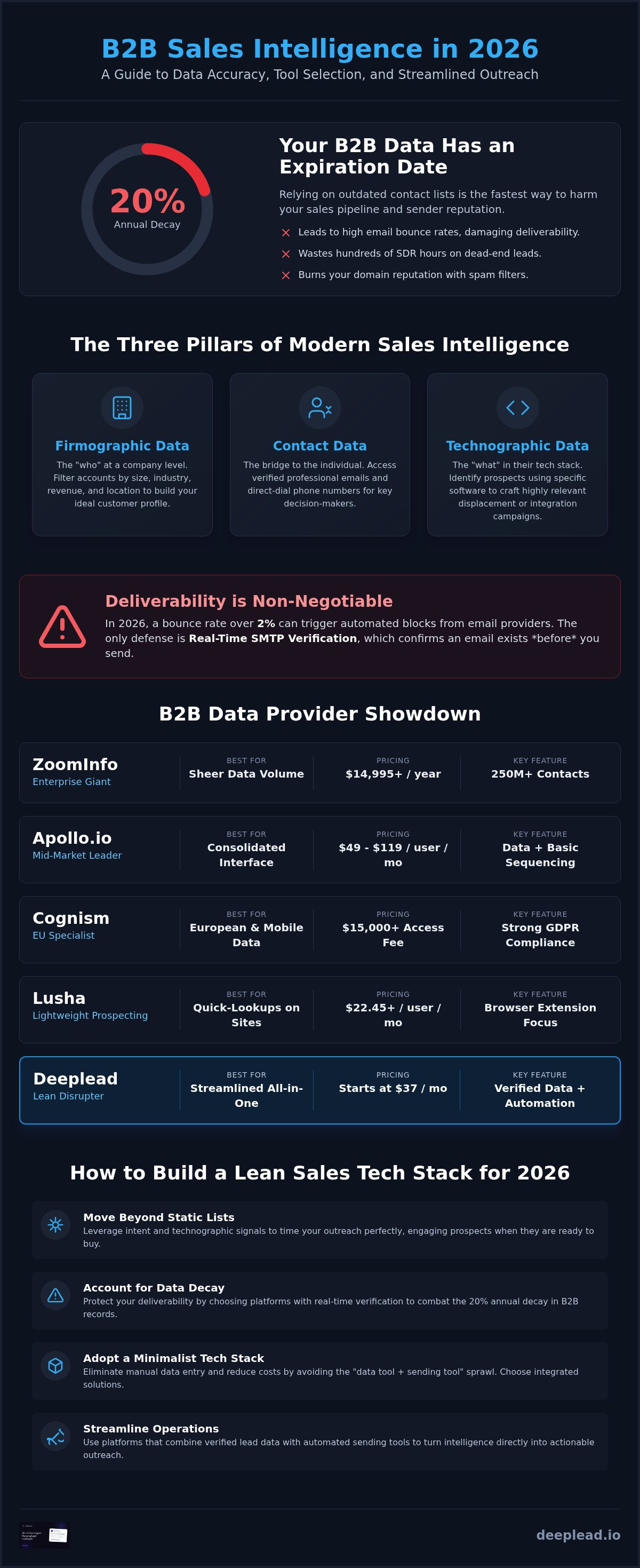
- Protect your deliverability by accounting for the 20% annual decay seen in B2B contact records.
- Identify the best sales intelligence tools b2b contact data by matching platform capabilities to your specific team size and budget.
- Move beyond static lists by leveraging intent and technographic signals to time your outreach perfectly.
- Adopt a minimalist tech stack approach to eliminate manual data entry and reduce the cost of multiple software subscriptions.
- Streamline your operations by using integrated platforms that combine verified lead data with automated sending tools.
What is Sales Intelligence and Why Does Data Quality Matter in 2026?
Sales intelligence is the intersection of contact data, technographics, and intent signals. It is the engine that transforms a cold list into a strategic outreach plan. In 2026, prospecting is no longer about finding any contact; it's about finding the right contact at the exact moment they are ready to buy. Selecting the best sales intelligence tools b2b contact data involves more than comparing database sizes. You need a system that understands the context behind the person.
Static lists are a liability. Industry research shows that roughly 20% of B2B data decays annually as professionals change roles, companies rebrand, or email structures evolve. If you rely on a database that was refreshed six months ago, one-fifth of your effort is wasted before you hit send. This decay leads to high bounce rates, which are the fastest way to destroy your sender reputation. Maintaining high data quality is no longer optional; it is the baseline for survival in a crowded inbox.
Bad data carries a heavy price. It wastes hundreds of SDR hours on dead-end leads and disconnected phone lines. More importantly, it burns your domain reputation. Modern spam filters in 2026 are aggressive. Once your domain is flagged for high bounces, your deliverability plummets, and even your perfectly crafted messages to qualified leads will land in the spam folder.
The Three Pillars of B2B Intelligence
- Firmographic Data: This covers the basics of your target accounts. It includes company size, industry, annual revenue, and geographic location. It helps you filter the "who" at a high level.
- Contact Data: This is the bridge to the individual. It consists of verified professional emails and direct-dial phone numbers. The best sales intelligence tools b2b contact data provide multiple touchpoints for a single lead.
- Technographic Data: This reveals the software stack your prospects currently use. Knowing if a prospect uses a specific CRM or hosting provider allows you to build highly personalized displacement campaigns.
The Impact of Data Accuracy on Email Deliverability
Email providers have shifted toward zero-tolerance policies for high bounce rates. In 2026, a bounce rate exceeding 2% can trigger automated warnings or temporary blocks on your sending accounts. Real-time SMTP verification is the only way to mitigate this risk. Unlike cached records, real-time verification pings the recipient's mail server to confirm the address exists before you attempt to send a campaign. This proactive approach keeps your inbox healthy and ensures your outreach actually reaches the human on the other side.
The Best Sales Intelligence Tools for B2B Contact Data
Database size is a vanity metric. If you buy a list of 250 million contacts but 20% are invalid, you're paying for failure. The most effective way to evaluate the best sales intelligence tools b2b contact data is by looking at the cost-per-verified-lead. Modern Sales Intelligence requires platforms that prioritize real-time verification over cached records. You need data that is ready for your outreach tool without requiring a separate cleaning service.
Enterprise Giants vs. Lean Disrupters
ZoomInfo remains the market leader for sheer volume, boasting over 250 million contacts. However, it comes with an enterprise price tag. Pricing starts at $14,995 per year for the Professional plan, often making it inaccessible for smaller teams. It's a powerful engine, but the complexity and cost can be a barrier for those who need a faster ROI.
Apollo.io serves the mid-market with a balance of data and basic sequencing. Their paid plans range from $49 to $119 per user, per month. It's a popular choice for teams that want a consolidated interface. If you're looking for a more streamlined, all-in-one approach at a lower entry point, Deeplead offers a self-serve platform starting at $37 per month. It eliminates the "data tool plus sending tool" sprawl by providing a built-in verified database and automated outreach in one place.
Specialized Niche Providers
Sometimes your needs are specific to a region or a workflow. Cognism is the top choice for European markets due to its strong GDPR compliance and high-quality mobile data. It typically requires a $15,000+ access fee, making it a significant investment. Lusha offers a more lightweight solution. Their browser extension allows for quick prospecting directly on LinkedIn or company sites, with plans starting at $22.45 per user, per month when billed annually.
For those focused solely on email discovery, Hunter.io remains a specialist. It excels at domain-based searches and finding the specific email patterns used by a company. While it lacks the deep firmographic data of larger platforms, it's efficient for simple verification needs. Choose your tool based on where your prospects live and how your team actually works. Don't pay for enterprise features if your goal is simply to start more conversations with accurate data.
Beyond Basic Contact Info: Intent and Technographic Signals
Standard contact data is the foundation. Signals are the trigger. Understanding What is sales intelligence in 2026 means looking for digital footprints that indicate a readiness to buy. The best sales intelligence tools b2b contact data don't just provide an email; they provide a reason to reach out today. This shift from static lists to signal-triggered outreach is what separates high-performing teams from those stuck in manual cycles. You aren't just looking for a person. You're looking for a window of opportunity.
Using Buying Intent to Prioritize Prospects
Intent data identifies companies currently researching your solution. By the time a prospect fills out a form on your website, they are already deep into their buying journey. You want to reach them earlier. First-party intent tracks visitors on your own domain. Third-party intent tracks behavior across the wider web, such as reading industry whitepapers or searching for specific category keywords. Identifying these in-market buyers allows you to prioritize accounts that have a high probability of conversion.
- First-party signals: Prospect activity on your pricing page or case studies.
- Third-party signals: Research spikes on competitor terms or industry-specific pain points.
- Automated alerts: Real-time notifications for new funding rounds or executive leadership changes.
Technographic Targeting: Selling into a Tech Stack
Technographic data reveals the software stack your prospects are using. This is a powerful tool for displacement campaigns. If you know a prospect is using a competitor's CRM or hosting provider, your outreach can focus on specific migration benefits or "better-together" integrations. It also helps you disqualify leads that lack the necessary technical infrastructure to support your product. This prevents wasted SDR hours on accounts that will never move past the discovery call.
In 2026, the most effective tools use AI to scan live web and social signals. Deeplead utilizes an AI Deal Explorer to identify high-value leads based on real-time business events. These signals include new hiring patterns or specific social media activity that suggests a change in strategy. When you reach out following a specific signal, your message feels like a timely solution rather than an interruption. This precision reduces your cost per lead and keeps your tech stack lean.
How to Build a Lean Sales Tech Stack for 2026
Efficiency is the only metric that matters for a modern sales team. Most organizations suffer from "tool sprawl," where they pay for multiple redundant subscriptions that don't communicate with each other. A lean stack focuses on the best sales intelligence tools b2b contact data that integrate directly into your execution layer. Complexity creates friction; simplicity creates speed. Your goal is to move from a lead signal to a sent email in minutes, not hours.
Calculating the ROI of your sales intelligence spend requires looking beyond the monthly subscription fee. You must account for the SDR hours saved by eliminating manual data cleaning and the increased revenue from higher deliverability rates. If a tool provides 10,000 leads but has a 15% bounce rate, it's more expensive than a tool that provides 1,000 verified leads with a 1% bounce rate. Prioritize the cost-per-qualified-meeting over the cost-per-contact.
Step 1: Define Your Ideal Customer Profile (ICP)
Precision starts with your ICP. Don't guess who your best buyers are; use your existing CRM data to build a lookalike model. Identify the specific firmographic constraints that define a high-value account. You should be able to narrow your search to 5-10 key filters in your intelligence tool to ensure every lead generated is a perfect fit. For example: "Our ICP is mid-market B2B fintech companies in the UK with 50-200 employees currently using Salesforce CRM."
Step 2: Integration and Workflow Automation
Manual CSV exports are the enemy of sales productivity. Every time an SDR manually moves data from an intelligence tool to a sending platform, you risk lead leakage and data decay. In 2026, your data source and outreach platform must have a native, real-time sync. This ensures that when a contact changes jobs or a company triggers a buying signal, your outreach sequences update automatically. Maintaining a unified reply management system prevents prospects from falling through the cracks during the handoff from automation to human conversation.
You can eliminate the friction of managing multiple vendors by choosing a consolidated solution. Start building your minimalist outreach kit and access verified data directly within your sending interface with the Deeplead All-In-One Outreach Platform. This approach ensures your data flows seamlessly into your campaigns without the need for manual intervention or third-party cleaning tools.
Deeplead: Streamlining Sales Intelligence into Actionable Outreach
Data is only valuable when it leads to a conversation. Most sales teams struggle because they treat intelligence and outreach as separate silos. You find the leads in one tool, export them, clean them in another, and finally upload them to a third for sending. This fragmented process creates data decay and wasted time. Deeplead solves this by providing an all-in-one alternative that places the best sales intelligence tools b2b contact data directly inside your outreach engine.
The core of the platform is a built-in, verified database. You don't need to purchase external lists or worry about high bounce rates. Every contact is verified at the point of search. This eliminates the need for third-party validation services and ensures your domain reputation remains intact. By consolidating your stack, you reduce your overhead and increase your speed to market.
Identifying high-value leads happens automatically through the AI Deal Explorer. Instead of manually filtering static databases, the AI scans live web and social signals to find prospects currently experiencing a business change. Whether it's a new funding round or a shift in technology usage, the AI surfaces these deals so you can reach out with perfect timing. This signal-based approach transforms cold outreach into a warm solution.
The Power of One Interface
Managing multiple subscriptions is a drain on resources. Deeplead: The All-In-One B2B Outreach Platform combines data discovery, AI-personalized writing, and automated sending in a single dashboard. By integrating the best sales intelligence tools b2b contact data with AI writing, the platform removes the manual friction of traditional prospecting. The platform also includes managed sending inboxes and pre-warmed domains; this ensures your infrastructure is ready for high deliverability from day one.
Performance-Based Lead Gen: Pay Only for Qualified Replies
Not every team wants to manage the outreach process themselves. For companies focused strictly on ROI, Deeplead offers a performance-based model. You can opt for pay-per-lead outreach, where you pay between $50 and $150 per qualified reply. This removes the risk of outbound sales by aligning costs directly with results. If you prefer a completely hands-off approach, the Done-For-You outbound service provides a fully managed solution for $3,000 per month.
Whether you are a founder running your first campaign or a scaled team looking for efficiency, there is a model that fits. You can get started with Deeplead for $37/month to access the self-serve platform. Stop managing a complex web of tools and start focusing on the conversations that drive revenue.
Future-Proof Your Outbound Strategy
The landscape of B2B sales has shifted from volume to precision. Success in 2026 requires moving beyond the "spray and pray" model by using data that updates in real-time. You've seen that the best sales intelligence tools b2b contact data are those that integrate intelligence directly into your outreach workflow. By focusing on intent signals and technographic fit, you can stop chasing dead leads and start building meaningful relationships.
A lean tech stack isn't just about saving money; it's about gaining speed. Consolidating your tools allows you to act on buying signals before your competitors even know they exist. You can now access verified data, AI-powered personalization, and performance-based pricing options all in one place. This integration ensures your domain reputation remains safe while your pipeline stays full.
Stop managing a fragmented system of exports and manual uploads. It's time to simplify your process and focus on what actually drives revenue: qualified replies. Start scaling your outbound with Deeplead today. Your next big deal is waiting for the right signal.
Frequently Asked Questions
What is the most accurate B2B contact data provider in 2026?
Accuracy depends on verification methods rather than database size. Providers like BookYourData guarantee 97% accuracy, while UpLead offers a 95% guarantee with credit refunds for invalid emails. The best sales intelligence tools b2b contact data use real-time SMTP pings to check addresses at the point of discovery. Deeplead includes a built-in verified database to ensure your outreach reaches the inbox, protecting your domain reputation from high bounce rates associated with stale lists.
How much do sales intelligence tools typically cost?
Costs vary significantly based on your team's scale. Enterprise platforms like ZoomInfo start around $14,995 annually, while Cognism often requires a $15,000 access fee. Mid-market tools like Apollo.io offer plans starting at $49 per user. For founders and lean teams, Deeplead provides a self-serve platform starting at $37 per month. This offers a more accessible way to combine high-quality data with automated outreach execution without the heavy enterprise commitment.
Can I get B2B contact data with emails for free?
You can access limited B2B data through various free tiers. Apollo.io offers 1,200 credits per year, and Lusha provides 40 credits per month. These plans are ideal for testing data quality or managing very low-volume prospecting. However, for a consistent sales pipeline, most teams upgrade to paid plans to access bulk exports, advanced filters, and real-time buying signals that aren't available on free versions of these tools.
How do I verify a B2B email address before sending?
You should use a tool that performs real-time SMTP verification. This process pings the recipient's mail server to confirm the address exists without sending an actual email. Modern outreach platforms often build this verification directly into the search interface. By using a platform like Deeplead, you skip the manual cleaning step because the contact data is already verified before it enters your automated sending sequences, keeping your bounce rate low.
What is the difference between intent data and contact data?
Contact data provides the "who," such as names, professional emails, and job titles. Intent data provides the "when" by tracking digital behaviors that suggest a company is in the market for a solution. Using the best sales intelligence tools b2b contact data alongside intent signals allows you to prioritize prospects who are actively researching your category. This results in higher conversion rates and a much more efficient sales process for your team.
Is sales intelligence software GDPR and CCPA compliant?
Most major providers are designed to meet GDPR and CCPA standards. European-focused tools like Cognism prioritize GDPR compliance by sourcing data specifically for B2B legitimate interest. It's essential to choose a provider that offers transparency about their data collection methods. Always verify that your outreach platform allows you to process opt-out requests quickly to maintain legal compliance across different geographic regions and protect your company from potential fines.
Do I need a separate tool for technographic data?
You typically don't need a separate tool. Most modern sales intelligence platforms include technographic data as a standard filtering option. This allows you to identify prospects based on the CRM, hosting provider, or ERP they currently use. Deeplead integrates these technographic signals into its AI Deal Explorer. This helps you find high-value leads that are a perfect technical fit for your specific software or service offering without extra subscriptions.
How often do B2B databases update their records?
Update frequency varies by provider, but top-tier databases refresh records daily or weekly. This is necessary because B2B data decays at a rate of roughly 20% every year as people change jobs or companies rebrand. To ensure the highest accuracy, choose a provider that uses real-time verification. This ensures that the record is checked at the exact moment you add it to your campaign, rather than relying on older cached data.