Score and Route Buyer Intent Data to Trigger Same Day Outreach for B2B

Buyer intent data is the layered set of signals that shows which accounts are actively researching your category right now, so you can reach them before a competitor does. It combines first-party behavior, third-party research activity, buying-committee movement, and product usage into one prioritization signal. Used well, it means fewer wasted calls and higher reply rates, because you are timing outreach to real buying momentum instead of guessing.
TL;DR:
- Multi-layer corroboration of intent signals, combining first-party, third-party, buying-committee, and product-usage data, can increase conversion rates by up to four times.
- Typically, only a small percentage of accounts show high intent within a 1 to 7-day window, making real-time scoring crucial to capitalize on active research.
- Validated identity resolution and short action windows are essential to avoid false positives and maintain trust in intent-driven outreach.
- Relying solely on third-party signals or static scores leads to poor performance; measures must include multiple signals and ongoing testing.
- Deeplead automates prompt, personalized outreach triggered by validated intent signals, integrating data, writing, and CRM workflows in one platform.
Table of Contents
- What Is Buyer Intent Data and Why Does It Have Four Layers?
- Where Do Buyer Intent Signals Actually Come From?
- How Do You Score and Act on Intent Signals?
- What Should Sales and Marketing Do With an Intent Signal?
- What Tech Stack Do You Need to Operationalize Intent?
- What Mistakes Sink Most Buyer Intent Programs?
- How Deeplead Turns Intent Signals Into Outreach
- What I’ve Learned Deploying Intent-Driven Outreach
- Try Deeplead for Signal-Triggered Outreach
- Sources
What Is Buyer Intent Data and Why Does It Have Four Layers?
Most teams think “intent data” means one thing: a vendor feed showing which companies are searching for your product category. That is only one slice. Real buyer intent data is a layered set of signals combining first-party, third-party, buying-committee, and product-usage information to infer who is researching and when to act, according to Abmatic AI’s guide on buyer intent data. Each layer answers a different question.
- First-party signals: What is happening on your own properties, like pricing page visits, demo requests, and content downloads.
- Third-party signals: What accounts are researching across the web, on review sites, publisher networks, and industry forums.
- Buying-committee signals: Who at the account is engaging, and whether new titles or departments are showing up in the activity.
- Product-usage signals: For trial or freemium products, which accounts are hitting usage milestones that historically precede a purchase.
This is different from lead scoring. Lead scoring typically ranks individual contacts based on firmographic fit and past engagement. Buyer intent data operates at the account level and answers a timing question: not “is this a good fit” but “is this account in-market right now.” The two work together. A well-fit account with rising third-party research and multiple stakeholders engaging is a far stronger signal than either data point alone.
Here is the payoff: when a third-party research surge lines up with first-party engagement and growth in buying-committee activity, predictive value jumps sharply compared to any single layer alone, per Abmatic AI’s analysis. One signal is a hint. Three aligned signals are a reason to call.
Where Do Buyer Intent Signals Actually Come From?
Before you buy anything, audit what you already have. Most B2B companies are sitting on first-party intent signals they never route to sales.
Owned properties generate the highest-confidence signals: repeated pricing page visits, demo requests, content downloads gated behind forms, and webinar attendance. DemandScience’s research on intent signals points to competitor site visits and repeated pricing-page hits as some of the highest-value indicators available, precisely because they are hard to fake and directly tied to purchase consideration.
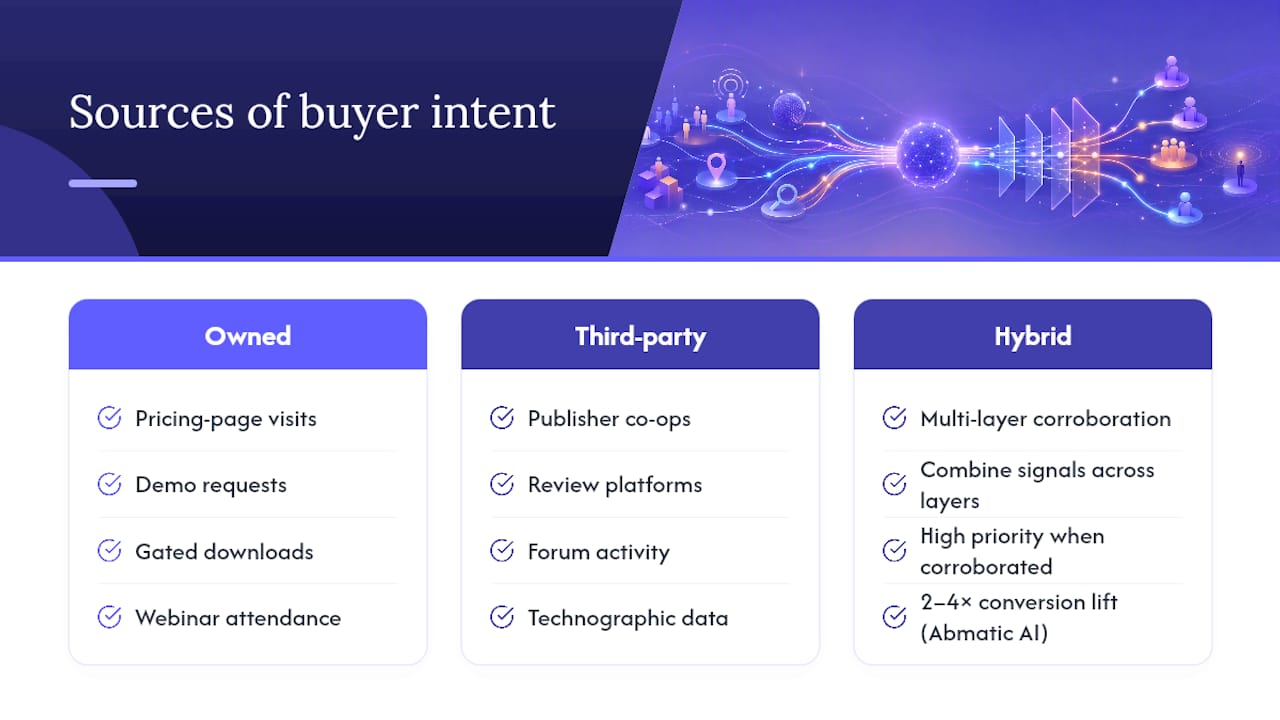
Third-party sources widen the lens beyond your own site. Publisher co-ops and review platforms aggregate topic-level research activity at the account level, which is how vendors surface companies researching your category even before they visit your site, based on G2’s research methodology. Forum activity, technographic data (what tools a company already runs), hiring signals (a company posting for a “revenue operations” role), and relevant news events (funding rounds, leadership changes) round out this layer.
Hybrid signals are where the real prioritization power sits. A single third-party research hit is noise. A third-party surge paired with a first-party pricing page visit and two new stakeholders engaging is a very different story.
Statistic callout: Multi-layer corroboration, meaning signals from more than one layer pointing to the same account, typically lifts conversion rates two to four times over relying on a single layer, according to Abmatic AI.
Treat any single third-party signal as a maybe. Treat two or more corroborating signals, especially with a first-party touch, as a call-today priority.
How Do You Score and Act on Intent Signals?
Scoring only works if you can tell accounts apart with confidence. That starts with identity resolution: matching anonymous website visits, form fills, and third-party research hits to the correct company and, ideally, the correct contact. Common failure points include IP-based matching that misfires on shared office buildings, VPNs masking true location, and stale firmographic databases that misclassify company size or industry. Clean this up before you trust any score.
Once identity resolution is solid, build a simple point-based framework. Here is a starting structure most revenue teams can adapt:
- First-party high-intent action (pricing page visit, demo request): an appropriate score.
- Third-party research surge (multiple sources, sustained over several days): a moderate score.
- Buying-committee growth (a second or third stakeholder engaging): a moderate score.
- Product-usage milestone (trial account hitting a key feature): a moderate score.
- Set your action threshold at a level that typically requires at least two corroborating layers before triggering outreach, consistent with the multi-layer corroboration principle above.
Time windows matter as much as the score itself. Intent signals decay fast. A third-party research surge from three weeks ago tells you far less than one from three days ago. Most teams should treat a 1 to 7 day action window as the difference between “still in-market” and “already decided.” Scoring inside the session, rather than waiting for an overnight batch job, matters here: real-time scoring enables interventions and immediate outreach, while batch scoring often arrives too late to catch a buyer while they are still active, per Intempt’s research on purchase propensity scoring.
Pro Tip: Run a simple A/B test before rolling out any scoring model company-wide: route half your qualifying accounts through the new intent-triggered play and hold the other half on your standard cadence. Measure reply rate and meetings booked after 30 days before you trust the score.
Build a feedback loop from day one. If reps are marking “intent” accounts as low quality, your weights are wrong, not your reps.
What Should Sales and Marketing Do With an Intent Signal?
A score without a routing rule is just a spreadsheet. Build clear triggers for what happens at each threshold.
- High-score accounts (above your action threshold): Route immediately to an SDR as a same-day alert, not a batch digest, since the window to reach an in-market buyer is measured in days.
- Mid-score accounts: Add to an ABM ad audience for targeted retargeting while marketing builds a stronger signal picture over the following week.
- Committee-growth accounts: Trigger a multi-thread outreach play addressing the new stakeholder directly, referencing the specific problem area their research suggests.
- Low or single-layer signals: Hold for nurture rather than direct outreach. A thoughtful lead nurturing sequence keeps these accounts warm until a second signal arrives.
Messaging should shift with the signal type. A pricing-page visit calls for a direct, low-friction message about next steps. A third-party research surge with no first-party touch calls for educational content that earns the click to your site. A buying-committee expansion calls for a message that acknowledges multiple stakeholders are now involved.
After activation, track meetings booked per intent-triggered outreach, qualified pipeline generated from intent accounts versus your standard list, and reply rate lift compared to non-intent-triggered sequences. If these numbers do not move within a full sales cycle, revisit your thresholds before you revisit your messaging.
What Tech Stack Do You Need to Operationalize Intent?
Most teams underestimate the plumbing required to make intent data usable, not the strategy behind it.
- CRM integration so scores and signals attach directly to account and contact records instead of living in a separate dashboard nobody checks.
- Tag deployment across your website to capture first-party behavior at the page and event level.
- An identity graph or resolution provider to connect anonymous traffic, form fills, and third-party research hits to the correct company record.
- A consent and privacy review covering how signals are collected and used, particularly for any data touching individual-level behavior across regions with different consent rules.
- A decision on real-time versus batch scoring, since real-time scoring supports in-session interventions and immediate SDR alerts, while batch scoring is adequate for weekly account prioritization but too slow for catching an active buyer, per Intempt’s findings.
Get the tags and CRM sync working first. Everything downstream, scoring, routing, and personalization, depends on that foundation being clean.
What Mistakes Sink Most Buyer Intent Programs?
Three failure modes account for most disappointing intent programs, and all three are fixable.
- Acting on third-party signals alone. A single research hit from a publisher network gets treated as a hot lead, reps waste calls on accounts barely aware they exist, and trust in the whole program erodes within a quarter.
- Ignoring the feedback loop. Teams set a scoring model once and never revisit it, so weights drift out of sync with what is actually converting.
- Over-trusting the score. A high number becomes an excuse to skip qualification entirely, which produces meetings that go nowhere and reps who start ignoring the alerts altogether.
The fix for all three is the same discipline: require corroboration across at least two layers before urgent outreach, keep action windows short (1 to 7 days), and run ongoing test-and-learn cycles rather than a “set and forget” model. Expect a full quarter, often close to 90 days, before tags, identity resolution, and routing rules are dialed in enough to judge performance fairly, based on typical deployment timelines from Abmatic AI. Measure ROI conservatively during that window, and rep trust will follow the results instead of the hype.
How Deeplead Turns Intent Signals Into Outreach
Most teams identify a hot account and then lose days assembling a list, writing emails, and finding a way to send them without hurting deliverability. Deeplead closes that gap by building outreach directly on top of signal detection.
A signal campaign in Deeplead fires the moment a live buying signal appears on a target account, no manual list-building required. From there:
- Deeplead pulls verified contacts at the account from its built-in business and people data.
- The AI Deal Explorer surfaces buying-intent leads alongside budget estimates, so reps know which accounts are worth an immediate call.
- Every email is individually AI-researched and written per recipient rather than templated, then sent from warmed-up inboxes to protect deliverability.
- Replies land in one unified inbox with AI auto-responders, and sync to HubSpot, Salesforce, Pipedrive, or any CRM through webhooks.
For a team that has built the scoring discipline described above, this closes the gap between “we spotted the signal” and “the prospect has an email in their inbox,” often within the same day the signal fires.
What I’ve Learned Deploying Intent-Driven Outreach
The biggest lesson is that corroboration beats volume every time. A list of a thousand “intent-flagged” accounts built on a single third-party signal converts worse than a list of fifty accounts where two or three layers line up. Teams chase the bigger list because it feels productive. It rarely pays off.
The second lesson: reps stop trusting scores the moment one bad batch of “hot” leads wastes their morning. Protect that trust deliberately, with tight thresholds and short action windows, or the entire program quietly dies from disuse.
One checklist item worth stealing: before any account gets an urgent SDR alert, confirm it clears at least two signal layers. That single rule prevents most of the false positives that kill a program’s credibility in its first month.
— Julian
Try Deeplead for Signal-Triggered Outreach
Deeplead is built for the exact gap this article covers: turning a buying signal into a sent, personalized email without stitching together five separate tools for data, writing, sending, and warmup. Instead of paying for a contact database, an email writer, a sending platform, and a CRM connector separately, you get all of it in one subscription.
If you are a small team or solo operator testing the waters, start with the self-serve plan from $37 a month, backed by a 7-day free trial. If you would rather pay only for results, Deeplead offers pay-per-lead options; see their website for current pricing details. Agencies and teams that want outreach run entirely for them can opt into done-for-you services; visit the website for current pricing. Whichever path fits your team, the signal campaigns and AI Deal Explorer are there to make sure the accounts showing real buying intent get contacted first, not last.
Visit Deeplead to start your trial and see which accounts in your market are showing intent right now.