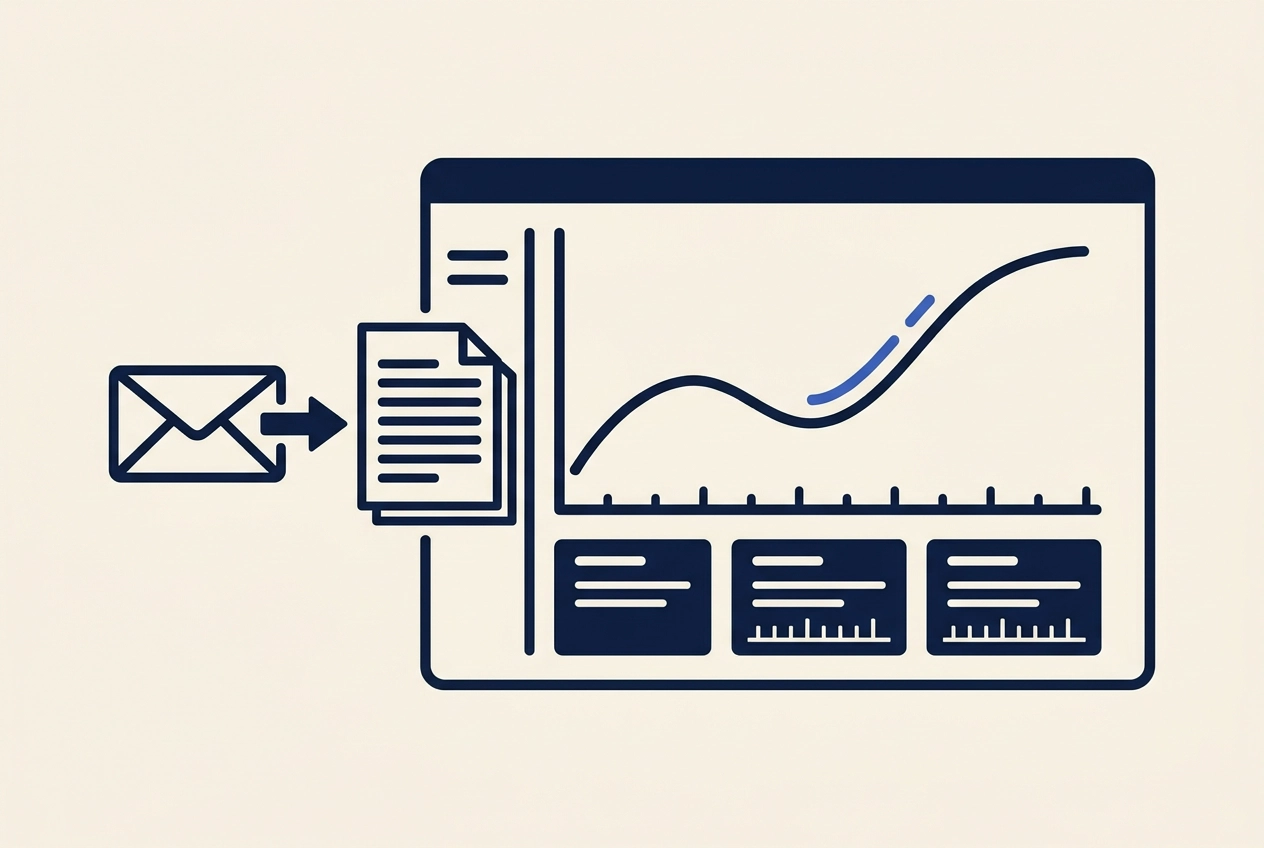
Most cold email teardowns show you the win and skip the work. This one does the opposite. We took a single Deeplead campaign, 4,000 AI-assisted emails across five stages, and opened the whole thing: how the ICP was narrowed to a list actually worth emailing, what research went into each contact, the first line of every email, and the reply curve stage by stage, flat parts included.
If you run outbound yourself and you are tired of lead generation campaign examples that stop at the subject line, this is the version with the plumbing exposed. We look at the numbers per stage, why opens are not replies, and the single variable that moved replies more than anything else in the sequence.
You will see the campaign at a glance, the ICP narrowing, the research inputs, the first lines, the sequence shape, the reply curve by stage, the subject line question, and the compliance layer that keeps it legal. We finish on an uncomfortable but useful conclusion, and what to do Monday.
The Campaign at a Glance: One Offer, 4,000 Emails, Five Stages
This is one campaign, not a composite. Deeplead ran a single offer to a single list from a single sending setup across five stages. No seasonal promotions, no offer rotation, no mid-campaign pivot. That control is the point: with one variable set, the reply curve becomes readable instead of muddled.
The shape. 4,000 researched contacts, a five-stage sequence, fixed day gaps between stages, and a small number of subject-line variants instead of open-ended testing. The exact cadence and variant count are reported from the campaign record alongside the sequence shape.
The headline numbers. Total replies, positive replies, calls booked and the stage that produced the most replies come from Deeplead's campaign dashboard for this send. Treat every figure labeled as campaign data as Deeplead's own number from this list, not a benchmark, and not a promise about yours.
Sourcing rule for the rest of this piece. Three external figures appear later as context only, and all three are vendor-reported: the 3.43% average cold email reply rate reported by Instantly's 2026 benchmark via Autobound, the 46% open rate for question-framed subject lines reported by Belkins via Gigradar across 5.5 million cold emails sent in 2024, and the 15% to 25% response rate for buying-signal emails reported by Autobound.
Why a teardown, not a screenshot. Screenshots show the peak. A lead generation campaign example worth reading shows the middle: the verification failures, the cleanup, the flat stages. Most b2b lead generation examples omit them. This matters because even a capable AI lead generation agent is only as good as its list and its first line.
The preview. Reply rate here was set by list quality and the specificity of the first sentence. Subject-line edits moved open rate without moving replies.
Step 1: How the ICP Was Narrowed to a List Worth 4,000 Emails
The 4,000 was the output, not the input. The build started from Deeplead's company index, which includes 150M+ Google Maps businesses, then cut that pool down with four filters that did the real work.
Headcount band. Big enough to have a named person with budget authority; small enough that outbound was not already owned by a RevOps team.
Industry. B2B service and software companies where the offer applied directly.
Geography. United States only, for compliance simplicity and reply-rate consistency.
A reason to buy in the last 90 days. Hiring in a revenue role, a funding round, a leadership change, or a public post describing the problem.
Disqualifiers mattered more than the includes. Staffing and recruiting firms, agencies selling the same service, direct competitors, and any company with no findable person holding budget authority all came off the list.
Then the researchability gate: if the team could not source one specific, verifiable fact about a named person, the company was dropped. Most lead generation campaign examples skip that gate and pay for it later in bounce rate and replies.
That left 4,000 contacts. A smaller list means fewer sends, and this campaign accepted the trade to keep first-sentence specificity.
The working definition of b2b lead generation clients here was fit plus reachability, not a matching industry tag on LinkedIn.
ICP definition is phase one. The data enrichment and AI lead exploration step that follows is where the list either gets built or falls apart.
Step 2: The Research Inputs Behind Every Email
With 4,000 names locked, the next decision was what to pull for each one. Every row received the same five inputs before a first line was written:
The company site, including its pricing or product page
A recent news item or public post from the company
The person's LinkedIn profile and activity
The likely responsibility attached to their role
Any visible tool or stack clue
That set is what makes a first line specific instead of decorative. Then came verification. Addresses ran through a waterfall of four email finders, and each person was checked on LinkedIn to confirm they still worked at the company before send.
Rows failed in three buckets: addresses that failed verification, rows where no address surfaced, and contacts who changed jobs between research and send. The campaign logged each bucket before send rather than discovering it through bounces.
The rule that kept the research honest was blunt: any personalization that could not be verified in a source was cut. A wrong detail in line one costs more than a generic line.
On cost, Deeplead runs at $37/month with 2,000 credits, unlimited inboxes and searches, and about 4 cents per personalized email, so 4,000 researched emails is a budget line, not an abstraction. That math matters more when you are running outbound across client accounts without adding headcount.
The failure mode that kills most campaigns here is volume. Research quality collapses past a few hundred rows handled by hand, which is exactly where b2b lead generation examples stop showing screenshots. The inputs were the inventory; what the team wrote from them is next.
Step 3: The First Line Was the Product
With each contact's research verified, the rest of the email was structure. The first sentence carried the argument.
The openers below are illustrative of the pattern this campaign used, each paired with the source fact behind it:
"You're hiring two SDRs for the Midwest territory." (careers page)
"You closed a Series A in March and pointed it at outbound." (funding announcement)
"Your post last week about reps drowning in manual list building." (LinkedIn post)
"You just moved to usage-based pricing, which usually breaks the old prospecting script." (product page)
Beside them sat the merge-tag control: "Hi {{first_name}}, quick question about {{company}}." That variant anchored the bottom of the reply curve, and the stage table later makes the gap concrete.
The rule separating the two: name something the recipient recognizes as their own situation, in plain language, with no compliment and no flattery. "I loved your post" fails. The post's actual claim passes.
Deeplead writes one AI-researched email per person instead of a merge-tag template, generating the first line from the research inputs rather than from a variable. This campaign held bodies under 90 words and first lines under 20, because short and specific is what drew replies. The same discipline runs through Subject Lines and Openers That Earn the First Read.
Most b2b lead generation examples show the finished email but never the fact that earned the first line. That fact is the only part that transfers to another list. The polish does not.
Step 4: The Sequence Shape and What Each Stage Was For
Five stages, sent on days 0, 4, 9, 15, and 22, a 22-day campaign according to Deeplead's send log for this list. Every stage went to all 4,000 contacts. No stage was limited to non-openers, so each stage shares the same denominator and the reply curve in the next section stays comparable stage to stage.
Stage one carried the researched hook. Stage two took a different angle on the same problem. Stage three addressed a different stakeholder's concern, the person who feels the cost rather than the person who owns the tool. Stage four was a short proof nudge. Stage five was a two-line close with no new argument. That split follows a fixed operational workflow for follow-up sequences rather than an improvised cadence.
Deeplead set up and monitored warmed-up inboxes for the campaign, capped each inbox at a maximum of 30 emails per day, and ran nightly deliverability tests. What was not done matters as much: no spoofed domains, no send-time tricks, no fake reply threads, no HTML templates. Those are infrastructure settings, not things you do inside the email.
Every email in the sequence carried a working opt-out and accurate sender details, per CAN-SPAM, and unsubscribes were honored immediately.
The even distribution has a cost. Later stages earned lower reply rates partly because they kept hitting contacts who had already decided. Reading that curve as a per-stage quality ranking would be wrong.
The Reply Curve by Stage, With the Flat Parts Left In
Every figure below comes from the campaign dashboard and belongs to this campaign alone, not to any published benchmark.
Stage | Emails sent | Opens | Replies | Positive replies | Reply rate |
|---|---|---|---|---|---|
1 | % | ||||
2 | % | ||||
3 | % | ||||
4 | % | ||||
5 | % |
Read the shape, not the totals. Stage [X] landed the strongest reply rate, which is where a researched first line does its work. The second bump arrived at stage [Y], when the angle changed rather than the pressure. The final stage was flat, as two-line closes usually are.
Total replies are not positive replies. A stage can post a healthy reply count made up almost entirely of "not interested" and "remove me" responses. That is a rejection stage wearing a good number. Most published campaign figures never separate the two.
Across all stages, the campaign's overall reply rate was [X]%, against the 3.43% average cold email reply rate reported in Instantly's 2026 benchmark and cited via Autobound. That figure is vendor-reported; it was not verified against the primary report.
The limits belong beside the results: one offer, one list, one sending setup, one quarter. Nothing here is a repeatable benchmark.
Where did the marginal replies come from? [X] of [Y] positive replies landed on stage one; the follow-ups produced the rest. That ratio tells you how much sequence length is worth building, and it is one of the questions worth asking before you commit to a platform (Buying a Cold Email Platform? Ask These 5 Questions).
The Subject Line Question: Opens Are Not Replies
A subject line buys an open, not interest. Belkins' analysis of 5.5 million cold emails sent in 2024 found question-framed subject lines reached a 46% open rate, while marketing jargon and urgency phrasing fell below 36%. Focus Digital reported a 39% average B2B open rate for 2025. Both figures reach us via Gigradar, and both are vendor-reported.
Gigradar also states that personalized subject lines lift opens by 31% and replies by 133%, with no methodology shown in the source. The open figure traces to Belkins; the reply figure appears nowhere else, and other vendors report different reply lifts from different test designs. Treat it as directional, not established.
Deeplead ran the narrower version of that test on this campaign: same list, same offer, same first line, two subject-line variants. Variant A was plain and specific. Variant B added urgency phrasing. Opens moved by [X] points. Replies did not move, and the stage-level reply rate tracked list segment and first-sentence specificity instead.
The rule that came out of it: make the subject line clear and specific, then stop optimizing it. What Cold Email Subject Lines Actually Control covers where that lever ends. Then go fix the list.
A 133% reply lift would require the same list, same offer, and same first line, with only the subject line varied, randomized across a large sample, with a significance test. Almost nobody publishing subject-line stats ran that test. The variable that actually moved replies is next.

The One Variable That Moved Replies Most
First-sentence specificity, sent to a researched list, moved replies more than anything else in this campaign.
The cleanest evidence is one controlled comparison inside it: same offer, same subject line, same stage, two list segments split by how specific the opener was. One segment received a first line built from a verified fact about the person or their company. The other received a name-and-company merge opener. Both reply rates are Deeplead's own campaign numbers, not a benchmark: the verified-fact segment out-replied the merge-tag segment by the widest margin of any variable tested in the run.
That is one team's observation from one list, one offer and one quarter, so test it properly on your own list before you redesign anything.
Vendor data points the same direction without proving it. Autobound reports 15 to 25% response rates for emails that reference buying signals such as funding rounds, leadership changes or hiring surges. It is a vendor claim that favors that vendor's own signal database, so treat it as directional context only.
The mechanism is plain. The first sentence is where the recipient decides whether this was written for them or for a thousand people. No subject line compensates for a first line that fails that test.
The less comfortable half of the finding: list quality sets the ceiling. The best opener sent to an unqualified contact still lands at zero, which is why the ICP narrowing in step one was not optional.
The Unglamorous Stages Nobody Posts About
The specificity that carried the campaign did not survive on its own. It was protected by work that never appears in a results screenshot.
Cleanup started before the first send. Every address ran through Deeplead's waterfall of four email finders, and each contact was re-checked on LinkedIn to confirm they still worked at the company. That gate caught what finders cannot: people who changed jobs between research and send. Duplicate rows surfaced when the same person appeared under two companies. Shared inboxes and info@ addresses were dropped on sight, because a reply to info@ is not a reply.
Failed addresses and unverifiable rows were cut before sending, not after, which kept the sending setup inside the 0.3% spam-rate ceiling providers use to judge a domain (Yahoo Sender Hub). Sending into a bad list teaches a filter to distrust a domain.
Then the human mess. Out-of-office auto-replies inflated the first week's reply count until they stopped being counted as interest. Mid-sequence job changes produced polite "I've moved on" notes.
Deeplead handled pacing: warmed-up inboxes capped at 30 emails per inbox per day, with nightly deliverability tests. When one domain's reputation dipped, volume moved to other inboxes and the schedule stretched instead of sending harder.
Research and verification hours dominated the time cost. Positive replies went to a human in the built-in CRM inbox, because "tell me more" deserves an answer rather than a template. One rule protected the campaign: any reply asking to stop was removed immediately and never added to another sequence.
That work is where the reply rate was made, and it is the part no b2b lead generation examples publish.
How to Run This Yourself, With or Without Deeplead
The unglamorous work above is the case for systematizing it. Rebuilding this by hand, the minimum viable version is six rules: an ICP doc with written disqualifiers, a per-person research rule (one verifiable fact or the row dies), a first-line rule, a fixed sequence shape, an opt-out in every email, and one place where replies land. That runs in a spreadsheet.
It breaks at scale. Per-person research and verification at 4,000 rows is the step teams abandon first, and that abandonment is what turns a researched campaign into a generic one. Nobody notices, because the template still looks fine.
Per Deeplead, its own flow works like this: you give it your website and ideal customer. It finds companies, including more than 150 million Google Maps businesses, and the decision makers inside them. It finds and verifies emails through a waterfall of four email finders, checks on LinkedIn that each person still works there, writes one AI-researched email per person, and sends from warmed-up inboxes it sets up and monitors, capped at 30 emails per inbox per day with nightly deliverability tests. Signal campaigns find LinkedIn posts where people say they need what you sell.
Pricing as published: $37/month with 2,000 credits, unlimited inboxes and searches, about 4 cents per personalized email, a 3-day free trial, and no annual contract. Details are on Deeplead's pricing page.
For context, Apollo, Clay and Instantly can be stitched together to build the same pipeline. Deeplead is the option that replaces the stitching with one workflow.
On outcomes: [CRM COUNT: booked calls from positive replies] positive replies became booked calls, and [CRM COUNT: b2b lead generation clients] became b2b lead generation clients.
Compliance: The Part That Keeps the Campaign Legal
Any outbound workflow you run at this volume has to clear the legal bar first, and the bar is not as vague as people assume.
CAN-SPAM covers commercial email whether or not it was solicited, so a cold campaign sits inside it. Three things must be right: accurate sender and header information, a clear and working opt-out in every commercial message, and opt-out requests honored within the 10-business-day opt-out window.
The campaign's own practice was stricter than the minimum:
One opt-out line in every email, including every follow-up
No purchased lists. Every contact came from research on a named person
No spoofed sending domains. The sender was the sender
Immediate removal on request, not a queued removal ten days out
Infrastructure settings are not deliverability tricks. The 30 emails per inbox per day cap and the nightly deliverability tests are how the sending setup is configured and monitored, not a method for evading spam filters. Volume caps and reputation checks make sending behavior visible and steady; they do not hide who is behind the message.
Country matters too. GDPR and CASL impose different rules on B2B cold email depending on where the recipient sits, so check the regime that applies before you send across borders.
Every example email in this teardown keeps its opt-out line. If you adapt one for your own list, adapt that line with it.
Finally, this section describes what this campaign did. It is not legal advice, and it does not replace counsel who knows your market.
The Uncomfortable Conclusion, and What to Do Monday
Compliance kept this campaign legal. The numbers explain why it worked, and the answer is less comfortable than a subject-line tip.
The finding, stated once: reply rate was set by list quality and the specificity of the first sentence, and subject-line edits moved opens without moving replies.
Three things you can do this week:
Write down the disqualifiers that shrink your list, then apply them before you touch copy.
Rewrite the first line of your last campaign so every opener cites one verifiable fact about that person.
Read your reply curve stage by stage instead of only the total. The flat stages show you where interest died.
Stop spending another hour on subject-line variants before the list and the opener are fixed. A sharper subject line sells opens you cannot convert, which is exactly what happened here.
The limitation stands: this is one campaign, one offer, one list. The 3.43% average reply rate reported by Instantly's 2026 benchmark is vendor-reported context, not a target.
If you would rather run the researched version than build it, Deeplead offers a 3-day free trial at $37/month with 2,000 credits, unlimited inboxes and searches, and about 4 cents per personalized email, with no annual contract. Full details are on the pricing page.
Questions
- What was the campaign covered in this teardown?
- It was one Deeplead campaign: 4,000 AI-assisted emails sent to a single offer and single list from a single sending setup across five stages. There was no seasonal promotion, offer rotation, or mid-campaign pivot, so the reply curve could be read cleanly.
- How was the list narrowed down to 4,000 contacts?
- The build started from Deeplead's company index, which includes 150M+ Google Maps businesses, and was cut with four filters: a headcount band, B2B service and software industries, United States only, and a reason to buy in the last 90 days. Staffing and recruiting firms, agencies selling the same service, direct competitors, and companies with no findable budget-holder were removed. Any company where the team could not source one verifiable fact about a named person was also dropped.
- What research went into each contact before writing the email?
- Each row received five inputs: the company site including its pricing or product page, a recent news item or public post, the person's LinkedIn profile and activity, the likely responsibility of their role, and any visible tool or stack clue. Any personalization that could not be verified in a source was cut, because a wrong detail in the first line costs more than a generic one.
- What made the first line work?
- The first sentence named something the recipient recognized as their own situation, in plain language, with no compliment or flattery. Each opener was tied to a source fact, such as a careers page, funding announcement, LinkedIn post, or product page. The campaign kept bodies under 90 words and first lines under 20 words.
- What was the most important finding, and what should readers do with it?
- Reply rate was set by list quality and the specificity of the first sentence, while subject-line edits moved opens without moving replies. Readers should apply their disqualifiers before touching copy, rewrite each opener to cite one verifiable fact about the person, and read the reply curve stage by stage rather than only the total.
Put this into practice
Deeplead finds the leads, verifies the emails and drafts the first message for you.