3–5 Follow Ups That Work for B2B: Cold Email Playbook 2026
Send your first follow-up around day 3, then space subsequent touches 4 to 7 days apart, and plan for 3 to 5 total follow-ups before you stop. Each touch needs its own job: a value bump, a new angle, an objection reframe, and finally a breakup note that gives the prospect permission to go quiet. Reply from the same thread every time, and make sure your automation stops instantly the moment someone replies.
TL;DR:
- Follow-up emails generate 42% to 70% of responses, with the first follow-up often accounting for about a quarter of replies, making sequence repetition crucial.
- A standard cadence of three follow-ups at days 3, 10, and 17, plus a final breakup at day 24, balances persistence with respect for recipient inboxes.
- Each follow-up should serve a distinct purpose, such as providing new value, a different angle, objection handling, or closing the conversation, rather than repeating the same pitch.
- Timing within the week and day is most effective on Tuesdays through Thursdays mornings, 9 to 11 AM local time, with adjustments made based on recipient behavior and time zones.
- Reliable automation with instant reply detection is essential to prevent double-sending and protect deliverability, while tracking reply, open, and spam rates guides ongoing sequence optimization.
Table of Contents
- Why Cold Email Follow-Ups Get More Replies Than Your First Message
- What’s the Best Timing and Cadence for Cold Email Follow-Ups?
- What Should You Say in Each Cold Email Follow-Up?
- Which Subject Lines and Preview Text Boost Follow-Up Open Rates?
- How Do You Automate Follow-Ups Without Hurting Deliverability?
- What Metrics Should You Track and A/B Test in Follow-Up Sequences?
- How Do You Build an Operational Workflow for Follow-Up Sequences?
- What Actually Goes Wrong With Cold Email Follow-Ups
- Run Your Follow-Up Cadence Without the Manual Busywork
- Sources
Why Cold Email Follow-Ups Get More Replies Than Your First Message
Your first cold email is a coin flip. The follow-ups are where the campaign actually gets won.
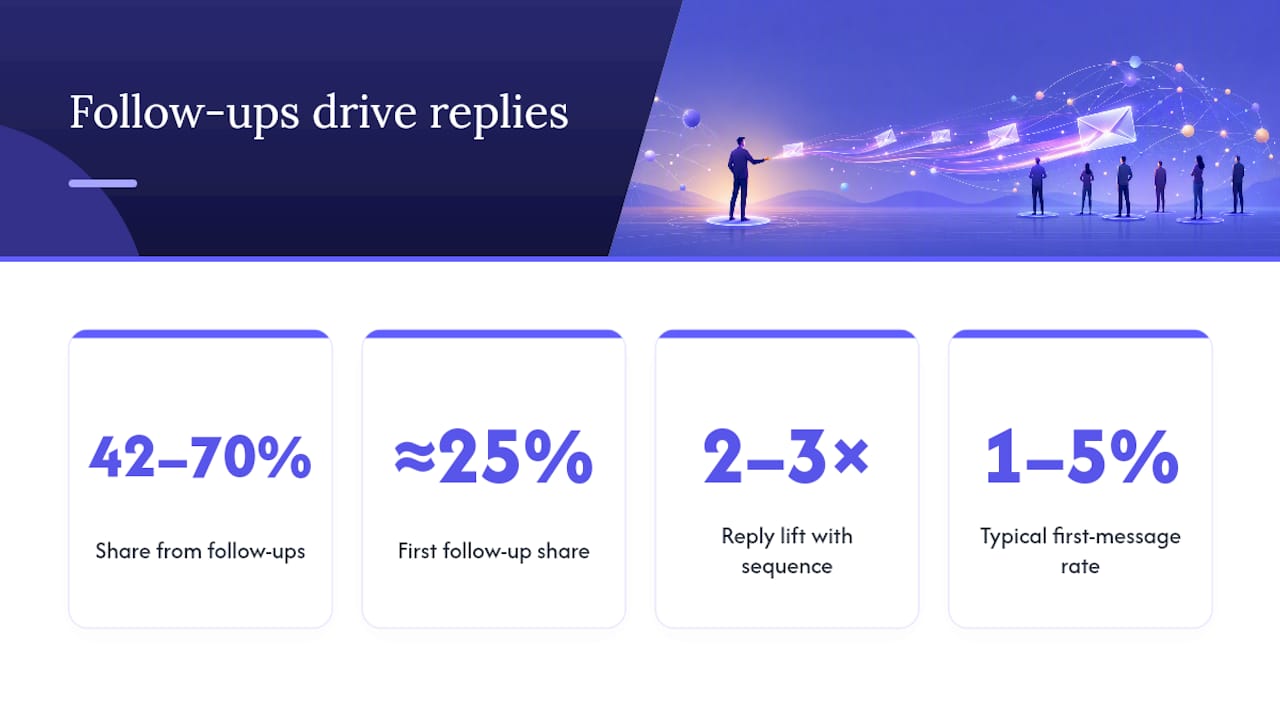
Follow-up messages generate roughly 42% to 70% of all replies in most cold outbound campaigns, and the very first follow-up alone often accounts for about a quarter of positive responses. If you send one email and walk away, you’re leaving the majority of your possible replies on the table.
Cold Email Reply Math: If your average cold email reply rate sits around 1 to 5%, a well-built follow-up sequence can roughly double or triple your total reply volume from the same list, since most responses come from touches two through five, not touch one.
Three things explain why repetition works here in a way it wouldn’t in, say, a cold call.
First, inbox attention is a timing problem, not an interest problem. Most B2B buyers aren’t ignoring you because they hate your offer. They’re ignoring you because your email landed during a sprint planning meeting or a Monday inbox purge. A second and third touch simply increases the odds you land during a moment when someone actually has three seconds to read.
Second, B2B buying is rarely a one-person decision. The person who opened your email might need to loop in a manager, check budget, or wait for a slower quarter. A single email assumes a single decision-maker acting fast. A sequence acknowledges that real buying committees move on their own schedule, not yours.
Third, there’s what some sales teams call the “last note” effect. When a prospect has been meaning to reply and forgetting, a well-timed follow-up (especially a low-pressure one) becomes the nudge that finally gets a two-line response: “Sorry, been buried. Can we talk Thursday?”
None of this works if every follow-up just repeats “just following up on my last email” with more exclamation points. The reason follow-ups convert is that each one is supposed to add something: a new stat, a different angle, a shorter ask. A follow-up that adds zero new information is asking for attention without earning it. A follow-up that adds one useful detail is a service, not an interruption. That distinction is the entire game.
What’s the Best Timing and Cadence for Cold Email Follow-Ups?
There’s no single universal cadence, but there is a strong default, and it’s backed by enough campaign data across enough industries to trust as a starting point.
The 3-7-7 baseline
The most commonly recommended schedule follows a 3-day floor for your first follow-up, then roughly 7-day gaps for the touches after that. It looks like this:
- Day 0: Initial cold email
- Day 3: First follow-up (value bump)
- Day 10: Second follow-up (new angle)
- Day 17: Third follow-up (objection handling)
- Day 24: Breakup email
Three days is long enough that you’re not pestering someone who simply hasn’t opened their inbox yet, and short enough that your first message is still fresh in their memory when the second one lands.
The 4-step alternative
Some teams prefer a tighter early cadence with a longer strategic gap before circling back with a different offer entirely. A 4-step skeleton built around day 1, day 3 or 4, day 8, and day 15, followed by a deliberate 30-day pause before re-approaching with a new value proposition, protects your sender reputation while letting you test more than one pitch against the same list.
| Cadence variant | Touch 1 | Touch 2 | Touch 3 | Touch 4 | Notes |
|---|---|---|---|---|---|
| 3-7-7 baseline | Day 3 | Day 10 | Day 17 | Day 24 (breakup) | Best default for most B2B segments |
| 4-step skeleton | Day 1 | Day 3–4 | Day 8 | Day 15 | Add a 30-day gap before a fresh offer |
| Signal-compressed | Within 24 hours | Day 4–5 | Day 9 | Day 14 (breakup) | Only when opens/clicks spike |
When to compress or extend the gaps
Rigid cadences ignore the one signal that actually matters: behavior. If a prospect opens your email three times in one afternoon or clicks a link in your signature, that’s a real-time signal worth acting on. In that case, compressing your follow-up window to about 24 hours can catch them while your offer is still top of mind.
Compression is a tool for genuine interest, not a shortcut for impatience. Using it on every contact regardless of engagement trades long-term deliverability for a short-term bump in replies, and your domain reputation pays for it later.
The opposite adjustment applies to senior executives. VPs and C-suite contacts tend to batch-process email once or twice a week, often on a Sunday night or during a specific weekday block. Stretching your gaps to 10 to 14 days for this segment usually outperforms a standard weekly cadence, since a second touch that lands three days after the first just looks impatient to someone who reads email in batches.
Best days and times to send
Timing within the day and week matters almost as much as the gap between touches. Data across multiple campaign analyses points to a consistent pattern: Tuesday through Thursday mornings, roughly 9 to 11 AM in the recipient’s local time zone, outperform Monday morning inbox floods and Friday afternoon distraction windows.
A few practical notes on applying this:
- Segment your list by time zone before scheduling, not after, especially for anything spanning US coasts or international markets.
- Avoid the first hour of the workday if you can help it. That’s when people triage, not read.
- Skip the last two hours before a long weekend for any touch you want opened.
- If sequencing global accounts, prioritize the recipient’s morning.
Write the entire sequence before you launch a single email. Sequences built in advance tend to stay value-led because you’re thinking strategically about what each touch adds. Sequences improvised message by message under silence tend to drift into needy reminders, because you’re reacting to no response instead of planning for one.
What Should You Say in Each Cold Email Follow-Up?
Every touch in your sequence needs a distinct job. Sequences that repeat the same pitch with a lighter version of “checking in” underperform sequences where each message earns its place in the inbox.
Here’s how the four core jobs break down, with short templates you can adapt.
1. Touch 1: the value bump (day 3)
This is a light, low-friction nudge that references your original email in one line and adds exactly one new piece of value: a stat, a resource, or a sharper reason to care. Keep it short. Multi-sentence follow-ups in the 50 to 125 word range tend to outperform one-line bumps, as long as every sentence earns its place.
Template A:
Hey [First Name], following up on my note below. Teams in [their industry] using [category] usually see [specific outcome] within the first month. Worth a 15-minute call to see if it applies to [Company]?
Template B:
Circling back, [First Name]. One thing I didn’t mention: [specific proof point or stat]. If that’s relevant to what you’re working on this quarter, happy to send more detail.
Template C:
[First Name], quick bump. If timing’s off right now, no worries, just let me know and I’ll follow up later in the year instead.
2. Touch 2: the new angle (day 8 to 10)
If the value bump didn’t land, the problem might be that your original pitch wasn’t the right hook for this person. Touch 2 should introduce a different angle entirely: a case study, a resource, or a use case they haven’t seen yet, paired with a lower-friction ask than “book a call.”
Template A:
[First Name], thought this might be more useful than my last note: [link to a relevant case study or resource]. It’s a quick read on how [similar company type] approached [problem]. Curious if it maps to what you’re seeing.
Template B:
Different angle this time, [First Name]. Instead of a call, would a two-minute video walkthrough be easier? I can send one over if that’s more your speed.
3. Touch 3: objection handling (day 15 to 17)
By the third follow-up, silence usually means one of a few predictable objections: no budget right now, already have a solution, or it’s simply not a priority this quarter. Name the likely objection directly and reframe it in two sentences. This is where sequences assigning a distinct job to each touch consistently outperform ones that just restate the pitch.
Template A:
[First Name], I’ll guess: this probably isn’t a priority right now, or you’re already covered on this. If it’s the second one, I’d still love to hear what you’re using, just for my own map of the space.
Template B:
If budget’s the blocker, [First Name], most teams start with a smaller pilot before committing to anything larger. Happy to talk through what that could look like for [Company].
4. Touch 4: the breakup email (day 24 or later)
The breakup note isn’t a threat. It’s permission to close the loop, and it consistently produces a disproportionate number of replies for how little it asks. People respond to a graceful exit far more often than they respond to persistence.
Template A:
[First Name], I don’t want to keep cluttering your inbox. I’ll assume the timing’s not right and close this out on my end. If anything changes, my note will still be here.
Template B:
Last one from me, [First Name]. If this genuinely isn’t relevant, no hard feelings, just reply “not now” and I’ll leave you alone. If it is relevant but the timing’s off, tell me when to circle back.
Keep every touch in the same email thread rather than starting fresh each time. It preserves context for the prospect and consistently produces higher open rates than a new subject line each round.
Pro Tip: Treat your post-reply sequence as a completely different job than your cold sequence. The cold run exists to get discovered; once someone replies, shift to faster, more personalized follow-ups built around closing, not discovery.
Which Subject Lines and Preview Text Boost Follow-Up Open Rates?
Subject lines for follow-ups do a different job than subject lines for your first cold email. The first email has to earn curiosity from a stranger. The follow-up just has to avoid looking like spam to someone who already saw your name once.
A few formulas that consistently perform well across follow-up types:
- Reply-style subjects: Keep the original subject line with “Re:” attached. This is the highest-performing option for same-thread follow-ups because it mimics a real ongoing conversation.
- Plain-language bumps: “quick follow-up” or “circling back” in lowercase, no punctuation. Understated language reads as human, not templated.
- Question-based: “still relevant?” or “worth a look?” These work especially well on touch 2 or 3.
- Social proof snippets: “how [similar company] solved this” signals value without a hard pitch.
- Breakup lines: “should I close this out?” or “last note from me” perform strongly on the final touch, since curiosity about closure often beats curiosity about a pitch.
- No subject at all (same thread): When you’re replying in-thread, some senders skip changing the subject entirely and let the original line carry through, which reinforces the reply-style effect.
Preview text matters more than most senders realize, since it’s often the deciding factor in whether an email gets opened at all on mobile. Write the first line of your email assuming it will be read as preview text before the subject line gets a second glance. Avoid opening with “Hi [Name],” since it wastes the preview window on something the subject line already implied.
To measure what’s actually working, test one variable at a time: same body copy, two different subject lines, split roughly 50/50 across a comparable segment. Track open rate first, then reply rate, since a subject line can lift opens without lifting replies if the body doesn’t follow through on what it promised.
How Do You Automate Follow-Ups Without Hurting Deliverability?
Automation is where good cadences go to die if the guardrails aren’t right. The single most important rule: your system has to detect a reply and stop the sequence instantly, every time, with no exceptions.
Automated sequences that lack reliable reply detection cause double-sends, where a prospect who already responded gets hit with a scheduled follow-up anyway. That’s not just an awkward look. It’s one of the fastest ways to generate a spam complaint from someone who was otherwise interested.
If your platform can’t confirm reply detection in real time, it’s safer to run in a manual “remind me to send” mode than to trust full automation. A missed touch is a minor loss. A double-send to someone who just replied is a credibility hit you don’t get back.
A few non-negotiable settings for any automated cadence:
- Enforce a 3-day floor on the first follow-up unless a genuine engagement signal justifies compression.
- Cap daily sending volume per inbox to protect domain reputation, especially on new or recently warmed addresses.
- Pause immediately on any reply, including auto-replies and out-of-office messages, then route genuine replies to a human, not back into the sequence.
- Verify contacts before sequencing, since a high bounce rate from bad data damages sender reputation faster than almost anything else in cold outreach.
- Warm every sending inbox before it carries volume. An inbox with no sending history looks suspicious to spam filters the moment it starts pushing cold volume.
Watch your spam and unsubscribe rates closely as your sequence runs. Data across campaign analyses shows deliverability risk climbs noticeably after the third rapid follow-up, which is one more reason the 3-to-5 touch ceiling isn’t arbitrary. It’s roughly where the math on diminishing returns and rising complaint risk starts to cross.
Pro Tip: If you’re managing multiple sending inboxes, stagger their warmup schedules so you’re never dependent on a single domain’s reputation. One flagged inbox shouldn’t be able to take down your entire sequence’s deliverability.
What Metrics Should You Track and A/B Test in Follow-Up Sequences?
Four metrics matter more than the rest combined: reply rate, conversion-to-meeting rate, spam or complaint rate, and general deliverability health (bounce rate, inbox placement).
Reply rate tells you whether your messaging is landing. Conversion-to-meeting tells you whether the replies you’re getting are worth having. A sequence that generates a lot of “not interested, please remove me” replies has a reply rate problem solved and a business problem unsolved. Track both separately, because optimizing for one without the other is how teams end up celebrating a metric that doesn’t pay the bills.
Spam and complaint rates deserve a permanent spot on your dashboard, not an occasional glance. They’re the earliest warning sign that a cadence is too aggressive, long before your reply rate actually drops.
For testing, isolate one variable at a time:
- Subject line tests: Same body, two subject variants, split evenly across a comparable segment.
- First-line tests: Same subject and offer, different opening sentence, since the first line often decides whether the rest gets read.
- CTA friction tests: Compare a hard ask (“book a call”) against a soft ask (“worth a quick reply?”) on the same touch.
- Cadence tests: Run the 3-7-7 baseline against a compressed variant on comparable list segments, and compare total replies per 100 sends, not just per-email open rate.
Segment your results by cohort before drawing conclusions. A sequence that underperforms on enterprise accounts might be crushing it with mid-market prospects, and averaging the two together hides both results. Break tests down by industry, seniority, or engagement signal whenever your list size allows for it, and don’t declare a winner until each variant has run against a large enough sample to rule out noise.
How Do You Build an Operational Workflow for Follow-Up Sequences?
Strategy only matters if the workflow behind it is repeatable. Here’s the operational sequence that turns everything above into a system instead of a one-off campaign.
- Pick your target segment based on firmographic or intent data, not a generic list.
- Verify every contact before it enters a sequence. Bad data is the single fastest way to damage deliverability.
- Warm your sending inboxes before they carry any real volume.
- Build the full sequence in advance, assigning a distinct job to each touch before writing a single line.
- Test on a small segment first, checking open and reply rates before scaling to the full list.
- Monitor reply-stop behavior daily, especially in the first few sequences on a new inbox or list.
- Sync every reply to your CRM so sales follow-up happens without a manual handoff.
A tool built for this workflow needs a specific feature set to run it safely: verified contact data going in, warmed sending inboxes, reliable reply-stop automation, a unified inbox for tracking responses across every sequence, and direct CRM sync so nothing gets lost between “got a reply” and “sales team knows about it.”
The Reply-Stop Gap: Since follow-ups drive up to 70% of total replies in a typical sequence, any tool that can’t reliably detect and stop on a reply is putting the majority of your campaign’s value at risk every time it fails silently.
An outreach workflow following this structure includes built-in contact data and verification, inbox warmup before sequences launch, replies landing in a unified inbox with reply-stop enforced automatically, and responses syncing to CRMs like HubSpot, Salesforce, or Pipedrive through webhooks. The point isn’t that any single feature is unique. It’s that running all of them from one place removes the coordination gaps where double-sends and deliverability problems usually start.
What Actually Goes Wrong With Cold Email Follow-Ups
The most expensive mistake teams make isn’t a bad template. It’s letting automation double-send to someone who already replied, usually because the sync between inbox and CRM lagged by a few hours at the wrong moment. That single failure can undo weeks of careful warmup and cadence discipline.
The second mistake is repeating the same offer across every touch with slightly different wording. If touch 1 pitches a demo, and touch 3 pitches the same demo with a different opening line, you haven’t built a sequence. You’ve built one email sent four times.
The third is ignoring time zones and workflow reality. A perfectly timed cadence on your calendar can land at 4 AM for a prospect three time zones over, and that’s a bad first impression before your message is even read.
Two techniques are worth trying beyond the basics here. Signal-based compression, reacting to real opens and clicks with a same-day follow-up, consistently outperforms a rigid schedule when you have the engagement data to justify it. And a breakup email that explicitly invites a one-word reply (“not now” versus silence) often produces more useful account intelligence than three polite check-ins combined, because it lowers the cost of responding to almost nothing.
— Julian
Run Your Follow-Up Cadence Without the Manual Busywork
This tool offers an alternative to using multiple separate tools for contact data, verification, warmup, sending, and reply tracking by running all aspects of the outreach workflow—verified contacts, warmed inboxes, automatic reply-stop, and CRM sync—from one dashboard instead of a patchwork of logins and exports.
A user picks a target segment, the system pulls verified contacts, researches each one, and writes individually personalized emails before sending them from warmed inboxes. Replies land in a unified inbox with AI auto-responders handling the first pass, and everything syncs to the CRM automatically. Pay-per-lead and done-for-you service options are also available for those who prefer not to run the sequence themselves.
Current plan details and trial information are available on the provider’s website. Start your trial here to see whether your next cadence runs cleaner than your last one.
Sources
The timing and reply-rate figures in this guide draw from a handful of primary sources worth checking directly. Whali’s follow-up guide backs the reply-share statistics and same-thread open rate data. The Outbound Game supports the 3-day cadence floor and signal-based compression rules. Pipeline Playbooks documents the 4-step alternative cadence and per-touch job assignment. Outsolvi covers the technical case for reply-stop automation.