The most expensive part of your sales process isn't the software; it's the hours your team spends on manual research and fixing broken deliverability. Most founders realize too late that a fragmented stack of five different tools is actually slowing them down. This playbook breaks down the essential Deeplead strategies for growth to help you reclaim that time. We've moved past the era of bulk outreach into a period where timing and intent dictate your success.
You're likely tired of seeing high-quality prospects ignore your emails because of poor personalization or technical filter issues. It's frustrating to pay for data, then for warming, and then for a sending tool, only to get mediocre results. We're going to change that. You'll learn how to master the exact outbound frameworks and AI-driven signals used to build a predictable B2B pipeline using the Deeplead platform.
We'll cover how to replace manual prospecting with an automated system that identifies buyers at the peak of their interest. From setting up pre-warmed inboxes to leveraging the AI Deal Explorer, this guide provides a clear path to reducing your cost-per-acquisition. Let's build a sales engine that works quietly in the background while you focus on closing deals.
Key Takeaways
- Transition from broad "spray and pray" tactics to signal-based growth to protect your domain reputation and increase response rates.
- Implement specific Deeplead strategies for growth that leverage live buying intent to reach prospects at the exact moment they are ready to buy.
- Replace manual lead research with the AI Deal Explorer and automated personalization loops to scale your pipeline without increasing headcount.
- Select the operational model that fits your goals, ranging from a $37/month minimalist sales kit to a performance-based pay-per-lead system.
- Sync your outreach data directly with HubSpot, Salesforce, or Pipedrive to focus on high-impact metrics like Qualified Reply Rate.
The Shift to Signal-Based Growth: Why Traditional Outreach Is Stalling
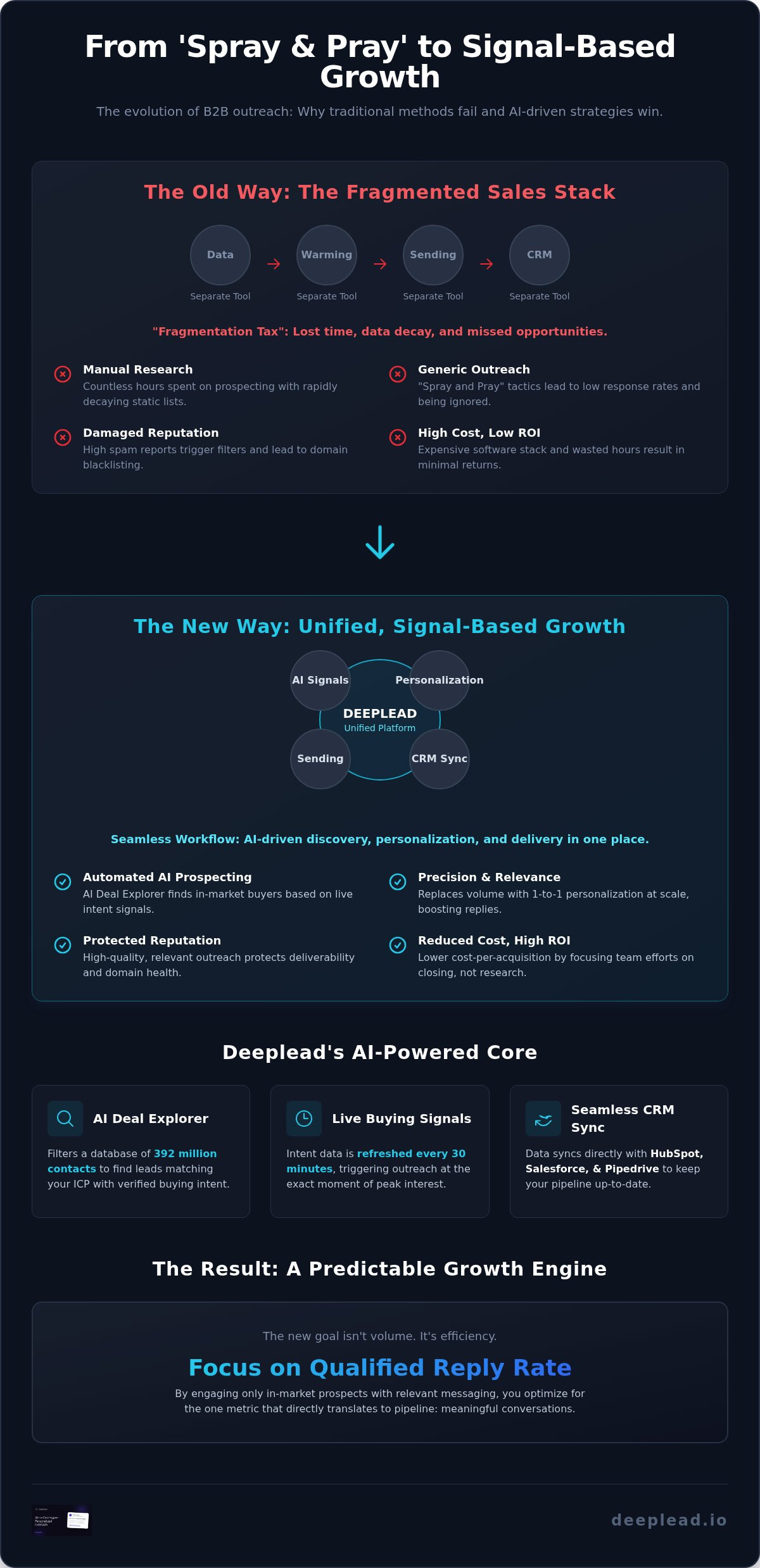
Traditional B2B outreach is broken. Sending thousands of generic emails used to be a viable numbers game, but in 2026, it's a recipe for domain blacklisting and zero ROI. Signal-based growth replaces this "spray and pray" approach by using live buying intent to trigger outreach. Instead of guessing who might need your service, you act on verified data. AI has moved us beyond generic templates into 1-to-1 relevance at scale. By consolidating your growth stack into a single interface, Deeplead helps you execute these strategies without the technical overhead.
Volume no longer equals pipeline. When you send irrelevant messages, you aren't just ignored; you're reported. High spam rates trigger permanent filters that can kill your entire sales operation. Deeplead strategies for growth focus on precision over quantity. This shift ensures your team spends time talking to prospects who are actually in-market, rather than shouting into the void. By automating the research phase, you reduce your cost-per-acquisition while maintaining a personalized touch that feels human.
The Death of the Fragmented Sales Stack
Managing separate tools for data, email warming, and sending creates a "fragmentation tax." Every time you export a CSV from one database and upload it to another, you lose time and accuracy. Data decay happens fast. A lead that was hiring last month might have filled the role today. Disconnected tools can't keep up with this pace. It's an inefficient way to work that leads to missed opportunities and stale pipeline.
Deeplead's unified approach keeps your data, AI personalization, and sending in one place. It's a minimalist sales kit that removes the friction of jumping between platforms. You don't need a complex integration to make your data talk to your inbox. The system handles the workflow from discovery to delivery, ensuring your outreach is always based on the most current information available. This integrated engine works quietly in the background, allowing you to focus on closing deals rather than managing software.
Understanding Modern Buyer Intent
Static lead lists are a relic of the past. Modern growth depends on "live" signals like recent funding rounds, job changes, or specific tech stack shifts. Timing is often the most underrated variable in B2B success. You need to reach the prospect when the problem is top-of-mind. This requires moving beyond traditional lead scoring methodologies and adopting dynamic, signal-triggered workflows.
Dynamic workflows allow you to automate your response to these market events. If a target company installs a competitor's software or hires a new VP of Sales, your system should react instantly. Deeplead identifies these triggers every 30 minutes. This speed allows you to be the first in the inbox with a relevant solution, turning cold outreach into a helpful, timely intervention. Deeplead strategies for growth prioritize these triggers, ensuring your message lands exactly when it's most useful to the buyer.
Deeplead’s AI Infrastructure: Building Your Foundation for Scale
Scaling a sales pipeline requires more than just a list of names. It requires a technical foundation that ensures your messages actually land. Most outbound failures stem from poor infrastructure, not bad sales copy. Deeplead’s AI infrastructure is designed to handle the heavy lifting of data verification and deliverability, allowing you to execute Deeplead strategies for growth with confidence. By automating the technical setup, you move from manual tinkering to consistent, high-volume performance.
The AI Deal Explorer and Lead Quality
The AI Deal Explorer filters through a database of 392 million people to find leads matching your specific Ideal Customer Profile (ICP). It uses algorithmic precision to surface companies showing active intent, which is refreshed every 30 minutes. This ensures you aren't chasing dead leads. When you focus on verified B2B contact data, you eliminate the friction of bounced emails and outdated information. This approach aligns with modern AI-driven B2B growth strategies that prioritize lead opportunity identification over raw volume. For a broader look at the market, you can compare these features with other best sales intelligence tools b2b contact data.
Automated Inbox Warming and Deliverability
Scaling outreach isn't possible on day one. You need a warm-up phase to establish trust with email providers. Deeplead handles the complex technical setup, including SPF, DKIM, and DMARC records; these are non-negotiable for modern inbox health. Without these, your domain reputation will plummet. Deeplead provides built-in warmed-up inboxes, even on the starter plan, creating a plug-and-play solution for growth. This system works quietly in the background to maintain high deliverability rates while you scale.
AI-researched email writing goes beyond simple "First Name" tags. It analyzes prospect data to create deep personalization that resonates with the recipient's specific business challenges. As your volume increases, managing responses becomes the next bottleneck. Deeplead’s unified reply management keeps your growth organized by centralizing all conversations in one interface. This prevents qualified leads from slipping through the cracks. If you're ready to streamline your sales stack, starting with these infrastructure pieces is the most efficient path forward. Implementing these Deeplead strategies for growth ensures your outreach is both sophisticated and sustainable.
3 Core Deeplead Strategies for Rapid Pipeline Expansion
Success in 2026 requires moving away from static campaigns. You need a dynamic system that reacts to market changes in real time. These three Deeplead strategies for growth allow you to maintain high relevance while automating the most labor-intensive parts of the sales cycle. By combining intent signals with AI-driven execution, you create a pipeline that fills itself.
The Signal-Trigger Playbook
Traditional outreach relies on broad lists that grow stale quickly. The Signal-Trigger Playbook shifts the focus to live events. You can set up triggers for specific B2B milestones, such as a company announcing a new executive hire or a recent funding round. Deeplead detects these signals every 30 minutes, allowing you to be the first to reach out when the need is highest.
Once a signal is detected, the system maps a specific AI-written message to that trigger type. If a company hires a new Head of Growth, your email should address the challenges of their first 90 days. This automation flows seamlessly from detection to a sent email, ensuring you never miss a window of opportunity. It replaces the need for a sales development representative to manually scan news feeds all day.
Scaling Personalization with AI
Generic templates are easy to spot and even easier to delete. To break through the noise, you need deep personalization that proves you've done your homework. Deeplead uses AI to research lead LinkedIn profiles and company news to provide necessary context for your outreach. This isn't about automated social interaction; it's about gathering intelligence to write a better, more targeted email.
Deeplead uses real-time data enrichment to craft unique opening lines that reference specific lead achievements or company milestones. These bespoke openers show the prospect that your message is intended specifically for them. This level of detail used to take hours of manual research, but now it happens instantly across your entire lead list. It allows a lean team to maintain the quality of a boutique agency at the scale of a global enterprise.
The final piece of the engine is the Auto-Responder Nurture. This strategy handles common objections or requests for information without manual input. When a prospect asks for a case study or says "not right now," the AI identifies the sentiment and sends the appropriate follow-up. Combining these three frameworks transforms your outbound process into a single, high-performance Growth Engine. It ensures your team only spends time on conversations that are ready to convert, effectively implementing Deeplead strategies for growth across your entire organization.
Operationalizing Growth: Choosing Your Deeplead Model
Choosing how to execute Deeplead strategies for growth depends on your current team size and technical capacity. You don't need a massive headcount to build a pipeline; you just need the right operational model. Deeplead offers three distinct paths: self-serve, pay-per-lead, and managed outbound. Each is designed to bridge the gap between having a product and finding a market. Transitioning between these models allows you to scale your outreach as your revenue increases.
The self-serve platform starts at $37 per month for the Starter plan. This is the entry point for founders who want to be hands-on with their outreach. It provides access to the database of 392 million people and includes pre-warmed inboxes. For teams that want to outsource the risk, the Pay-Per-Lead model charges $50 to $150 per qualified reply. Finally, the $3,000 per month Done-For-You service provides a fully managed sales engine. This variety ensures that every business, from a solo founder to a growing agency, has a path to predictable B2B leads.
The Minimalist Sales Kit: Scaling on a Budget
The $37 per month Starter plan acts as a minimalist sales kit for lean teams. It consolidates your data, personalization, and sending tools into one interface. You manage your own inbox health and reply handling, which keeps costs low while you find your product-market fit. Using the built-in B2B database, you can filter for high-intent signals without paying for separate data enrichment tools. When you find that manual reply management is taking up more than five hours of your week, it is usually time to move from self-serve to a performance-based model.
Performance-Based Growth: The Pay-Per-Lead Advantage
The Pay-Per-Lead model eliminates software management overhead entirely. You pay between $50 and $150 for each qualified reply, which means you only pay for measurable results. Deeplead qualifies these leads before they ever reach your calendar, ensuring your sales team only talks to prospects who match your ICP. This model is best for teams focused on pure ROI. To justify this cost, calculate your lead-to-revenue ratio. If a qualified reply leads to a high-value contract, the upfront cost becomes a small fraction of the total deal value.
Whether you choose to manage the platform yourself or opt for a managed service, the goal remains the same: building a system that works quietly in the background. You can start with a low-cost plan to test your messaging and then switch to an expert-led model for rapid scaling. This flexibility prevents you from being locked into a strategy that no longer fits your company's stage. If you are ready to start building your pipeline, select the model that fits your current goals and begin your first campaign today.
Measuring Success and Optimizing Your Growth Engine
Tracking the right data is the difference between a vanity project and a revenue engine. High open rates mean nothing if they don't result in qualified conversations. You should focus on Qualified Reply Rate and Pipeline Value as your primary indicators of health. These metrics tell you exactly how effectively your Deeplead strategies for growth are performing. By monitoring the quality of replies, you can adjust your targeting and value propositions in real time.
Optimization requires constant testing. You can't assume your first AI-generated hook is the best one. Use Deeplead to run continuous A/B tests on your subject lines and opening hooks. Small changes in wording can lead to significant shifts in engagement. This methodical approach ensures your growth engine becomes more efficient over time, reducing your overall cost-per-acquisition. It's about making small, data-driven adjustments that compound into significant pipeline gains.
CRM Synchronization and Data Flow
A growth engine is only useful if the data flows where your sales team lives. Deeplead syncs directly into HubSpot, Salesforce, and Pipedrive to ensure every qualified lead is automatically pushed to your reps. This eliminates manual data entry and prevents leads from getting lost in your inbox. Maintaining a clean database is handled through built-in verification; this keeps your CRM free of stale or incorrect contact information.
Automating the feedback loop is essential for long-term success. When a lead closes in your CRM, that data should inform your next campaign. You can identify which signals and messages led to the highest-value deals and double down on those specific segments. This creates a self-optimizing system that gets smarter as you feed it more results. It turns your outbound process into a sophisticated engine that works quietly in the background.
The 90-Day Deeplead Growth Roadmap
Building a predictable pipeline doesn't happen overnight. You need a structured plan to move from initial setup to full automation. This 90-day roadmap provides a clear path for implementing Deeplead strategies for growth effectively without overwhelming your team.
- Days 1-30: Focus on technical setup, domain warming, and testing your first intent signals to establish a baseline.
- Days 31-60: Scale your AI personalization and refine your Ideal Customer Profile based on initial reply data and sentiment analysis.
- Days 61-90: Move toward full automation and evaluate if transitioning to a Managed Service fits your rapid scaling needs.
Finalizing your strategy means committing to a consistent process. Outbound success is a result of compounding efforts rather than a single campaign. If you follow this roadmap, you'll have a sophisticated engine working quietly in the background by the end of the quarter. It's time to stop manual prospecting and start scaling. Start your 90-day growth engine with Deeplead today.
Future-Proof Your Outbound Engine
The shift toward signal-based growth is no longer optional; it's the standard for B2B success in 2026. By moving away from fragmented tools and static lists, you protect your domain reputation and ensure your message reaches the right buyer at the exact moment they need you. Implementing Deeplead strategies for growth allows you to automate the heavy lifting of lead research and technical setup. This leaves your team free to focus on closing qualified deals rather than managing software.
Success comes from combining verified B2B contact data with AI-researched personalization at scale. Whether you're a solo founder using a plan that starts at just $37 per month or a large team scaling with a managed service, the goal remains a predictable pipeline. Deeplead provides the infrastructure to turn cold outreach into a sophisticated engine that works quietly in the background. It's time to replace manual prospecting with a system built for speed and precision.
Scale your B2B outreach with Deeplead's all-in-one platform and start building your 90-day roadmap today. Your next qualified lead is ready to talk.
Frequently Asked Questions
What are the most effective Deeplead strategies for B2B growth?
The most effective Deeplead strategies for growth involve using the AI Deal Explorer to identify high-intent signals like recent funding or executive hires. By triggering automated campaigns based on these live events, you reach prospects exactly when they have a problem to solve. This approach replaces broad lists with dynamic workflows. It ensures your messages are timely and relevant, which significantly increases the likelihood of a positive response compared to traditional, static outreach.
How does Deeplead's AI personalization compare to manual research?
Deeplead's AI personalization performs deep research on lead achievements and company milestones in seconds, a task that typically takes a human researcher 15 to 20 minutes per lead. It uses real-time data enrichment to craft unique opening lines that reference specific context. This allows you to maintain the quality of bespoke, 1-on-1 outreach at a scale that manual research simply can't match. You get the benefits of a boutique approach with the efficiency of automation.
Can I use Deeplead to scale my startup's outbound sales predictably?
You can build a predictable pipeline by leveraging the platform's integrated infrastructure. Startups often struggle with fragmented tools, but Deeplead combines verified B2B data, AI writing, and automated sending in one interface. This consolidation removes the technical friction that usually stalls growth. By setting up automated signal-triggered workflows and using pre-warmed inboxes, you create a consistent flow of qualified leads without needing to hire a large sales development team or manage multiple subscriptions.
What is the difference between the $37 plan and the Pay-Per-Lead model?
The $37 monthly plan is a self-serve SaaS platform designed for teams that want to manage their own outreach using the built-in database and sending tools. In contrast, the Pay-Per-Lead model is a performance-based service where you only pay for qualified replies. This model costs between $50 and $150 per lead and is ideal for businesses that prefer to outsource the management of software and inbox health to focus strictly on ROI.
How does Deeplead ensure my emails don't end up in the spam folder?
Deeplead maintains high deliverability by handling the technical setup of SPF, DKIM, and DMARC records for your domains. Every plan includes access to pre-warmed inboxes, which are essential for establishing trust with email providers. Additionally, the platform's emphasis on high-relevance, signal-based outreach reduces the risk of being reported as spam. By sending fewer, more targeted messages rather than bulk blasts, you protect your domain reputation and ensure your emails consistently reach the inbox.
Does Deeplead integrate with my existing CRM like HubSpot or Salesforce?
Deeplead provides direct synchronization with major CRM platforms including HubSpot, Salesforce, and Pipedrive. This integration ensures that every qualified lead is automatically pushed to your sales team without manual data entry. It also allows for an automated feedback loop where closed deal data can be used to optimize your future targeting and messaging. By keeping your CRM and outreach tools connected, you maintain a clean database and a streamlined, high-performance sales workflow.
What kind of 'signals' can I use to trigger growth campaigns in Deeplead?
You can trigger campaigns based on various live B2B signals such as new executive hires, recent funding rounds, or shifts in a company's technology stack. The AI Deal Explorer identifies these events every 30 minutes, allowing for near-instant outreach. These signals indicate a change in a company's needs or budget, making them the perfect moment to introduce your solution. Using these triggers is one of the core Deeplead strategies for growth that ensures high relevance.
Is the Pay-Per-Lead model more cost-effective than hiring an SDR?
For many teams, the Pay-Per-Lead model is significantly more cost-effective than hiring a full-time Sales Development Representative. You avoid the overhead of salaries, benefits, and tool subscriptions, as well as the time required for training and management. Since you only pay for qualified replies, your costs are directly tied to measurable results. This performance-based approach allows you to scale your lead generation up or down based on your current budget and sales capacity without long-term contracts.