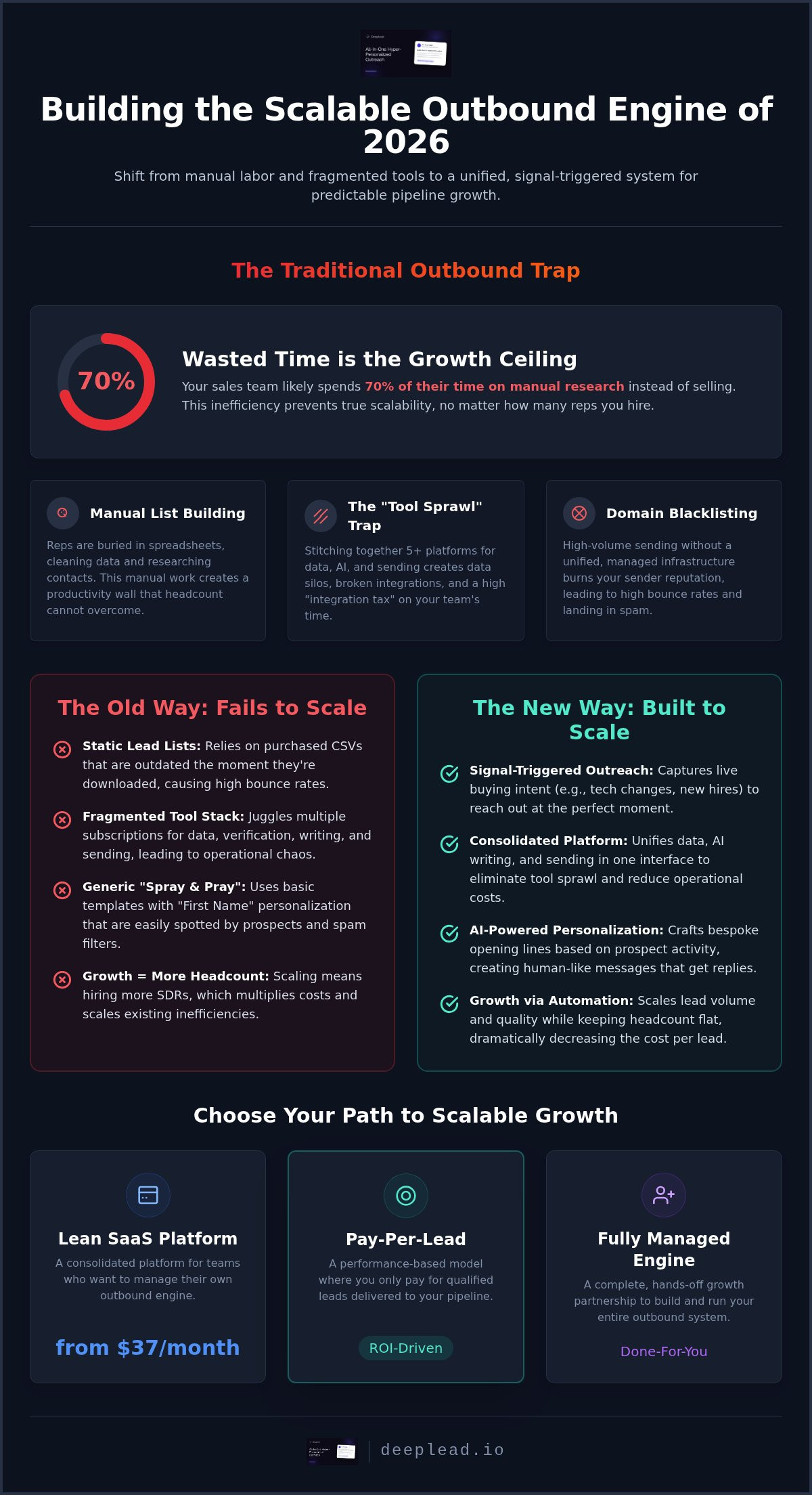
Your sales team likely spends 70% of their time on manual research instead of actually selling. It's a common trap where growth traditionally means hiring more SDRs and paying for ten different software subscriptions. Building a scalable outbound sales solution in 2026 requires a shift from manual labor to signal-triggered automation. You need a system that handles data, writing, and sending without the friction of fragmented tools or high bounce rates.
It's frustrating to watch deliverability drop while your tech stack costs climb. You want a predictable flow of qualified replies without the headache of managing multiple vendors. This article explains the exact steps to build a high-volume outbound engine that generates pipeline without increasing your headcount. We'll cover how to consolidate your platform, leverage pre-warmed domains, and choose an ROI-driven path that scales from a $37/month entry point to a fully managed growth engine.
Key Takeaways
- Shift from static lead lists to signal-triggered outreach to capture live buying intent. This transition ensures your sales efforts are focused on prospects who are ready to engage.
- Build a scalable outbound sales solution by consolidating your data, AI writing, and sending tools into one interface. Reducing tool sprawl eliminates fragmented data and lowers operational costs.
- Protect your deliverability by using managed sending inboxes and pre-warmed domains. High-volume outreach requires a technical foundation that prevents emails from hitting the spam folder.
- Evaluate flexible scaling models ranging from lean $37/month SaaS platforms to performance-based pay-per-lead options. These paths allow you to grow your pipeline without the high cost of traditional sales development teams.
- Automate the research phase to let your reps focus on closing deals rather than manual data entry. A consolidated engine maintains quality at scale while keeping your headcount flat.
Why Traditional Outbound Sales Strategies Fail to Scale in 2026
Building a scalable outbound sales solution isn't about hiring ten more SDRs. In 2026, scalability is defined as the ability to increase lead volume while maintaining quality and simultaneously decreasing your cost per lead. Most teams hit a "productivity ceiling" because they rely on manual list building. When your reps spend hours cleaning spreadsheets, they aren't selling. This manual toil creates a wall that no amount of headcount can overcome; it simply scales the inefficiency.
The "Tool Sprawl Trap" is equally dangerous. Many companies stitch together five different platforms for data, verification, AI writing, and sending. This creates a hidden "integration tax" where hours are lost syncing data between silos and fixing broken API connections. Even worse, high-volume sending without a consolidated infrastructure often leads to domain blacklisting. If your tools don't talk to each other, you risk burning your sender reputation before you even book a meeting. Without a unified system, your cost per lead actually increases as you try to scale.
The Shift from Volume to Precision
Generic templates are dead. In 2026, prospects can spot AI-generated fluff in seconds. Scalability now requires moving away from static CSV lists that age the moment they are downloaded. You need live data triggered by specific buying signals. While AI has lowered the barrier to entry for cold outreach, it has also raised the bar for what counts as a quality message. Precision is the only way to maintain high response rates at scale. Relying on "spray and pray" tactics today is a fast track to the spam folder.
The Operational Cost of Fragmented Sales Stacks
Fragmented stacks suffer from rapid data decay. Third-party databases often contain outdated information. This leads to high bounce rates and ruined campaign ROI. This fragmentation also breaks your reporting. It's impossible to forecast pipeline accurately when your data is spread across disconnected tools. Understanding the foundational principles of sales means recognizing that operational efficiency is just as important as the sales pitch itself. If you can't see the full picture, you can't scale the engine. Every minute spent troubleshooting a tech stack is a minute lost on revenue-generating activities.
Building a Signal-Triggered Infrastructure for Predictable Growth
A predictable scalable outbound sales solution relies on timing. Most teams target prospects based on static job titles or industry codes. This is a mistake. In 2026, the difference between a reply and a bounce is a trigger signal. These signals indicate live buying intent. They tell you exactly why you should reach out today instead of next month. When you shift your focus from "who they are" to "why now," your conversion rates naturally climb.
Setting up this data foundation requires a move away from manual list building. Use AI Deal Explorers to scan for accounts showing high-value activity across the web. These tools act as a filter, identifying prospects who are actively solving the problems your product addresses. Integrating this intent data directly into your sending engine eliminates the friction of manual uploads and data cleaning. The system acts on live data instantly, ensuring your outreach is always relevant and timely.
Identifying High-Value Intent Signals
Effective triggers go beyond basic company updates. Track technographic changes to see when a prospect installs or removes a competitor's software. Monitor executive moves or aggressive hiring patterns in specific departments. These are growth indicators that signal a budget shift or a new strategic direction. Use live B2B database triggers to launch automated campaigns the moment these events occur. This ensures your message arrives when the problem is top of mind for the decision-maker. It transforms your outreach from an interruption into a timely solution.
AI-Powered Personalization at Scale
Personalization shouldn't be a bottleneck for growth. Stop using basic "First Name" tags that look obviously automated. Use AI to research and write bespoke opening lines based on a prospect's recent activity or public statements. This creates a human-like tone that bypasses modern spam filters. AI can summarize complex company reports or recent social posts into a single, relevant sentence. If you want to see how this works in practice, you can explore automated intent triggers to start building your own high-volume engine. This level of detail makes your sequence feel bespoke even when it's running for thousands of leads. It's the only way to maintain quality while increasing your outreach volume.
Comparing Scalability Models: SaaS vs. Pay-Per-Lead vs. Managed Services
Scaling your outreach doesn't always mean hiring more people. You have three distinct paths to build a scalable outbound sales solution based on your current resources and goals. Each model offers a different balance of control, risk, and speed. Understanding these options helps you avoid the trap of over-hiring before your process is proven. You can choose to manage the engine yourself, pay only for results, or outsource the entire function.
The self-serve SaaS model is the most accessible entry point. Starting at $37/month, it provides the core infrastructure needed for high-volume outreach. This includes a built-in verified database and warmed-up inboxes. It's designed for teams that want to keep their operations lean while maintaining full control over every campaign detail. You get the tools to build your own engine without the high overhead of a traditional sales stack.
When to Choose a Subscription-Based Platform
This model is ideal for founders and small teams who need to iterate quickly. You can test new niches and messaging styles without waiting for an external agency to catch up. Leveraging automated lead generation software simplifies your daily workflow. It handles the data enrichment and sending, so you only focus on the strategy. Because the data is verified within the platform, you eliminate the cost of third-party verification tools and reduce software overhead.
The performance model offers a zero-risk approach to scaling. You pay only for qualified replies, typically between $50 and $150 per lead. This model is perfect for businesses with a clear understanding of their customer lifetime value and a desire for predictable costs. It removes the uncertainty of outbound by tying your investment directly to tangible sales opportunities.
The Business Case for Pay-Per-Lead Outbound
Paying per qualified reply eliminates the "empty spend" problem associated with traditional marketing. You aren't paying for clicks or impressions; you're paying for conversations. This model scales linearly with your revenue. If you need ten more meetings this month, you simply increase your lead order. Compare this to a full-time SDR salary, which carries fixed costs regardless of performance. Pay-per-lead turns your outbound function into a variable cost that you can toggle based on your sales capacity.
For companies that want to outsource the entire function, managed services at $3,000/month provide a "Done-For-You" experience. This includes managed sending inboxes and pre-warmed domains to protect your reputation. It is the fastest way to deploy a scalable outbound sales solution without managing the technical setup yourself. You simply show up to the meetings while the engine generates the pipeline in the background.
5 Steps to Deploy a Scalable Outbound Engine Without Tool Sprawl
Building a scalable outbound sales solution requires a methodical approach. You don't need a bloated tech stack; you need a streamlined engine that functions as a single unit. Follow these five steps to deploy your system without the burden of tool sprawl. This process moves you from manual research to an automated, high-volume pipeline that maintains quality at every stage.
- Step 1: Consolidate your tech stack into a single B2B outreach platform.
- Step 2: Provision and warm up dedicated sending domains to protect deliverability.
- Step 3: Define your Ideal Customer Profile (ICP) using AI-driven research.
- Step 4: Build intent-based sequences that trigger automatically.
- Step 5: Use a unified inbox to manage replies and sync qualified leads to your CRM.
Step 1 & 2: Infrastructure and Deliverability
Never send cold emails from your primary company domain. This is a common mistake that can jeopardize your entire business communication. Instead, provision secondary domains specifically for outreach. Warming up these inboxes ensures your messages land in the primary folder rather than the spam tab. Aim for a 95%+ deliverability rate by gradually increasing your daily volume over several weeks. Domain warming is a critical safety measure that builds trust with email providers to ensure high deliverability at scale.
Step 3 & 4: Data-Driven Campaign Execution
Define your ICP using AI Deal Explorers. These tools filter for companies with actual buying power by analyzing live market data and intent signals rather than static lists. Move away from generic outreach by setting up "if-this-then-that" logic for your sequences. For example, if a prospect installs a new software or hires a key executive, the system triggers an automated, relevant sequence. This focus on consolidation is why modern Outreach.io alternatives are gaining traction. They prioritize automation that works without manual oversight, allowing you to scale volume without adding headcount.
Manage all replies in a unified inbox. This prevents leads from falling through the cracks during the handoff to your CRM. Syncing qualified leads directly to HubSpot, Salesforce, or Pipedrive keeps your pipeline data clean and your forecasting accurate. You can start building your outreach engine today with a platform that handles data, AI writing, and sending in one place. This integrated approach ensures your scalable outbound sales solution remains efficient as your lead volume grows.
Consolidating Your Pipeline: Why Deeplead is the Ultimate Scalable Solution
Deeplead provides a scalable outbound sales solution by unifying the three core pillars of outreach: data, AI writing, and sending. Most teams waste hours jumping between a database provider, an email verification service, and a separate sending platform. This fragmentation creates data decay and technical friction. Deeplead replaces this mess with a single interface. It includes a built-in verified database and warmed-up inboxes, meaning you don't need to purchase or manage separate warm-up tools.
The platform offers a clear path for growth. You can start small and scale as your revenue allows. Whether you're a solo founder on a $37/month plan or an enterprise requiring a $3,000/month managed powerhouse, the infrastructure remains the same. Once you identify a winning campaign, you can push qualified leads directly into HubSpot, Salesforce, or Pipedrive. This seamless CRM integration ensures your sales reps spend their time closing deals rather than manually updating lead statuses.
A Minimalist Approach to High-Performance Sales
Complexity is the enemy of scale. Deeplead utilizes a minimalist interface designed to reduce rep burnout and focus on results. Instead of navigating dozens of menus, you focus on the signals that matter. The AI-researched email writing maintains high response rates by providing context that generic templates miss. This efficiency allows you to maintain quality even as your volume increases. For those who want to eliminate risk entirely, performance-based lead gen is the "final boss" of outbound. You only pay for qualified replies, turning your sales development into a predictable, ROI-driven engine.
Next Steps: Launching Your First Scalable Campaign
Validation is the first step toward a scalable outbound sales solution. Start with the self-serve plan for $37/month to test your messaging and refine your ICP. Once you see a consistent flow of replies, you can transition to the pay-per-lead model to accelerate growth without hiring more staff. This progression ensures you only spend more as you generate more. You can Start scaling your outbound with Deeplead today and replace your fragmented tools with a single, high-performing engine.
Future-Proof Your Pipeline with Signal-Triggered Outreach
Scaling your sales function in 2026 requires more than just high-volume sending. It demands a shift toward consolidated, signal-triggered automation that replaces fragmented tool stacks. By moving away from manual research and adopting a unified engine, you eliminate the productivity ceiling that stalls growth. A true scalable outbound sales solution integrates your data, personalization, and deliverability into a single workflow. This approach keeps your headcount flat while your pipeline expands.
You don't need to over-engineer your outreach to see results. Deeplead offers everything you need to start, including a built-in verified B2B database and warmed-up inboxes starting at $37/month. With AI-powered auto-responders handling the initial engagement, your team can focus exclusively on closing. Whether you are validating a new niche or outsourcing your entire function, the path to predictable growth is now accessible. Build your scalable outbound engine with Deeplead today. Your future pipeline depends on the infrastructure you build now.
Frequently Asked Questions
What is the most scalable outbound sales solution for a startup?
The most efficient option is a consolidated platform that combines B2B data, AI writing, and automated sending. Startups benefit from a $37 per month self-serve model because it eliminates the need for multiple expensive subscriptions. This approach allows a single founder to manage high-volume outreach without hiring a full sales team. It is the fastest way to validate messaging before moving to more expensive managed services or performance-based models.
How much does it cost to scale an outbound sales team?
Costs vary depending on the model you choose. A self-serve SaaS platform starts at $37 per month and includes data and warmed-up inboxes. For zero-risk growth, a pay-per-lead model costs between $50 and $150 per qualified reply. Fully managed services cost $3,000 per month. These options are significantly more affordable than hiring a full-time SDR, which requires a base salary, benefits, and a separate tech stack budget.
Can I scale outbound sales without using LinkedIn or cold calling?
Yes, you can build a highly effective scalable outbound sales solution using only email and signal-triggered data. Modern platforms use AI to research prospects and write personalized messages that bypass the need for social selling or phone dialers. By focusing on buying intent signals like hiring patterns or technographic changes, you generate a predictable pipeline through email alone. This method is easier to automate and scale than manual outreach.
What is the difference between a SaaS outbound tool and a pay-per-lead service?
A SaaS tool is a self-serve platform where you manage the campaigns, data, and writing for a fixed monthly fee. It's best for teams that want full control over their process. A pay-per-lead service is performance-based; you only pay for the qualified replies you actually receive. This model shifts the operational risk to the provider, making it ideal for businesses that want a guaranteed ROI without managing software.
How do I prevent my emails from going to spam when scaling volume?
You must use managed sending inboxes and pre-warmed domains to protect your sender reputation. Never send cold emails from your primary company domain. Instead, provision secondary domains and gradually increase your sending volume through a warming process. Integrated platforms include these warmed-up inboxes by default to ensure deliverability stays above 95%. This technical foundation is essential for maintaining high-volume outreach without being flagged by email providers.
Is AI personalization necessary for scalable outbound sales in 2026?
AI personalization is critical because generic templates no longer bypass modern spam filters. Prospects can easily identify "spray and pray" tactics, which leads to lower response rates. AI researches a prospect's recent activity to write bespoke opening lines that feel human and relevant. This level of detail is necessary to maintain high engagement at scale. It allows you to send thousands of emails that feel like they were written individually.
How long does it take to see results from a scalable outbound solution?
Results typically appear within the first 30 days after your domains are warmed and your messaging is validated. The first two weeks focus on infrastructure setup and ICP research. Once your signal-triggered sequences go live, you should start seeing qualified replies within days. The speed of results depends on how quickly you can iterate on your messaging based on the initial feedback from your target audience.
What is a qualified reply in a pay-per-lead model?
A qualified reply is a response from a prospect who matches your Ideal Customer Profile and expresses interest in a meeting or more information. This excludes out-of-office replies, "not interested" messages, or responses from people outside your target criteria. In a performance-based model, you only pay for these high-value interactions. This ensures every dollar spent is tied directly to a potential sales opportunity that can move into your pipeline.