Six Step Lead Qualification Framework for B2B Sales Teams

A lead qualification framework is a repeatable set of criteria for deciding which prospects deserve sales time and which don’t yet. One action to take now: match your framework to your deal size and sales motion, score leads on a 1 to 100 scale, and back it with a defined ICP and a routing SLA. Everything else is calibration.
TL;DR:
- Matching your qualification framework to deal size and sales motion improves routing accuracy and helps reps focus on leads with real closing potential.
- Using a 1 to 100 lead scoring system based on firmographic and behavioral signals enables meaningful prioritization and better resource allocation.
- Implementing a one-hour speed-to-contact SLA significantly increases the likelihood of converting qualified leads into opportunities.
- Choosing the appropriate qualification framework depends on deal complexity and buyer research level, with mid-market and enterprise sales requiring more detailed models.
- Regular calibration and monitoring of qualification and scoring processes prevent pipeline leaks and ensure alignment with evolving target customer profiles.
Table of Contents
- What Lead Qualification Frameworks Actually Do (And Why B2B Teams Need One)
- The Main Lead Qualification Frameworks, Side by Side
- Lead Scoring: Turning Qualitative Signals Into a 1-100 Number
- Building an Operational Framework: The 6-Step Checklist
- Matching the Framework to Your Deal Size and Sales Motion
- Mistakes That Wreck Qualification, and Week-One Fixes
- Operational Benchmarks and Where Automation Fits In
- The One Change That Moves the Needle Fastest
- Sources
What Lead Qualification Frameworks Actually Do (And Why B2B Teams Need One)
A lead qualification framework forces you to answer four questions before a rep spends an hour on a prospect: Does this company fit your ideal customer profile? Does the buyer have real intent? Do they have budget authority? Is the timing right? Ad hoc judgment answers these inconsistently from rep to rep. A framework makes the answer repeatable.
The payoff shows up in three places. Reps stop chasing companies that will never close. Marketing and sales stop arguing about what “qualified” means, because the definition is written down and shared. And routing gets faster, which matters more than most teams assume: speed to contact is one of the strongest predictors of whether a lead converts at all. The moment you formalize qualifying sales leads instead of leaving it to gut feel, that first phone call or email stops being random.
Here’s what a working framework clarifies for every lead that enters your pipeline:
- Fit: Does the account match your ICP on firmographics like size, industry, and tech stack?
- Intent: Is the buyer actively researching a solution, or just browsing?
- Authority: Can this person actually approve a purchase, or are they gathering information for someone else?
- Timing: Is there a triggering event, budget cycle, or deadline pushing urgency?
Skip any one of those four and you get a pipeline full of leads that look promising and never close.
The Main Lead Qualification Frameworks, Side by Side
Every major B2B qualification framework asks a version of the same four questions. What changes is the order, the emphasis, and how many stakeholders each one assumes you’re dealing with. Highspot’s sales checklist frames this as matching the framework to deal size and motion rather than picking whatever’s trendy. Here’s how the main options break down.
-
BANT (Budget, Authority, Need, Timeline). Built for transactional, lower-touch B2B sales where the buying process involves one or two people. The core question: “Can this person buy, and will they buy soon?” Capture it in CRM as a single qualification field with four sub checkboxes. Skip BANT when you’re selling into an enterprise with a ten-person buying committee. It flattens too much nuance for that.
-
MEDDIC (Metrics, Economic Buyer, Decision Criteria, Decision Process, Identify Pain, Champion). Built for complex, enterprise deals with long cycles and multiple approvers. The core question: “Who actually signs, and what does success look like to them in numbers?” Capture the Economic Buyer’s name and the Champion’s name as required CRM fields. Skip MEDDIC for self-serve or SMB motions. It’s overkill for a $2,000 annual deal and will slow your reps down for no reason.
-
CHAMP (Challenges, Authority, Money, Prioritization). Built for buyer-led mid-market SaaS, where prospects arrive already aware of their problem. The core question: “What challenge brought you here, and how urgent is solving it?” Capture the stated challenge verbatim in a free-text CRM field, since that language is gold for later messaging. Skip CHAMP when your buyers don’t self-identify a challenge. Cold outbound into unaware markets doesn’t fit this model well.
-
GPCTBA/C&I (Goals, Plans, Challenges, Timeline, Budget, Authority, Negative Consequences, Positive Implications). An expanded, consultative version built for complex sales where you need to build a business case alongside the buyer. The core question: “What happens if you do nothing, versus what happens if this works?” Capture Negative Consequences and Positive Implications as two separate notes fields; they double as your close deck talking points. Skip this one for short sales cycles. It’s too heavy for anything under a 30-day cycle.
-
FAINT (Funds, Authority, Interest, Need, Timing). Built for category-creation or innovation deals where the buyer may not yet have budget allocated for something entirely new. The core question: “Is there money somewhere in this organization, even if it isn’t earmarked yet?” Capture “Funds Identified: Yes/No/Unclear” as a dedicated field, since that distinguishes FAINT from BANT. Skip FAINT if you’re selling an established, budgeted category like payroll software. Buyers already have a line item for you.
-
SPICED (Situation, Pain, Impact, Critical Event, Decision). Built for consultative sellers working accounts where buyers are sophisticated and already deep into their own research. The core question: “What critical event is forcing a decision now, and who owns that decision?” Capture the Critical Event date as a CRM field, since it becomes your natural forecast anchor. Skip SPICED for transactional, high-volume motions. The discovery depth it demands doesn’t scale to hundreds of leads a week.
Pro Tip: Don’t marry one framework forever. Many mid-market teams run BANT for inbound demo requests and MEDDIC for anything over a certain contract value, sorted automatically by deal size in the CRM.
The frameworks reorder the same underlying signals, fit, authority, intent, and timing, because different buyers reveal those signals in a different sequence. A self-aware enterprise buyer walks in with Decision Criteria already formed (MEDDIC territory). A buyer discovering a brand-new category doesn’t even know their budget exists yet (FAINT territory). Picking the wrong order means asking questions your buyer isn’t ready to answer, which is why “qualification calls” so often feel like interrogations instead of conversations.
Lead Scoring: Turning Qualitative Signals Into a 1-100 Number
Most B2B teams that formalize lead assessment criteria land on a 1 to 100 scoring scale, and for good reason: it’s granular enough to rank leads meaningfully but simple enough for reps to act on without a data science degree. Business confirms this is the dominant industry pattern, built by combining two distinct signal types.
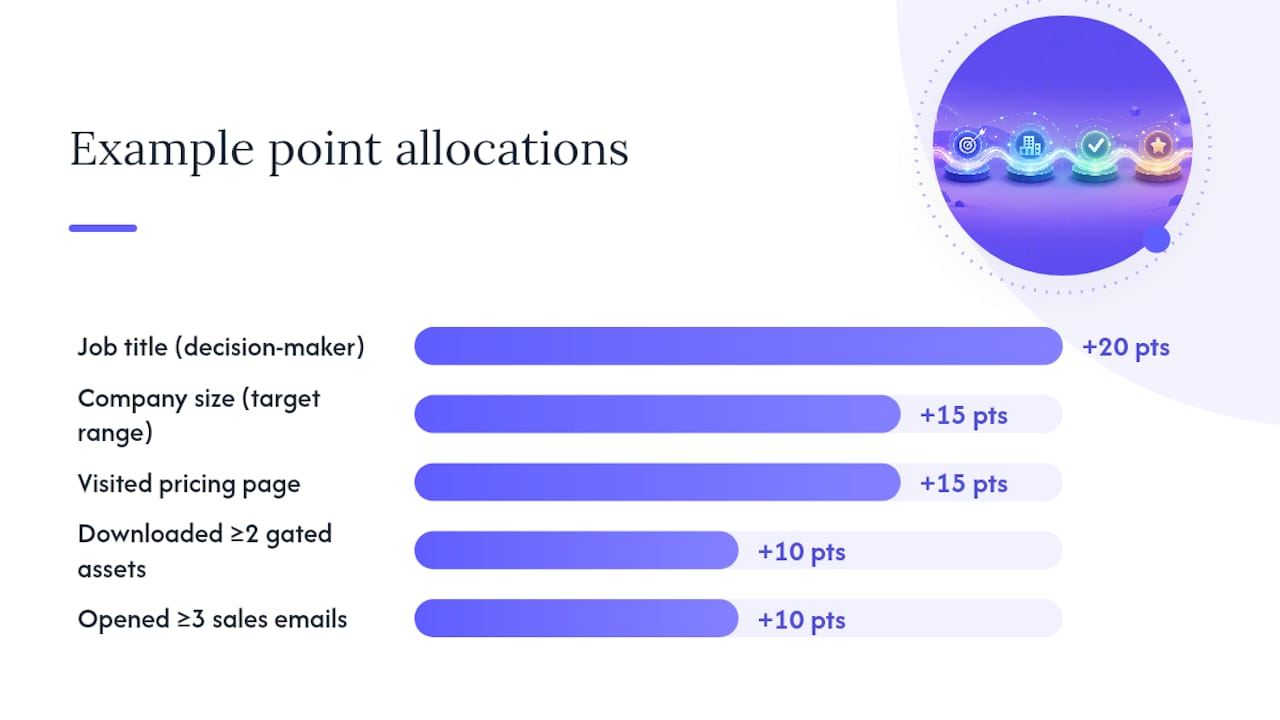
Fit scoring measures firmographic match: company size, industry, job title, tech stack. Engagement scoring measures behavior: website visits, content downloads, email opens, demo requests. A illustrative point allocation might look like this:
- Job title matches decision-maker persona: +20 points
- Company size within target range: +15 points
- Visited pricing page: +15 points
- Downloaded two or more gated assets: +10 points
- Opened three or more sales emails: +10 points
- Generic personal email domain: -25 points
Some teams pair a fit grade (A through D) with the numeric engagement score rather than folding everything into one number. ZoomInfo’s guide recommends exactly this: grade for fit, score for intent, then route based on the combination. A high-fit, low-engagement lead gets a different follow-up than a low-fit, high-engagement one, even if their raw scores happen to match.
Predictive scoring is the advanced tier, where machine learning models analyze your historical closed-won and closed-lost data to weight signals automatically instead of relying on a static point sheet. Salesforce’s Einstein Lead Scoring documentation positions this as valuable once you have enough historical volume and reliable data to train on, but it needs continuous monitoring to keep sales trusting the score.
ZoomInfo recommends testing that threshold over a 30 to 90 day live window before treating it as final.
Building an Operational Framework: The 6-Step Checklist
A framework on a slide deck does nothing. It has to live in your CRM, your routing rules, and your reps’ daily queue. Here’s the sequence.
-
Define your ICP and buyer roles. Write down firmographic criteria (industry, size, revenue band) and the specific job titles that can buy. Vague ICPs produce vague scores downstream.
-
Pick a framework and translate it into CRM fields. Whichever framework you choose, HubSpot Academy’s lead qualification lesson stresses turning each acronym letter into an actual CRM property, not just a mental checklist reps are supposed to remember.
-
Design scoring rules and set an initial threshold. Use the 80% closed-won benchmark described above as your starting MQL cutoff, then document exactly how each point gets earned.
-
Set routing rules and a response SLA. Once a lead crosses the MQL threshold, route it to the right rep automatically and enforce prompt contact as soon as possible. Sendspark’s B2B qualification guide treats this ICP plus scoring plus SLA combination as the minimum viable system, not an optional extra.
-
Run a 30 to 90 day calibration window. Watch how scored leads actually convert, then adjust point weights where the data disagrees with your assumptions.
-
Build ongoing governance. Assign someone to own the scoring model, review it quarterly, and keep marketing and sales aligned on what “qualified” means as your ICP shifts.
Pro Tip: On launch day, pull a report of every lead sitting above your MQL threshold that hasn’t been contacted in over an hour. If that list isn’t empty, your routing rule is broken, not your scoring model.
Track MQL to SQL conversion and SQL to opportunity conversion weekly during calibration. Those two ratios tell you faster than anything else whether your thresholds are set correctly.
Matching the Framework to Your Deal Size and Sales Motion
Choosing among BANT, MEDDIC, CHAMP, FAINT, and SPICED comes down to two variables: how many people approve the purchase, and how much of their own research the buyer has already done before talking to you.
- BANT fits transactional, SMB-focused motions with one or two decision-makers and short cycles.
- CHAMP fits mid-market SaaS where buyers arrive self-aware of their problem and want a consultative conversation.
- MEDDIC fits enterprise deals with formal procurement, multiple stakeholders, and long cycles measured in quarters.
- FAINT fits category-creation sales where budget doesn’t exist yet and you’re building the case for a new line item.
- SPICED fits consultative sellers working sophisticated buyers who’ve already done deep research and need a critical event to trigger urgency.
Highspot’s framework guidance reinforces this mapping directly: qualification only works when it’s aligned to your actual buying committee and routing process, not applied uniformly across every segment. Before rolling any framework out company-wide, test it against a single segment, one product line or one region, for a full sales cycle. Watch whether the CRM fields you built actually get filled in consistently; a framework reps skip is worse than no framework at all.
Mistakes That Wreck Qualification, and Week-One Fixes
The same handful of errors show up across most B2B pipelines. Fixing them doesn’t require new software, just discipline.
- Treating the framework as a script. Reps read questions verbatim and buyers disengage. Fix: train reps to hit the same signals through natural discovery conversation, not a checklist read aloud.
- Disqualifying too early. A “no budget yet” answer gets marked dead instead of nurtured. Fix: reframe early-stage no’s as nurture-track leads with a follow-up date, not closed losses.
- Ignoring the buying committee. One enthusiastic contact gets treated as the whole deal. Fix: require reps to map at least two additional stakeholders before a lead advances past SQL.
- No SLA on routing. Qualified leads sit in a queue for days. Fix: instrument an alert that flags any MQL untouched after one hour.
Pro Tip: Watch three numbers weekly: MQL acceptance rate, speed to contact, and lead to opportunity conversion. A dip in any one usually points to exactly which mistake above just crept back in.
Operational Benchmarks and Where Automation Fits In
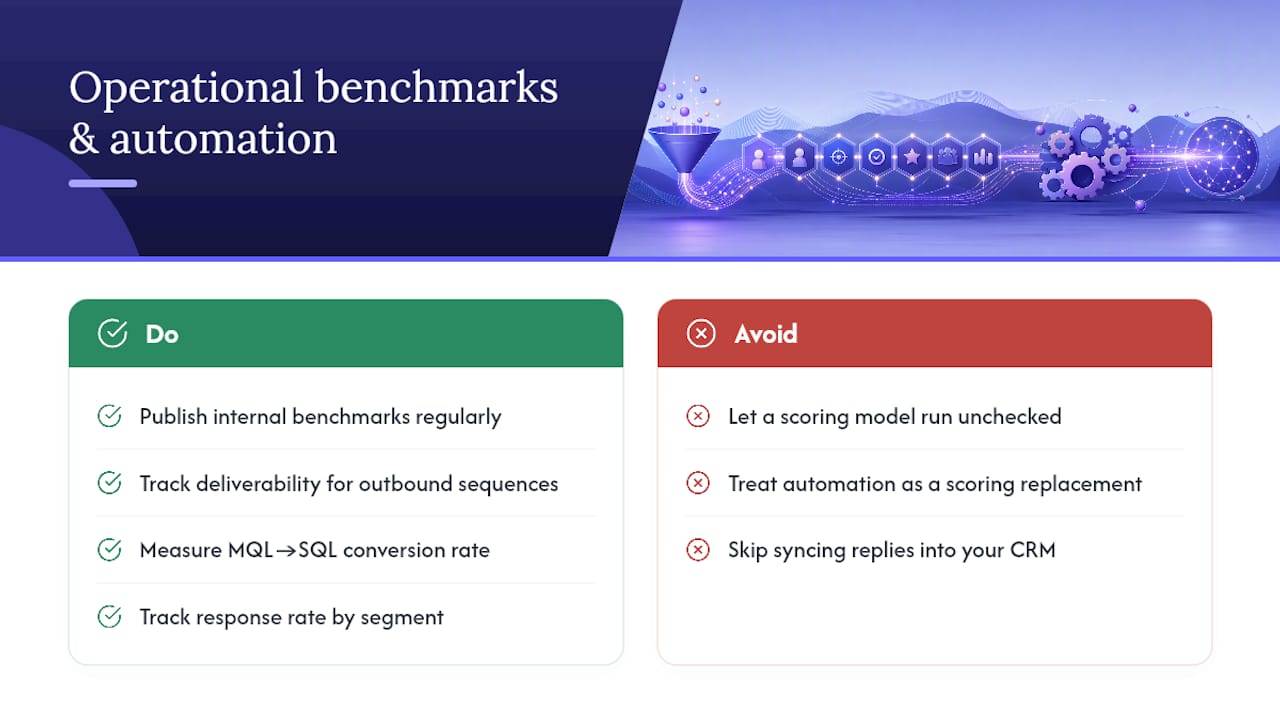
Publishing internal benchmarks keeps qualification honest. Track deliverability on outbound sequences, MQL to SQL conversion rate, and response rate by segment, and review them on the same cadence you review pipeline. Teams that skip this tend to keep running a scoring model long after it’s stopped matching reality.
Automation increasingly handles the mechanical half of this work; learn how AI-driven signals and SEO can increase high-intent inbound leads for your lead generation. Deeplead combines verified contact data, AI-researched personalized emails, warmed sending inboxes, and a unified reply inbox with AI auto-responders in one system, which matters for qualification because faster, more relevant first contact is exactly what pushes a lead across an engagement threshold sooner. Growth-tier signal campaigns can trigger outreach the moment a buying signal appears, and replies sync directly into HubSpot, Salesforce, Pipedrive, or any CRM connected by webhook, keeping your qualification fields populated without manual entry. None of that replaces a scoring model. It just removes the friction between “this lead is qualified” and “this lead has been contacted.”
The One Change That Moves the Needle Fastest
If you only fix one thing this quarter, fix speed to contact. Run a seven-day experiment: pull every lead crossing your MQL threshold and route it to a rep with a hard one-hour contact SLA, then compare that cohort’s SQL conversion against the prior month’s baseline. Teams that run this test almost always find the lift comes less from a smarter scoring model and more from simply not letting qualified leads go cold.
The conventional wisdom overweights framework selection. Reps argue for weeks about BANT versus MEDDIC when the bigger leak in most pipelines is a qualified lead sitting untouched for six hours. Pick a reasonable framework, get the scoring roughly right, and then obsess over the clock. That’s where the actual gains hide.
Test the one-hour SLA on a single segment before rolling it everywhere, measure the conversion delta honestly, and let the number decide whether it’s worth scaling.
— Julian