B2B Buyers: Outsourced Lead Generation Costs, 60 to 90 Day Pilot
Outsourced lead generation makes sense once your team needs pipeline faster than you can hire and train SDRs, or when you lack the tools and data infrastructure to run outbound at scale. Expect starting costs commonly begin in the low thousands per month for managed programs, or typically range from tens to low hundreds of dollars per qualified reply on pay-per-lead deals. First qualified meetings generally appear within one to three months. The smartest move: run a 60 to 90 day pilot with written acceptance criteria before you sign anything longer.
TL;DR:
- Outsourcing lead generation is most effective for rapidly scaling pipeline when internal resources, tools, or expertise are limited, often costing thousands monthly.
- A pilot program of 60 to 90 days with clear acceptance criteria helps evaluate vendor quality, data accuracy, and communication alignment before long-term commitments.
- Combining cold email with LinkedIn outreach and intent data improves response rates, but a proper CRM handoff with detailed context is essential for sales follow-up.
- Pay-per-lead models cost between $50 and $150 per qualified reply, but hidden costs like data refreshes and deliverability support can inflate the total expense.
- Running a controlled pilot, tracking five key KPIs weekly, and defining success criteria upfront help ensure measurable ROI within six to nine months.
Table of Contents
- Pros and Cons of Outsourcing Lead Generation
- Pricing Models and What They Really Cost
- How Outsourced Lead Generation Programs Actually Work
- Decision Framework: How to Choose and Run a Pilot
- Timeline, KPIs, and Expected ROI Scenarios
- Risks, Compliance, and Quality Controls
- An All-in-One Alternative to Multi-Vendor Outsourcing
- Try Deeplead Before You Sign a Longer Contract
- What I’d Actually Watch For in Your First 90 Days
- Sources
Pros and Cons of Outsourcing Lead Generation
Speed is the biggest draw. A specialized vendor can activate campaigns in weeks, not the months it takes to hire, train, and ramp an in-house SDR. You also get access to specialist skills, established intent-monitoring tools, and sending infrastructure that would otherwise take real investment to build. When volume needs change, scaling a vendor contract up or down is faster than hiring or laying off staff.
The tradeoffs are real too. You give up some direct control over messaging and cadence. Onboarding takes work: your ideal customer profile, objection handling, and competitive positioning all have to get transferred to people who don’t live inside your business every day. Brand voice mismatches happen when a vendor’s copywriters haven’t absorbed how your company actually talks to prospects. Quality also varies wildly between providers, which is why a pilot period matters more here than in almost any other outsourced function.
A hybrid model often works best: keep strategy, ICP definition, and lead scoring in-house, while a vendor or platform handles data sourcing, outreach execution, and inbox management. This preserves your institutional knowledge of what a good lead looks like while offloading the operational grind.
Before committing, ask yourself:
- Do we have a documented ICP and messaging framework a vendor could actually execute against?
- Can we commit to weekly review calls for at least the first 60 days?
- Is our CRM clean enough to receive handed-off leads without manual cleanup?
- Would a bad quarter from a vendor set back our pipeline more than a bad quarter from an unfilled SDR role?
Pricing Models and What They Really Cost
Three pricing structures dominate outsourced lead generation, and all shifts risk differently between you and the vendor.
- Monthly retainer. You pay a fixed fee regardless of output volume, usually in exchange for a set number of campaigns, sending seats, or hours of strategic work. Retainer programs often start in the low thousands per month, scaling up with team size and channel complexity.
- Pay-per-lead (CPL). You pay only for qualified replies or meetings that meet agreed criteria, commonly landing between $50 and $150 per qualified reply depending on how strict “qualified” gets defined. This shifts more risk onto the vendor, which is why CPL programs tend to define “qualified” narrowly.
- Outcome-based or hybrid. A smaller base fee covers infrastructure and setup, with bonuses tied to meetings booked or opportunities created. This splits risk and works well once you’ve validated a vendor through a pilot.
Sticker price rarely tells the whole story. Watch for hidden costs: data refresh fees when contact lists go stale, deliverability remediation if sending domains get flagged, CRM integration charges, and the internal management time required to review leads and give feedback. A retainer that looks cheap on paper can cost more once you factor in the hours your team spends coaching the vendor.
Before signing, ask every vendor: What exactly counts as a “qualified” lead in the pricing tier we’re paying for? Who owns the contact data after the contract ends? What happens if reply rates fall below an agreed floor? Answers to these three questions expose more about true cost than the rate card does.
How Outsourced Lead Generation Programs Actually Work
Most outsourced programs follow a similar operational sequence, whether you’re working with a boutique agency or a self-serve platform.
- ICP discovery. The vendor maps your ideal customer profile, target titles, and firmographic filters.
- List building and verification. Contacts get pulled from databases and checked for accuracy so you’re not burning sending reputation on dead emails.
- Messaging. Copy gets drafted, often personalized per recipient rather than blasted as one template.
- Inbox warmup and sending. Domains and inboxes get gradually warmed before full-volume sending begins, protecting deliverability.
- Reply handling and qualification. Responses get sorted, and genuine interest gets separated from out-of-office replies or outright rejections.
- CRM handoff. Qualified conversations move into your sales pipeline with context attached.
Channel mix matters. Programs that combine cold email with LinkedIn outreach and intent-signal monitoring generally outperform single-channel email campaigns, since prospects respond to different channels depending on where they are in their buying process. Intent data, in particular, can flag companies actively researching solutions like yours before they ever fill out a form, letting reps prioritize outreach toward people already in-market.
A clean handoff to sales isn’t optional. At minimum, every lead should arrive in your CRM with the prospect’s role, the specific pain point they mentioned, the channel that generated the reply, and a timestamp. Handoffs missing this context routinely get ignored by sales reps within a day.

Decision Framework: How to Choose and Run a Pilot
Evaluate every proposal against six criteria: ICP fit, channel coverage, data quality, reporting cadence, service-level agreements on qualified meetings, and CRM integration capability. A vendor who can’t explain how they’ll verify data accuracy or produce weekly pipeline metrics isn’t ready for your budget.
Watch for red flags before you sign anything:
- Vague or infrequent reporting with no visibility into reply rates or list quality.
- Refusal to share a sample of the contact list or messaging they’d use.
- Guaranteed volumes that sound too good given your industry and price point.
- No explicit terms on who owns the contact data once the contract ends.
Structure your pilot around a defined scope and a hard stop date, ideally 60 to 90 days. Set acceptance criteria upfront: a minimum number of qualified meetings, a lead quality bar sales agrees to honor, and a governance rhythm of weekly check-ins. Short, tightly scoped pilots with measurable criteria consistently give buyers a clearer read on fit than open-ended contracts do, since neither side is locked into assumptions that turn out wrong three months in.
Pro Tip: Write the data export and transfer terms into the pilot contract before you sign, not after you decide to leave. Vendors are far more cooperative about handing over contact data and campaign history when it’s a contractual obligation rather than a favor you’re asking for on your way out.
Timeline, KPIs, and Expected ROI Scenarios
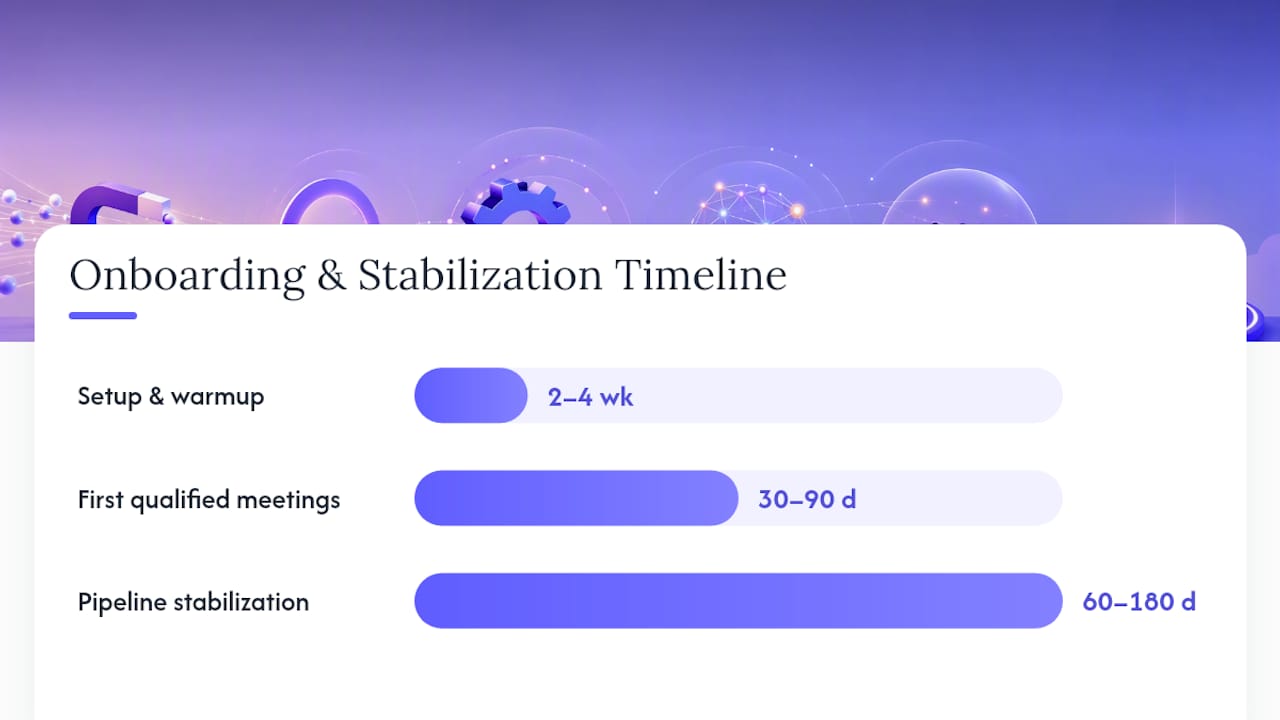
Setup and inbox warmup typically take two to four weeks before meaningful sending volume begins. First qualified meetings usually appear within 30 to 90 days, and pipeline flow tends to stabilize somewhere between 60 and 180 days depending on your sales cycle and market.
Track five numbers every week: qualified meetings booked, reply rate, MQL to SQL conversion, customer acquisition cost per SQL, and pipeline velocity. These five tell you more about program health than total leads generated ever will.
For rough ROI math, divide your monthly spend by the number of SQLs produced to get cost per SQL, then compare that against average deal size and close rate. If a $3,000 monthly program produces 10 SQLs and your close rate on SQLs runs at 20% with an average deal size of $15,000, that’s $30,000 in expected revenue against $3,000 spent. Well-run B2B lead generation programs typically deliver 3 to 5 times ROI within 6 to 9 months, with SQL flow often stabilizing in the 60 to 90 day window. Demand a dashboard that updates weekly, not a summary email that arrives once a month.
Risks, Compliance, and Quality Controls
Deliverability failures are the most common way outsourced programs quietly underperform. Insist on documented domain warmup schedules and dedicated sending infrastructure rather than shared IP pools.
Data handling deserves equal scrutiny. Cybersecurity incidents carry serious business consequences, so require any vendor touching your contact data to show clear security protocols, opt-out handling, and data deletion processes. This isn’t legal advice, but it’s a baseline question every procurement conversation should include.
Push for concrete quality controls before signing:
- Email and phone verification on every contact before outreach begins.
- Human review of replies, not just automated categorization.
- Documented suppression list hygiene to avoid re-contacting opted-out prospects.
- Contract language covering SLA remediation and full data export rights on termination.
An All-in-One Alternative to Multi-Vendor Outsourcing
Instead of stitching together separate providers for data, copywriting, sending infrastructure, and inbox management, some teams choose a single platform that handles all of it. Some platforms bundle contact data, personalized emails, sending inboxes, and a unified reply inbox into one system.
The integration payoff is concrete: fewer handoff points means fewer places for context to get lost, and replies can sync directly into popular CRMs through webhooks. Bundling data, warmup, and sending in one system can remove integration friction that otherwise delays stabilization past 90 days.
- Some platforms offer self-serve plans designed for teams comfortable running their own campaigns with software support.
- Pay-per-lead pricing may suit teams seeking outcomes without managing tools.
- Done-for-you managed services may appeal to teams that want outreach handled entirely, more like a traditional agency relationship but with a single vendor solution.
Try Deeplead Before You Sign a Longer Contract
Some platforms provide the control benefits of running lead generation in-house without the overhead of assembling multiple separate tools by integrating verified contacts, personalized emails, sending inboxes, and a unified reply inbox into one platform, with replies syncing to CRMs.
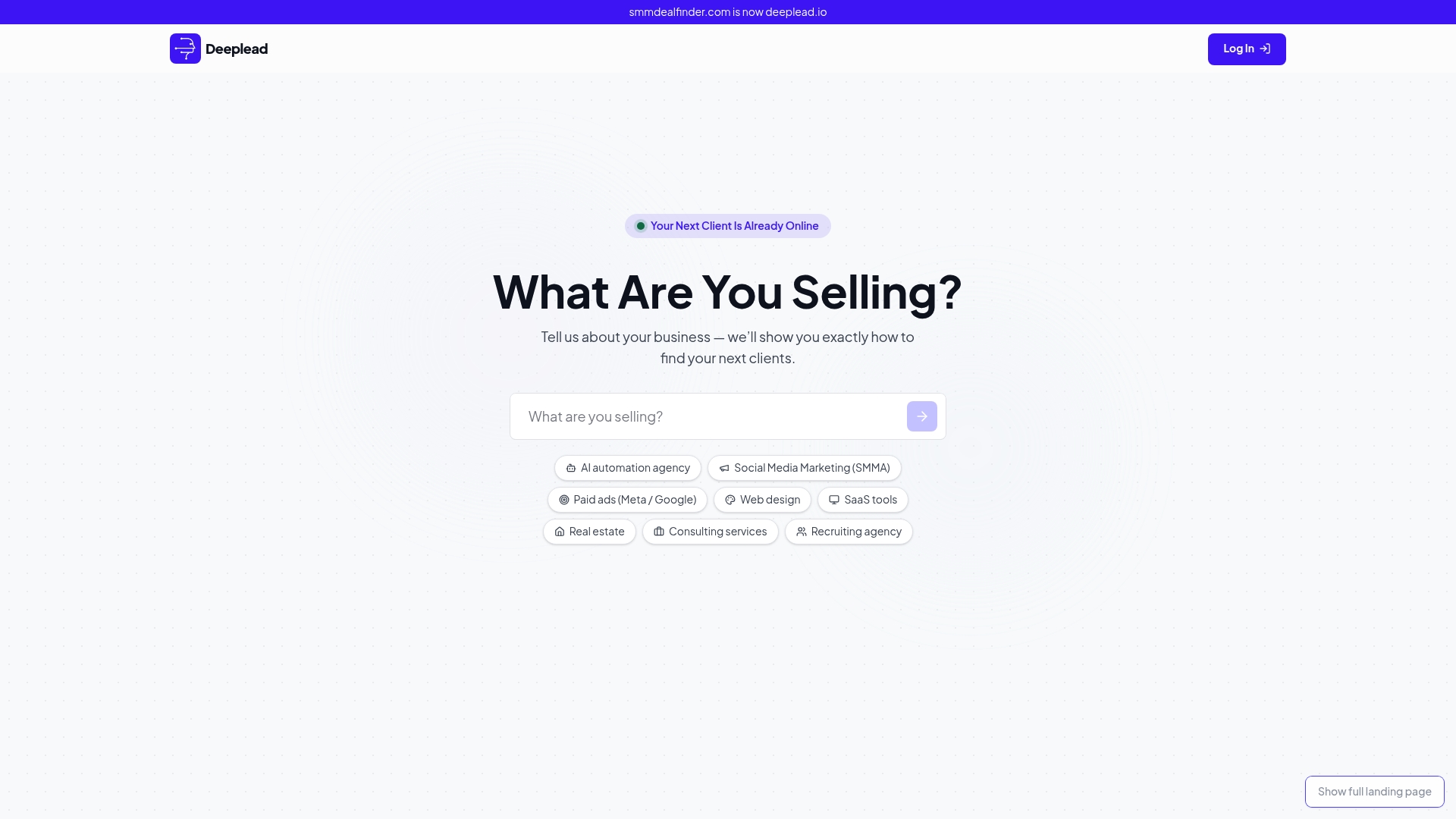
Pricing and trial options vary; some providers offer monthly plans with free trials, pay-per-lead pricing, and done-for-you managed services. Check the provider’s website for current details. If your team has the bandwidth to run campaigns with software support, start the trial. If you’d rather hand it off entirely, request a demo of Deeplead’s managed service and compare the proposal against the pilot framework above.
What I’d Actually Watch For in Your First 90 Days
My honest read: most outsourcing decisions fail not because the vendor was bad, but because nobody defined what success looked like before the contract started. Run a 60 to 90 day pilot with a written minimum for qualified meetings and a lead quality bar sales actually agrees to.
Review metrics weekly, tag every handed-off lead in your CRM by source, and personally spot-check a sample of conversations each month. Keep strategy in-house if your ICP is complex or evolving fast. Lean on an external partner when execution volume, not judgment, is the bottleneck.
— Julian