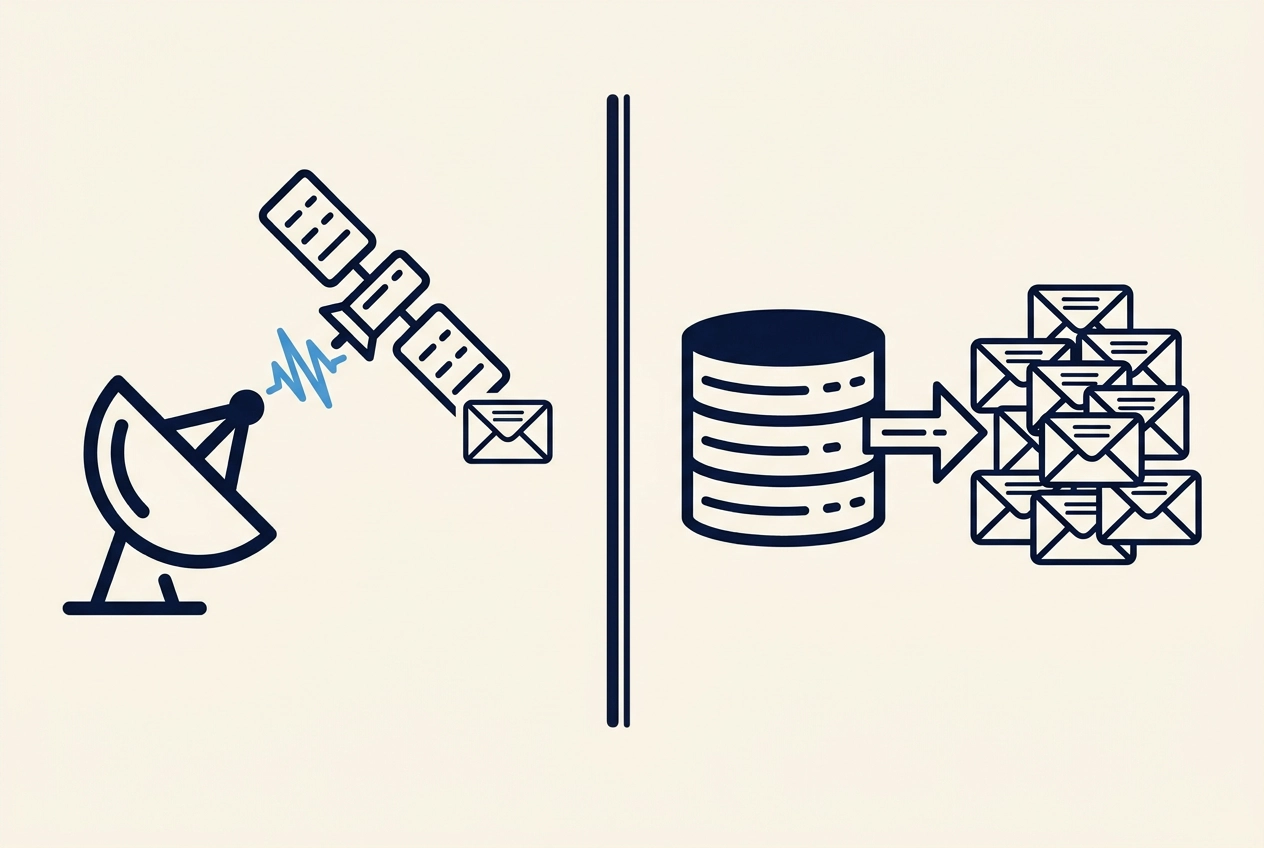
Ask an outbound operator whether list prospecting is dead and you will usually get a confident yes. Ask to see the reply data, and the confidence fades to a shrug.
The "lists are dead" argument sells well because it is a story about the future. It is not a buying decision. Signals and lists solve different problems. Signal outreach pays when your offer is triggered by a public event: a hiring post, a "looking for a tool" post, a funding announcement. List outreach wins wherever intent is invisible, which is most of your market. Run them on the same budget, at the same volume, and one of them will quietly drain a small team.
This post compares signal outreach and list prospecting side by side for linkedin b2b lead generation: the volume thresholds where each pays, the reply benchmarks each can realistically claim, what 500 emails a week actually costs in inbox capacity, and where a signals feed bankrupts a small team. We will cover the cut order when capacity runs out, and how to run both without doubling your workload. Deeplead's plan and credit details live at deeplead.io/pricing.
Why "Lists Are Dead" Is a Bad Buying Decision
Search "lists are dead" and most results sit on a page selling signal data. Autobound sells it; ZoomInfo GTM Studio, Amplemarket and SaleHive all market buying-signal or intent features. They may be right; the argument arrives with a price list attached.
Signals cost money too: a trigger feed bills monthly whether your market posted or not, caps reach at the share of your ICP with a public event, and expires in days. A feed consumed in two afternoons is outbound's quiet waste. Still weighing feeds? Our FAQ on intent data providers covers sourcing.
At 500 emails a week, fashion is irrelevant. The question is whether a hiring post or a "looking for a tool" post marks the buying moment. If it does, signals earn their cost. If intent is invisible, lists do the work.
This is a budgeting problem: two demand types, two cost structures, two reply bands, one shared constraint, inbox capacity. No published benchmark separates signal reply rates from list reply rates. Every number below carries its source, date and limitation; thin evidence is labeled judgement.
Trigger-Visible Signals vs Invisible Intent in B2B Lead Generation
Trigger-visible demand means the buyer published something that maps to your offer. Deeplead's signal campaigns find LinkedIn posts where people say they need what you sell: a public, datable event you can answer the same day. Daily monitoring is the basis of a signal-triggered infrastructure for predictable growth.
Invisible intent publishes nothing. Say a 40-person logistics firm will buy a routing tool in Q3. On a list, it looks identical to one that never will. Lists are the only route to that company and to its near-twin that buys next year.
Signals decay in days: a "hiring two SDRs" post is a buying window. A list is a permanent, if blunt, addressable market.
Signals shrink the pool: if 12,000 US companies fit your ICP and 60 post the trigger this month, your campaign caps at 60 contacts. The other 11,940 are still buyers, just invisible.
For b2b lead generation strategies, signals set precision, lists set volume. Using one approach for both starves campaigns waiting for triggers or pads the feed with matches that underperform a plain cold list.
Signal Outreach and List Prospecting Side by Side
Cost per contact: signals carry a fixed monthly trigger subscription plus monitoring labor, so one email costs what 200 cost. Lists front-load verification and research; cost per email falls as volume rises.
Reply band: Autobound, which sells signal data, reports signal-based personalization beating firmographic personalization by 3 to 5x and top SDR teams reaching 5 to 15% reply rates. Mailshake's 2026 roundup reports 3.43% average reply rate and 2.09% across 1.37M+ cold emails. Different lists, different definitions; stacking them on one scoreboard is this debate's most common mistake.
Ramp time: signals need daily monitoring and a reply within days. Lists can be built today and sent next week.
Inbox load at 500 a week: neither gets a capacity discount. At Deeplead's stated cap of 30 emails per inbox per day, that is about 4 inboxes across five sending days, 3 across six.
What kills each: signals die from a shallow trigger pool and stale windows. Lists die from bad verification, high bounce rates, and repeated targeting. Different failures, different fixes. Try Deeplead for Signal-Triggered Outreach.
How Each Approach Looks on LinkedIn and in the Inbox
Signals suit LinkedIn because posts are public and recent, which is why signal-based LinkedIn B2B lead generation works. Lists suit email, still the only channel that scales to an ICP nobody is talking about.
Autobound, a signal-data vendor, reports a 3 to 5x reply advantage for signal personalization and 5 to 15% replies for top signal-using SDR teams. Mailshake reports 3.43% average reply rate and 2.09% across 1.37M+ emails, SaaS bands: 1.5 to 3% average, 3 to 5% good, 5%+ elite, 0.3 to 1% average meetings booked. SaleHive puts B2B at 3 to 5% typical for 2025 to 2026, top quartile above 5.5%, elite above 10%, and flags bounces above 3%.
Mailshake does not name the publisher behind its 3.43% figure; SaleHive's article carries a 2018 byline under a 2026 title.
Cost rows stay "not published": no source compares cost per booked meeting, so do not estimate one. Volume is judgement: no source gives the threshold where signal volume runs out or list volume starts hurting deliverability, so set your own against bounce and positive-reply data.

What 500 Emails a Week Actually Costs in Inbox Capacity
At Deeplead's stated cap of 30 emails per inbox per day, 500 emails a week needs about 4 inboxes over five sending days, or 3 over six. That arithmetic uses one product limit, not an industry rule; caps vary by provider. Ramp inboxes with a documented warm-up schedule.
500 a week is 100 a day, workable for two people. Replies are the real load: 5% on 500 sends is 25 weekly answers, plus follow-ups and opt-outs. Workload scales with replies, not sends.
Signal campaigns rarely reach 500 a week honestly. If 60 companies match your trigger this month, no inbox math gets you there. Padding with weak triggers pays signal prices for list reply rates; backfilling from a list blurs both data sets.
Deeplead costs $37/month for 2,000 credits, unlimited inboxes and searches, and about 4¢ per personalized email, plus a 3-day free trial and no annual contract. See current pricing.
Every email carries an opt-out, per CAN-SPAM, with no spoofing or deliverability tricks. The cap keeps sending inside a pattern that survives filtering, not a puzzle to defeat.
The Reply Benchmarks Each Approach Can Realistically Claim
Capacity aside, signal claims look stronger on paper. Autobound, which sells signal data, reports signal personalization beating firmographic personalization by 3 to 5x, with top SDR teams reaching 5 to 15% replies. Treat that as an upper bound, not a forecast.
List data is lower. Mailshake's roundup reports 3.43% reply rate, 2.09% across 1.37M+ emails, SaaS bands of 1.5 to 3% average and 3 to 5% good, agency bands of 2.5 to 4.5%. SaleHive puts B2B at 3 to 5%, top quartile above 5.5%, elite above 10%.
Say the caveats: Mailshake never names the publisher behind 3.43%; SaleHive's article carries a 2018 byline under a 2026 title; the signal figures come from the seller. Five questions to ask before buying a cold email platform.
Measure against delivered emails, not sent. Pair reply rate with positive-reply rate, bounce rate and meetings booked; drop open rates. A 6% reply rate that is mostly unsubscribes loses to 2.5% that books three meetings.
Do not stack vendor and aggregate figures; run both against one ICP for 30 days using your own numbers.
Where Signal Outreach Quietly Bankrupts a Small Team
The pool is shallower than the pitch implies. Your first 50 signal contacts are the best emails you will send all quarter; contacts 51 to 300 are weaker matches at identical cost, so cost per reply climbs while your payment stays flat.
Signal costs are fixed and output is variable. A trigger subscription bills monthly whether 20 people posted or 200. In a quiet month you pay for a tenth of the volume; in a loud month you cannot send fast enough to use it all.
Triggers decay in days. A post from three weeks ago is a cold email with extra steps and a higher data bill. Reply later than a week and signals degrade into lists with worse economics.
Trigger volume is not buyer volume. Some "looking for a tool" posts come from companies that already bought; some posters cannot sign a contract. Counting triggers as pipeline keeps the meetings column flat.
Platform terms matter. Deeplead's signal campaigns find LinkedIn posts where people say they need what you sell, and Advanced Workflows: Signal-Triggered Campaigns and Intent covers that workflow. Do not build a process on scraping public posts outside a platform's terms.
Where List Prospecting Beats Signals Every Time
Signals fail on shallow pools and stale windows; lists fail on relevance, a cheaper problem. Most B2B purchases are never announced: no post, no title change, no intent feed surfaces them. For that silent majority, a list is the only access.
When the trigger pool is empty, list sends are the marginal email filling inbox capacity. Deeplead's unlimited inboxes and searches at $37/month keep that cost low; about 4¢ per personalized email is the number to plan around.
Lists are predictable. Output does not depend on whether your market posted this month, so forecasting and testing offers, subject lines or segments is simpler. If you sell across 20 industries and four company sizes, no trigger bundle covers that spread; one segmented list does. A broad contact database makes that easier.
The cost is relevance. Plan on 1.5 to 5% replies, watch bounce rate above 3%, and spend on verification rather than database size. Confirming the email is real and the person still works there separates a working campaign from one that burns your reputation.
How to Run Both Without Doubling Your Workload
Run both by splitting four things and one shared obligation.
Budgets. Fund signals from a fixed monthly trigger budget; fund lists per send. A weak signal month can't hide inside list performance.
Caps. Signals send first, because their windows close fastest; lists take the remainder. At Deeplead's stated 30 emails per inbox per day across 4 inboxes, you get about 120 daily slots: cap signals at 60, lists at 60, until your data says otherwise.
Benchmarks. Score signals on reply rate and meetings booked within 7 days of the trigger; a late reply means the timing was wrong. Score lists on positive-reply rate, bounce rate and meetings booked across the full sequence, measured against delivered emails.
Messaging. A signal email names the public event and why it matters, researched one person at a time. A list email carries ICP pain and proof; there is no event to reference. Reusing one template wastes the trigger and weakens the list send.
Hygiene. An opt-out in every email, no spoofing, no deliverability tricks, verified addresses, and a LinkedIn check that each person still works there. That protects the reputation both campaigns run on.
The Cut Order: Which Campaign Stops First
Rank campaigns by meetings booked per dollar, not reply rate. "Interesting, not now" and "send pricing" are both replies; only one is demand.
Cut signals first when this month's trigger pool fits inside one day's sending capacity. A monthly fee for a feed you finish in two afternoons is the clearest waste in outbound, and the easiest to spot.
Cut lists first when bounce rate passes 3%, positive replies collapse, or a narrow ICP means the same few hundred companies see your name every quarter. That is pestering, not prospecting.
Do not halve both. Two half-volume campaigns never reach a test threshold, so you learn nothing and blame outbound. Cut one, hold the other at full volume, read the result in three weeks.
Keep a floor on both: a small always-on signal monitor and a small always-on list send. That baseline shows which to scale next, based on your own numbers rather than a vendor benchmark.
What to Do This Week
Write both bands down before you spend another dollar. Plan list sends against 1.5 to 5% replies and budget signals for higher but far sparser replies, then let your own 30-day data overrule any vendor average.
Split budgets, caps and benchmarks, and reply to every trigger inside a week or cancel the feed. Measure against delivered emails, keep an opt-out in every send, and confirm on LinkedIn that each person still works there before writing.
Run both demand types for 30 days. Deeplead's $37/month plan includes 2,000 credits, unlimited inboxes and searches, starts from your website and ideal customer, and comes with a 3-day free trial and no annual contract. Check current terms before you commit, then start the free trial.
Conclusion
Signal outreach and list prospecting solve different demand problems, so the question is never which one wins outright. The answer is sequencing. Keep a small always-on floor for both, split budgets, caps and reply benchmarks, and judge results against delivered emails. When one has to be cut, cut the whole campaign, never halve both, because two half-volume tests teach you nothing. Let your own 30-day numbers overrule any vendor average, and cancel a signal feed you cannot reply to inside a week.
Then run both demand types for 30 days with real caps. Deeplead's $37/month plan includes 2,000 credits, unlimited inboxes and searches, starts from your website and ideal customer, and comes with a 3-day free trial and no annual contract. Check deeplead.io/pricing, then start sending.
Questions
- What is the difference between signal outreach and list prospecting?
- Signal outreach targets buyers who have published a public, datable event that maps to your offer, such as a hiring post, a 'looking for a tool' post, or a funding announcement. List prospecting targets companies whose buying intent is invisible, which is most of the market. Signals set precision and lists set volume.
- When does signal outreach make sense versus list prospecting?
- Signals earn their cost when a public event, like a hiring post or a 'looking for a tool' post, marks the buying moment. If intent is invisible, lists do the work. Signal campaigns are capped by how many companies in your ICP post the trigger, while lists cover the wider market.
- How many inboxes do I need to send 500 emails a week?
- At Deeplead's stated cap of 30 emails per inbox per day, 500 emails a week needs about 4 inboxes across five sending days, or 3 across six. The post notes this uses one product limit, not an industry rule, and that caps vary by provider.
- What reply rates can I realistically expect?
- The post reports Mailshake's 3.43% average reply rate and 2.09% across 1.37M+ cold emails, and SaleHive's 3 to 5% typical for B2B. Autobound, which sells signal data, claims 5 to 15% replies for top SDR teams, but the post treats that as an upper bound. The author recommends running both against your own ICP for 30 days and using your own numbers.
- Which campaign should I cut first if inbox capacity runs out?
- Cut signals first when this month's trigger pool fits inside one day's sending capacity, since a monthly fee for a feed you finish in two afternoons is wasteful. Cut lists first when bounce rate passes 3%, positive replies collapse, or a narrow ICP means the same companies see your name every quarter. Do not halve both; cut one and hold the other at full volume.
Put this into practice
Deeplead finds the leads, verifies the emails and drafts the first message for you.