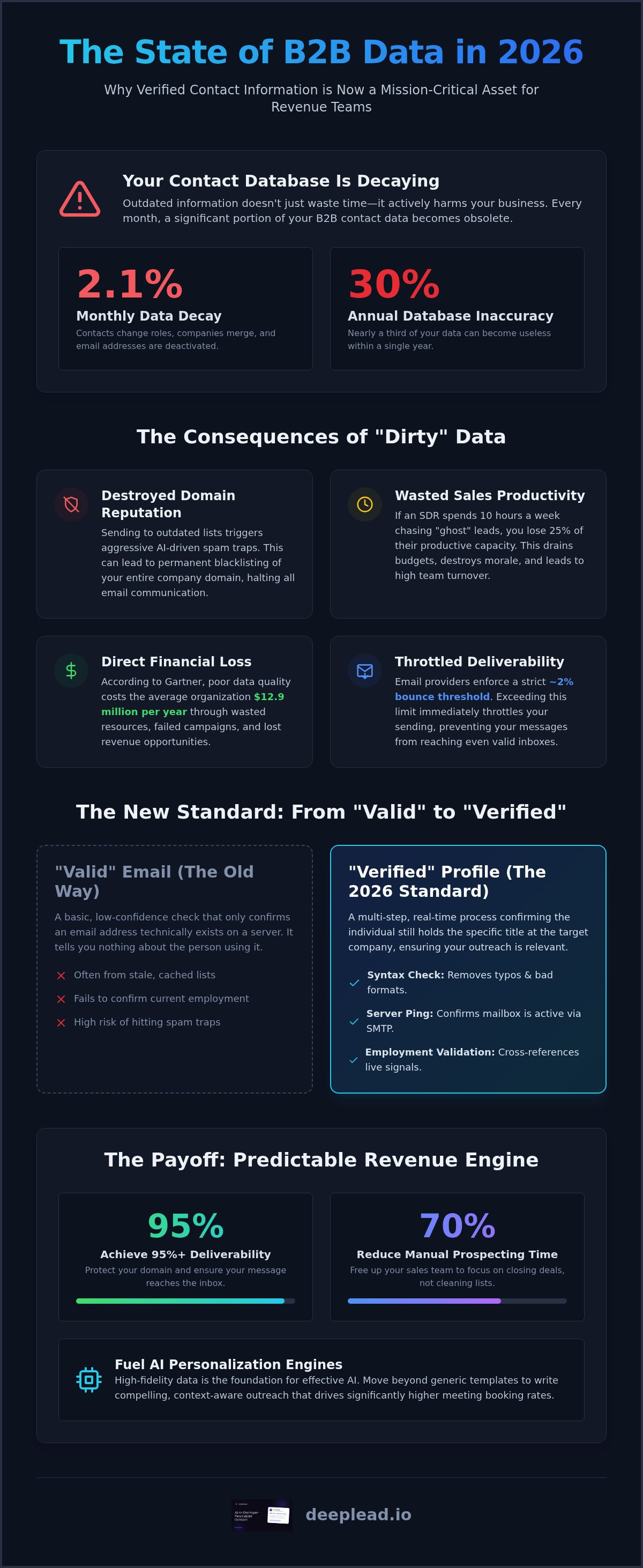
Every month, 2.1% of your B2B contact records decay as prospects change roles or companies merge. This means up to 30% of your database becomes useless every single year. Relying on outdated lists doesn't just waste time; it actively destroys your domain reputation. Accessing verified b2b lead data is no longer a luxury for sales teams. It's the only way to survive aggressive AI-driven spam filters in 2026.
You've likely felt the sting of high bounce rates and generic outreach that never reaches a human inbox. It's exhausting to watch your deliverability tank because of a "dirty" list. We understand that your time is better spent closing deals than cleaning spreadsheets or fighting with email providers.
This article teaches you how to identify, verify, and leverage high-quality contact data to drive predictable revenue. You'll learn the exact steps to achieve 95% deliverability and reduce your manual prospecting time by 70%.
We'll walk through the mechanics of waterfall enrichment and live intent signals. You'll see how to build a high-performance outreach engine that keeps your sales pipeline full and your sending reputation pristine.
Key Takeaways
- Distinguish between simple email validation and comprehensive profile verification to ensure every lead in your pipeline is truly actionable.
- Protect your company’s domain reputation by eliminating unverified data that triggers aggressive 2026 AI-driven spam traps.
- Apply a 5-point evaluation framework to source verified b2b lead data that features real-time validation and transparent sourcing.
- Leverage high-fidelity data to fuel AI personalization engines, moving beyond generic templates to drive significantly higher meeting booking rates.
- Consolidate your outreach stack by integrating data, AI writing, and automated sending into a single, high-performance ecosystem.
What is Verified B2B Lead Data?
In the modern lead generation ecosystem, the definition of "quality" has shifted. Verified B2B lead data is contact information that has passed through a multi-step validation process involving both technical checks and human-verified signals. It isn't just a list of names. It's a map of current professional relationships.
Many providers offer "valid" emails, but there's a critical distinction. A valid email simply exists on a server. A verified profile confirms that the individual still holds the specific title at the specific company you're targeting. In 2026, relying on cached data that is 30 days old is a high-risk strategy. Data decays at a rate of 2.1% every month. A list from last quarter is already over 6% inaccurate. High-performance outreach requires real-time verification to maintain momentum.
The process rests on three specific pillars:
- Syntax check: Automated formatting and string validation to remove typos.
- Server ping: Technical confirmation of mailbox activity without sending mail.
- Employment validation: Cross-referencing live signals to confirm current roles.
Syntax and Technical Validation
Technical validation begins by scrubbing for typos and malformed strings. It identifies and filters out disposable domains that prospects often use to bypass gated content. The most robust systems utilize SMTP handshakes. This process pings the recipient's mail server to confirm the address exists without actually sending a message.
Catch-all domains present the biggest technical risk for modern sales teams. These servers are configured to accept all mail, making it impossible to know if a specific user exists without a deeper check. In 2026, aggressive AI filters monitor your "unknown" recipient rate. Sending to too many invalid catch-all addresses will trigger a domain-wide blacklist. You need a platform that identifies these risks before you commit your reputation to a campaign.
Professional Context Verification
A working email is useless if it belongs to someone who left the company six months ago. Professional context verification cross-references live signals to confirm the lead's current role and seniority. It also checks that the company firmographics still match your Ideal Customer Profile (ICP).
Data decay is an invisible revenue killer. Research from Dun & Bradstreet shows that B2B contact data decays at 2.1% per month, compounding to roughly 22-30% annually. Real-time enrichment prevents you from wasting hours prospecting leads who have already changed jobs. It keeps your outreach relevant. It ensures your message reaches the desk of the person actually empowered to sign the deal.
The High Cost of Unverified Data in 2026
Using outdated contact lists is no longer a minor inefficiency. It is a direct threat to your technical infrastructure. In 2026, email providers use sophisticated spam traps to identify and block low-quality outreach. These traps are "dead" email addresses that act as bait. If you send mail to these addresses, you are instantly flagged as a spammer. Relying on verified b2b lead data is the only way to ensure your messages bypass these digital landmines.
The damage to your domain reputation can be permanent. One bad campaign targeting a stale list can blacklist your entire company domain, stopping even internal communications. Gartner research shows that poor data quality costs organizations an average of $12.9 million per year. This isn't just about the cost of the data itself. It's the cost of the infrastructure you lose and the revenue you fail to generate. When your domain is flagged, your ability to reach even existing customers vanishes.
Spam Filters and AI-Driven Gatekeepers
Modern email providers use AI to analyze your sending patterns in real time. They look for high bounce rates and low engagement signals. Most providers now enforce a strict 2% bounce threshold. If your campaign exceeds this limit, your delivery is immediately throttled or blocked. A single hard bounce signals to mail servers that your list is unmanaged, causing immediate and often irreversible damage to your sender score. To maintain a healthy pipeline, you must integrate pre-verified data into your sending tool from the start.
Wasted Sales Productivity
Calculate the true expense of your sales development team. If an SDR spends 10 hours a week chasing "ghost" leads who have changed jobs, you are losing 25% of their productive capacity. This wasted effort does more than drain your budget. It destroys team morale. Constant rejection from invalid addresses leads to burnout and high turnover. Quality over quantity is the only scalable outbound strategy left in 2026. Every minute spent on a dead lead is a minute not spent with a qualified decision-maker.
Compliance also demands accuracy. With the 2026 California Delete Act, data brokers must process deletion requests through the DROP (Delete Request and Opt-out Platform) system. Using unverified, non-compliant data puts your company at risk of heavy CCPA and GDPR fines. High-performance outreach requires data that is not only accurate but also opt-out-aware. Accuracy is your best defense against both spam filters and legal liabilities. Protecting your brand means ensuring every contact on your list actually belongs there.
How to Evaluate B2B Data Quality: A 5-Point Framework
Choosing a data provider shouldn't feel like a gamble. You need a systematic way to audit your sources. High-performance teams use a 5-point framework to ensure their verified b2b lead data actually converts. Use these criteria to separate modern intelligence tools from legacy list brokers.
- Data Freshness: Prioritize real-time validation over total database size.
- Sourcing Transparency: Know if data is licensed, scraped, or crowdsourced.
- Enrichment Capabilities: Look for layers like technographics or hiring signals.
- Integration Depth: Ensure data flows directly into your sending engine.
- Accuracy Guarantees: Confirm the provider offers credits for any bounces.
Transparent sourcing is about both compliance and accuracy. Scraped data often misses professional context, while licensed data from official business registries provides a more stable foundation. If a provider can't explain their sourcing methodology, they likely aren't meeting 2026 privacy standards. Manual CSV exports are also a relic of the past. They introduce human error and allow data to age before it's even used. Your data source should live inside your outreach platform. This integration ensures that every lead is checked and personalized the second you're ready to hit send.
Freshness vs. Database Size
Don't be blinded by vanity metrics. A database with 100 million leads is useless if 40% of the entries are outdated. Static lists are essentially snapshots of the past. They fail to account for the 2.1% monthly decay rate of professional contact info. Perform a "Real-Time Verification" test before buying. The tool should verify the lead’s status at the exact moment of export, not just when it was first added to the database. This shift from static lists to live intelligence is what keeps your bounce rate below the 2% threshold.
Technographic and Firmographic Depth
Effective targeting requires more than just a job title. You need to understand the prospect's environment. Use the best technographic data platforms to filter prospects by their existing tech stack. If you sell a HubSpot integration, you shouldn't waste time on Salesforce users. Knowing what tools a company uses allows you to tailor your value proposition before you even write the first draft.
Company size and revenue data are equally vital. Use these firmographic markers to tier your outreach and allocate your SDR resources efficiently. For high-ticket managed services, "Direct Dial" numbers are a non-negotiable requirement. Reaching a decision-maker directly bypasses the gatekeeper and accelerates your sales cycle. High-quality verified b2b lead data provides these specific entry points, turning a cold list into a warm opportunity.
Turning Verified Data into Personalized Outreach
High-fidelity data is the fuel for modern AI personalization engines. Even 100% verified b2b lead data will fail to convert if your message feels like a mass blast. In 2026, buyers have developed a "template blindness" that filters out anything generic. You must bridge the gap between accurate contact info and hyper-relevant messaging to see a return on your outreach investment.
Personalization has moved beyond simple first-name tags. It now requires demonstrating a deep understanding of specific business challenges. This involves mapping distinct data points, like recent company news, hiring trends, or specific tech stacks, directly into your AI prompts. When your data is accurate, your AI can draft icebreakers that feel human and researched. If your data is flawed, your AI begins to hallucinate, creating awkward and unprofessional content that burns your brand reputation.
The AI Link: Fueling Personalization
AI models rely on the professional context provided by your data source. If your database lists a lead as a "Marketing Manager" but they were promoted to "VP of Growth" last month, the AI-generated icebreaker will feel outdated and irrelevant. This is why Deeplead integrates data pulls directly with AI personalized email writing. By using live signals rather than cached records, the platform ensures every draft reflects the prospect's current reality. This integration eliminates the friction of moving data between separate tools, allowing you to scale personalization without sacrificing quality.
Intent Data: The Ultimate Verification
The most effective outreach is triggered by timing, not just targeting. Intent data identifies "in-market" buyers who are actively searching for solutions like yours. By leveraging the best intent data providers, you can prioritize leads based on hiring rounds, new funding, or recent software installations. This shifts your strategy from "cold" prospecting to "warm" engagement by using verified b2b lead data as a filter for intent. Signal-Triggered Campaigns are the 2026 gold standard for outbound sales. Instead of guessing who might need your service, you respond to concrete evidence of a business need. This methodical approach ensures your team spends time only on high-probability opportunities.
Ready to turn your data into revenue? Start building your first intent-triggered campaign with Deeplead today.
Why Deeplead is the Best Platform for Verified B2B Data
Managing separate tools for prospecting, cleaning, and sending creates unnecessary operational friction. Deeplead solves this by providing a unified ecosystem where verified b2b lead data is natively integrated with AI writing and automated delivery. You don't need to export CSVs or pay for external email cleaners. The platform handles verification at the point of discovery, ensuring your outreach is always powered by live, accurate signals. This transparency allows you to focus on closing deals rather than managing spreadsheets.
The AI Deal Explorer functions as a sophisticated engine working quietly in the background. It identifies high-value leads within our database that match your specific intent triggers. This moves you beyond basic filtering and into the realm of predictive sales intelligence. You can target prospects based on real-time business changes, such as tech stack updates or new funding rounds. Since the data is pre-verified, your message remains relevant and your deliverability stays high. The process is intuitive; the results are predictable.
Replacing the Fragmented Sales Stack
Most sales teams lose revenue through a disconnected stack. Switching to our all-in-one platform starting at $37/month provides immediate cost savings and total operational clarity. You eliminate the data leaks that happen when moving leads between tools. Maintaining inbox health becomes an automated process because managed sending inboxes and pre-warmed domains are built into the workflow. This integrated approach protects your domain reputation and ensures a high-performing path to success without the need for manual intervention.
Predictable Growth for Lean Teams
Founders use Deeplead to scale outbound efforts without the need for a large sales team. For companies that want expert management, our Done-For-You Outbound service handles the entire process for $3,000/month. We also provide performance-based options through our Pay-Per-Lead model. You pay $50 to $150 per qualified reply, which creates a direct link between your spend and your pipeline. This bespoke approach allows you to scale at your own pace while maintaining a controlled narrative flow in your sales cycle. It's a streamlined path to revenue that values your time and productivity.
Start building your verified lead list with Deeplead today.
Build Your Revenue Engine on a Clean Foundation
High-performance outreach in 2026 demands a shift from volume to precision. You've seen how unverified lists destroy domain reputation and waste valuable sales hours. Success now requires a 5-point quality framework and real-time validation to combat the 2.1% monthly data decay rate. By integrating verified b2b lead data directly into your sending engine, you eliminate technical friction and ensure every message reaches a human inbox.
Consolidating your sales stack is the most efficient path to predictable growth. Moving from fragmented tools to a unified ecosystem prevents data leaks and protects your sender score. Deeplead provides this foundation with a 95%+ Accuracy Guarantee and built-in AI personalization. You can automate complex prospecting tasks while maintaining the bespoke quality that decision-makers expect. Precision is the only way forward.
Take control of your pipeline with a platform designed for modern deliverability. Use the AI-powered Deal Explorer to identify high-value opportunities and scale your revenue without increasing your headcount. Scale your outreach with verified data on Deeplead. Start today for $37/month and build a sustainable outbound engine.
Frequently Asked Questions
What is the difference between a bounce and an unverified email?
A bounce is a technical event that happens after you send an email; an unverified email is a status indicating that the contact information hasn't been checked for accuracy. Sending to unverified addresses is what causes high bounce rates. Using verified b2b lead data ensures that mailboxes actually exist before you hit send. This proactive approach protects your domain reputation from the permanent damage caused by hard bounces and spam traps.
How often should I verify my B2B lead list?
You should verify your B2B lead list at the moment of export or immediately before launching a new campaign. Professional data decays at a rate of 2.1% per month; which means a static list can become over 25% inaccurate in just one year. Real-time validation is the only way to ensure you aren't wasting resources on prospects who have changed roles or companies since the data was first collected.
Is it legal to use verified B2B lead data for cold email in 2026?
Yes; it's legal to use verified B2B lead data for outreach as long as you comply with regional regulations like GDPR and CCPA. In 2026, the California Delete Act requires stricter processing of opt-out requests through the DROP platform. Using verified data helps maintain compliance by ensuring you aren't contacting individuals who have previously opted out or whose professional status has changed. Always include a clear unsubscribe link in every communication.
Can I find direct phone numbers in a B2B contact database?
Yes; high-quality databases often include direct dial numbers alongside verified email addresses. Deeplead provides custom B2B data pulls and enrichment services that allow you to identify specific contact points for your target decision-makers. Having direct access helps you bypass gatekeepers and reach stakeholders more efficiently. While our platform specializes in email outreach, having verified phone data provides essential context for your sales team when they move prospects through the funnel.
How does intent data improve the quality of my lead list?
Intent data identifies "in-market" buyers by tracking signals like hiring trends, tech stack changes, or recent funding rounds. It improves list quality by narrowing your focus to prospects who are actively showing a need for your solution. This turns cold prospecting into a timely response to a specific business event. Combining intent signals with verified b2b lead data ensures you are contacting the right person at the exact moment they are ready to buy.
What should I do if my B2B data provider has a high bounce rate?
Stop your campaigns immediately to prevent further damage to your domain reputation. A bounce rate exceeding 2% triggers modern AI spam filters and can lead to permanent blacklisting. Audit your provider's verification methods to see if they use real-time checks or outdated cached records. Most high-performing teams solve this by switching to an integrated platform where data is pre-verified within the same interface used for automated sending and AI writing.
Does Deeplead offer a free trial for its lead database?
Deeplead doesn't offer a traditional free trial; however, our All-In-One Outreach Platform starts at a low entry point of $37 per month. This self-serve plan provides access to our integrated database, AI writing tools, and automated sending features. It's designed for lean teams that want to test the platform's efficiency without a heavy upfront commitment. For organizations seeking guaranteed ROI, we also offer performance-based pay-per-lead models for qualified replies.
How do I integrate verified data into my CRM like HubSpot or Salesforce?
Deeplead offers native synchronization with major CRM platforms including HubSpot, Salesforce, and Pipedrive. You can map your verified lead data directly into your existing sales workflows without the need for manual CSV uploads. This automation ensures your CRM remains the single source of truth for your sales team. By syncing data directly, you eliminate the risk of manual entry errors and ensure your records are updated with the most recent professional context.