Most outbound teams can quote their send volume and reply rate from memory. Ask what a single held meeting costs and the conversation stalls. That gap has a cause: sends and replies are free to look at, so they get measured, while tool pricing is often the only cost anyone wrote down. The result is an annual argument about subscriptions instead of a cost you can audit.
Title: Cost Per Booked Meeting: The AI Lead Generation Math No Demo Answers
Meta description: Work out your cost per booked meeting for AI lead generation: three line items, six columns, and arithmetic you can defend with no demo and no call.
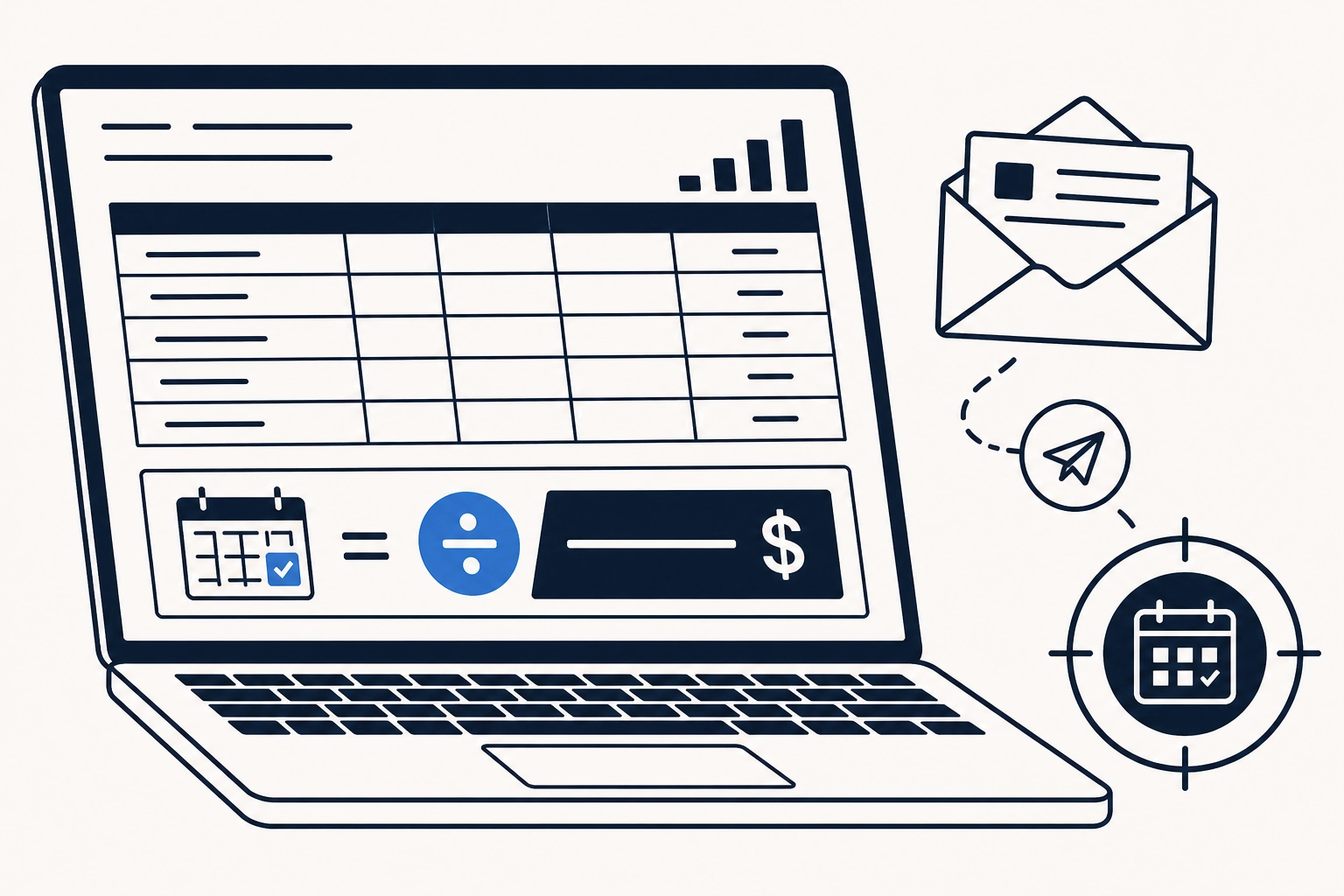
This tutorial rebuilds outbound as a manufacturing cost. You will build one spreadsheet with three line items (verified contacts, sends, meetings held) and divide total spend by the meetings that actually happened. We will define cost per booked meeting, show the six columns that hold the model, run a worked example with placeholder inputs, and make buy versus build arithmetic rather than taste. You will also see where ai lead generation tools fit, how Deeplead's published pricing at deeplead.io/pricing slots into the sheet, the compliance line item you cannot skip, and why you should compute this number before you renew anything. No demo, no discovery call, just arithmetic you can defend in a budget review.
What Cost Per Booked Meeting Actually Means
Cost per booked meeting is total outbound spend across verified contacts, sends, and human hours divided by meetings that actually took place. The title uses booked, but the formula uses held. Define a booked meeting as one that lands on the calendar, then track held meetings separately. No-shows cost money and produce no revenue, so held is the stricter denominator a finance reviewer will accept.
Tool pricing is not a cost per outcome: a subscription price is one line item with no denominator. Two platforms can look different and produce the same cost per meeting, or the reverse.
Treat outbound as a manufacturing cost per unit, where the unit is a held meeting. Same discipline as cost per widget, different unit. That framing is why one spreadsheet can settle a buy-versus-build argument that feature lists cannot. If you are weighing platforms, start with the questions that predict results instead of another feature grid.
It is not a benchmark. This article publishes no target cost per meeting because contact costs, send costs, human hours, and hold rates differ by market, offer, and process. Your inputs produce your number.
The Three Line Items That Belong in the Spreadsheet
With the denominator settled as held meetings, build the numerator from three line items only.
Verified contacts. This is what you spend to end up with reachable, correct people: contact data, email finding and verification, plus the LinkedIn check that each person still works where the record says. Track cost per verified contact, not cost per record purchased. Bounced and stale records belong in the cost of the contacts you can actually use.
Sends. Include inbox infrastructure, domain and mailbox setup, warmed inbox capacity, sending software, and any per-email charge. If a platform bills per personalized email rather than per seat, record this line as variable, because it moves with volume.
Human hours. Count the reply-handling time nobody invoices: reading replies, qualifying, sending the calendar link, chasing no-shows. A full campaign teardown shows how much work sits behind a reply curve. Multiply actual hours by your own fully loaded hourly cost, not a market salary claim.
Human hours belong in the numerator even though no invoice shows them. They are usually the largest hidden cost in an outbound stack, and leaving them out is the most common way a build-it-yourself model flatters itself.
If AI-assisted research and writing genuinely cut your setup and reply-handling hours, enter the reduced hours you actually worked. Do not enter an assumed efficiency gain you have not measured.
Leave out unrelated marketing spend, content production, and event costs. Keep the sheet narrow so the denominator stays honest.
Build the Spreadsheet in Six Columns
Now put those three line items on one sheet with a fixed denominator. Use six columns.
Column 1: period. One month, stated as a date range, so credit consumption and invoice cycles align.
Column 2: verified contacts sourced. Column 3: cost per verified contact. Divide contact spend by that count.
Column 4: emails sent. Column 5: send cost. Put per-email pricing here when the platform charges that way. Spread domain, mailbox, and inbox overhead across the period.
Column 6: held meetings. Keep two off-sheet working cells nearby: reply-handling hours and loaded hourly cost. Multiply them, add the result to the numerator, and you are done.
Keep a second tab for the funnel: contacts sourced, emails sent, replies received, meetings booked, meetings held, no-shows. That tab explains the result; it does not change the formula. For a cleaner way to compare platforms before you enter their costs, see compare AI lead generation tools.
Show the formula plainly:
(contact cost + send cost + human hours) / held meetings
No weighting, no coefficients, nothing a reviewer has to trust you on.

A Worked Example With Placeholder Inputs
With the six columns in place, populate them with placeholders before real invoices. Everything below is hypothetical. The figures illustrate arithmetic only: not benchmarks, averages, or a Deeplead claim about results.
Stack A: platform plus your hours. A $99 subscription, 1,200 sends at 3¢ each ($36), and 7 reply-handling hours at a $45 loaded rate ($315) total $450. Ten held meetings make that $45 each.
Stack B: agency retainer. A $2,500 retainer, $500 setup, and 4 internal hours at $45 ($180) total $3,180. Twenty held meetings make that $159 each. When weighing these structures, compare outbound scalability models before assuming the smaller invoice wins.
Stack C: hired SDR. Use your inputs: $60,000 base, a 1.43x loaded-cost multiplier derived from BLS private-industry compensation data, $3,600 tooling, and two ramp months at $7,450 before any meetings. That is $104,300 for the year. The two $7,450 ramp months are added on top of the loaded annual figure, not inside it, so the arithmetic reads $60,000 x 1.43 + $3,600 + $7,450 + $7,450 = $104,300. At 30 held meetings monthly (360 annually), cost per held meeting is $290. An SDR opens the sale and sets the meeting, not the close, so the held meeting is the right unit for that stack.
Now rerun Stack A at three hold rates from your own calendar. Twelve booked meetings at 75% held cost $50 each; at 50%, $75; at 25%, $150. The article supplies no hold rate.
Report average cost per held meeting and marginal cost of the next meeting. Fixed costs set the average; marginal cost, often send cost plus hours, decides whether scaling pays.
Buy vs Build Becomes Arithmetic, Not Taste
The rule fits in one line: pick the stack with the lowest cost per held meeting at the volume you actually need, and ignore the sticker price of the components.
The debate usually goes wrong because teams compare a subscription to a retainer to a salary, three different units, sometimes one month against one year. Run all three through the same division and the argument collapses into one table.
Each option wins somewhere specific. A platform tends to win on low fixed cost, per-email pricing that scales with volume, and no headcount added. An agency tends to win by absorbing the hours, which are usually the largest line item. A hired SDR tends to win on durable pipeline, control of messaging, and compounding market knowledge; the ramp period where they book nothing is a real cost and belongs in the numerator.
The break-even logic is explicit. If platform cost plus your hours sits below retainer or salary cost per held meeting at your target volume, buy. If the hours you must add to run the platform are larger than the retainer, the retainer is cheaper even though the invoice looks bigger. For how retainer structures are typically priced and piloted, see outsourced lead generation costs.
Two fudges wreck the comparison: quoting a platform's monthly fee against an SDR's annual salary, and leaving your own hours off the platform side.
That leaves a table instead of an argument, which is the right input for choosing what to price next.
Where Deeplead Fits in the Spreadsheet
With the comparison on one unit, the only question left is which inputs to enter. Deeplead is one candidate for the contact and send columns, not a verdict: enter it when you are pricing the platform-plus-your-hours stack.
Deeplead states $37 per month with 2,000 credits, unlimited inboxes and searches, about 4 cents per personalized email, and a 3-day free trial with no annual contract. Check current Deeplead pricing instead of trusting this article.
Per the product description, it finds companies, including 150M+ Google Maps businesses, and the decision makers inside them. It verifies emails through a waterfall of four email finders, checks on LinkedIn that each person still works there, writes one AI-researched email per person rather than a merge-tag template, and sends from warmed-up inboxes at a maximum of 30 emails per inbox per day with nightly deliverability tests.
Credits and the per-email quote are separate vendor statements. Confirm how credits map to sends and what verification and enrichment consume before either number reaches Column 3. Do not derive one rate from the other.
Deeplead promises no cost per meeting, no hold rate and no reply-rate guarantee. Your held meetings still supply the denominator.
Replies land in one inbox with a built-in CRM, and an MCP or REST API is available, which matters to the hours cell if you automate qualification. If you are unsure how much of the pipeline the agent covers, this six-stage breakdown of AI lead generation lists what to grade before you buy.
One Compliance Line Item You Cannot Skip
Wherever the platform sits in your spreadsheet, the send line still carries a legal line item. Cold email is regulated: CAN-SPAM covers commercial email in the US, and GDPR plus PECR add consent and opt-out obligations in the UK and EU. Confirm current rules in the FTC's CAN-SPAM compliance guide and the ICO's electronic mail marketing guidance, not from memory.
Every email in your sequence needs a working opt-out. A pasteable line does the job: "If you would rather not hear from me again, reply with remove and I will delete your details and not contact you again." That line plus a suppression list you actually honor are part of the process description, not a footnote. If you run outbound for clients, document the per-client isolation model next to those suppression rules.
No spoofing, no fake reply-thread tricks, no deliverability games. Beyond legal exposure, a blocked domain can take the send line item out of commission and make your cost per held meeting meaningless.
As a rule of thumb, treat the compliance cost as a small add-on to the send line item rather than a line you scale: a suppression process, an honest sender identity, and warmed, monitored inboxes. If you cannot state where your opt-out goes and who honors it, stop before you scale. Volume multiplies both meetings and liability.
Compute It Before You Renew Anything
With compliance handled, the renewal decision comes down to arithmetic you can defend. Build the six-column sheet this week using last month's real numbers, not estimates. One month of actuals beats a year of projections because it captures credit burn, sending limits, no-shows, and the hours you actually worked.
Run that calculation for every stack you pay for, including the platform or retainer up for renewal, and compare at the volume you actually need. If inbox capacity is the constraint, compare signal and list costs before deciding what to cut. Recompute monthly. Inputs move, and your own trend line is the only defensible benchmark, whether you buy, hire, or build.
Conclusion
Cost per booked meeting is the one outbound number you can defend: verified contacts, send costs, and reply-handling hours, divided by held meetings. Once the arithmetic is on paper, buy versus build stops being a matter of taste and becomes a monthly trend line you can compare at the volume you actually need. The next step is simple: build the six-column sheet this week and run it on the stack up for renewal before you sign anything. Deeplead offers a 3-day free trial with no annual contract, so you can test the platform side at low risk.
Questions
- What is cost per booked meeting, and why does the formula use held meetings?
- Cost per booked meeting is total outbound spend across verified contacts, sends, and human hours divided by meetings that actually took place. Although the title says booked, the formula uses held meetings, because no-shows cost money and produce no revenue. Held is the stricter denominator a finance reviewer will accept.
- Which three line items belong in the numerator?
- The numerator includes only three line items: verified contacts (contact data, email finding and verification, and LinkedIn checks), sends (inbox infrastructure, sending software, and any per-email charges), and human hours (reply-handling time, multiplied by your own fully loaded hourly cost). Unrelated marketing spend, content production, and event costs are left out.
- How should the spreadsheet be structured?
- The post uses a single sheet with six columns: period, verified contacts sourced, cost per verified contact, emails sent, send cost, and held meetings. Off-sheet working cells hold reply-handling hours and loaded hourly cost. A second tab tracks the funnel (contacts sourced, emails sent, replies, meetings booked, meetings held, no-shows) to explain the result without changing the formula. The formula is (contact cost + send cost + human hours) / held meetings.
- Does the article provide a target cost per meeting or a benchmark?
- No. The post explicitly publishes no target cost per meeting, because contact costs, send costs, human hours, and hold rates differ by market, offer, and process. Your own inputs produce your number.
- How should buy versus build decisions be made?
- Pick the stack with the lowest cost per held meeting at the volume you actually need, and ignore the sticker price of individual components. Run platforms, agencies, and hired SDRs through the same division so they share one unit. If platform cost plus your hours is below the retainer or salary cost per held meeting at your target volume, buy. If the hours needed to run the platform exceed the retainer, the retainer is cheaper despite a larger invoice.
Put this into practice
Deeplead finds the leads, verifies the emails and drafts the first message for you.